Your turntable is not merely resting on a piece of furniture; it is anchored to a mechanical foundation that dictates the purity of every note. In 2026, industry experts recognize that optimizing your turntable rack placement audiophile strategy is a more significant sonic upgrade than a sub-200 dollar cartridge replacement. With 46.8 million vinyl units sold in 2025, the pursuit of perfect analog sound has never been more vital. You know the frustration of a stylus skipping on a bouncy floor or the hollow hum of acoustic feedback when you turn up the volume. It is a common struggle to level heavy equipment on generic furniture that often sags under the 50 kg weight of a typical high-end setup.
This guide will help you master the art of positioning to eliminate resonance and protect your delicate records for a lifetime. You will learn how to identify the most stable zones in your room and why natural, handmade materials outperform mass-produced alternatives. We will explore how to create a visually stunning listening sanctuary where sound and style are one; ensuring your system delivers the crystal clear audio reproduction you deserve. It is time to treat your passion with the authentic structural foundation it requires.
Key Takeaways
- Learn to treat your turntable as a high-precision instrument that measures vibrations, allowing you to eliminate the micro-distortions that cloud your music.
- Use the "Bouncy Floor" test to diagnose whether your listening environment suffers from air-borne or structure-borne interference.
- Discover why solid hardwood naturally dampens high-frequency ringing, providing a more authentic foundation than resonant materials like glass or composite boards.
- Follow a professional 5-step protocol for turntable rack placement audiophile success to locate the "Quiet Zone" where your equipment can truly breathe.
- Transform your listening experience by aligning technical performance with handcrafted aesthetics, creating a sanctuary where sound and style are one.
The Science of Turntable Placement: Why the Rack is a Performance Component
A turntable is far more than a playback device; it's a high-precision vibration-measuring instrument. The stylus is designed to detect nanoscopic variations within a vinyl groove, often measuring movements smaller than a human hair. When your turntable rack placement audiophile strategy is overlooked, the stylus cannot distinguish between the music and the ambient vibrations of your home. These unwanted micro-vibrations translate into an audible "mud" that obscures the soundstage and softens the impact of your favorite albums. To achieve true clarity, one must grasp The Science of Vibration Isolation, which dictates how energy is managed within a high-end environment.
There is a fundamental difference between a rack that serves as "support" and one that functions as an "isolator." A standard shelf merely holds weight, but a dedicated HiFi rack manages energy. A typical setup including a turntable, amplifier, and a modest collection of records can easily exceed 50 kg, placing immense pressure on any surface. By effectively isolating the turntable, you lower the system's "noise floor." This is the point where electronic and mechanical hum disappears, allowing the delicate textures of a recording to bloom from total silence. It's in this space that the full sonic potential of your collection is finally unlocked.
To better understand the relationship between furniture and resonance, watch this helpful video:
The Role of Mechanical Grounding
Unwanted energy is a constant threat to analog purity. It travels from the stylus, through the tonearm, and into the plinth. If that energy has nowhere to go, it reflects back into the record, creating ghost-like echoes of distortion. A handcrafted rack made from solid materials provides a "sink" for this mechanical energy. Mechanical grounding is the path of least resistance for vibrations. By providing a clear exit for these disturbances, the rack ensures the stylus only reads what is pressed into the wax.
Acoustic Feedback Loops
Large speakers move a significant amount of air, which can physically shake your furniture. This leads to acoustic feedback loops, a destructive cycle where bass frequencies are picked up by the turntable and re-amplified. Refining your turntable rack placement audiophile setup helps break this cycle, protecting the integrity of the signal. This problem is exacerbated when equipment is placed on hollow surfaces that act like drum skins. To explore how to further decouple your system, see The Ultimate Guide to Turntable Isolation Platforms and Shelves (2026). Proper placement is the first step in turning a room into a dedicated sanctuary for sound.
Mechanical vs. Acoustic Isolation: Identifying Your Room’s Vibration Profile
Achieving a quiet background starts with identifying how energy enters your playback chain. Vibrations typically fall into two categories: air-borne and structure-borne. Air-borne energy consists of sound waves that physically strike your turntable, while structure-borne energy travels through the building itself. Mastering your turntable rack placement audiophile strategy requires a deep understanding of these invisible forces. While many enthusiasts focus on the equipment, the room often dictates the ultimate quality of the analog signal. If your rack sits in a corner, you might be fighting room nodes where bass energy builds up to three times its normal intensity, clouding your mid-range clarity.
You can diagnose floor-to-rack transmission using the "Bouncy Floor" test. Place the stylus in a groove with the platter stationary, then walk firmly near the rack. If you see your woofers pulse or hear a low-frequency thump through the speakers, your floor is communicating directly with your cartridge. This is particularly common in older homes with suspended timber floors. Because a full setup with records can weigh over 50 kg, the pressure on these floors is immense. In some cases, wall-loading with a dedicated shelf is superior to floor-loading, provided the wall is a load-bearing masonry structure rather than a hollow partition.
Managing Air-Borne Resonance
Air-borne resonance is a constant threat when speakers are positioned too close to the source. Ideally, your turntable should live outside the direct "firing line" of your woofers to prevent the plinth from acting like a microphone. High-mass furniture is essential here; it possesses the inertia required to resist the physical pressure of sound waves. When researching the Best Isolation Materials, you'll find that solid, natural materials provide the dampening necessary to keep these waves from reaching the stylus. For those seeking the ultimate foundation, our Reference HiFi Rack offers the mass and stability required to anchor your system against acoustic interference.
Defeating Structure-Borne Energy
Structure-borne energy is often more insidious than air-borne noise. While metal spikes are frequently used for coupling a rack to the floor for stability, they don't always provide the decoupling needed to stop footfall. In homes with significant floor flex, you need a solution that breaks the mechanical link between the floor and the record. This is where the choice of materials becomes critical. Solid wood doesn't just support the weight; it absorbs the energy that would otherwise cause your stylus to skip. To learn more about managing these contact points, explore our guide on Speaker Feet and Acoustic Isolation: The Complete Audiophile Reference. By addressing both air and structure, you create a sanctuary where the only thing moving is the music.

Choosing the Right Support: Why Solid Wood Outperforms Composite Materials
The "Knuckle Test" is the simplest way to understand why your choice of material matters. Tap your knuckle against a glass shelf or an MDF board and you will hear a sharp "clink" or a dull, lingering "thump." Now, perform the same test on a thick plank of solid hardwood. The sound is immediate, organic, and quickly extinguished. This reveals how different materials handle resonance. For a turntable rack placement audiophile setup, these vibrations are the primary enemy of detail. While glass and metal often ring at high frequencies, solid wood possesses a cellular structure that naturally absorbs and dissipates energy before it can reach your stylus.
MDF and veneer furniture might look acceptable in a catalog, but they often fail the audiophile test over time. MDF is essentially compressed sawdust and synthetic resins; it lacks the internal structural integrity of natural grain. This leads to "micro-sway," which are minuscule lateral movements that occur as your turntable's motor rotates or as sound waves hit the rack. These tiny shifts interfere with the stylus's ability to track the groove accurately. Furthermore, standard composite furniture is not designed to support the 50 kg weight of a high-end turntable and record collection, often sagging within 18 months and throwing your equipment out of level.
The Sound Signature of Solid Hardwood
Different wood species offer unique acoustic properties that can subtly refine your system's voice. Walnut is often celebrated for its rich, warm character, while Oak and Ash tend to provide a more neutral and detailed presentation. By exploring The Audiophile’s Guide to Custom Hardwood Audio Furniture: Myths vs. Reality, you can learn how these materials influence signal integrity. We exclusively use solid timber because it avoids the sterile, "dead" sound associated with plastic-coated composites. Our goal is to help you live your passion by providing a foundation that is as authentic as the music you play.
Mass Loading vs. Dampening
High-end analog systems require a delicate balance of mass and damping to perform at their peak. Our Reference HiFi Rack provides the necessary weight to anchor heavy decks while the natural fibers of the wood act as a filter for mechanical noise. Unlike granite or stone, which can be heavy but still "ring" like a bell, solid wood provides the ideal balance of rigidity and damping. This ensures that your turntable stays perfectly still, allowing the cartridge to extract every ounce of detail from the vinyl. In a space where sound and style are one, the material of your rack is the final, essential component of your signal path.
The Audiophile Placement Protocol: 5 Steps to Resonance-Free Listening
Setting up your listening sanctuary is a ritual of precision. Even the most exquisite handcrafted rack requires a systematic approach to perform at its peak. To truly master turntable rack placement audiophile standards, you must follow a disciplined order of operations. This protocol ensures that the structural integrity of your furniture translates directly into sonic purity, protecting your investment and your passion.
- Step 1: Mapping the Quiet Zone. Begin by identifying the areas in your room where bass energy is least concentrated. Avoid corners and the direct line of fire from your speakers. A distance of at least 1.5 to 2 meters from large woofers is a critical baseline to prevent acoustic feedback.
- Step 2: Structural Alignment. Ensure the rack itself is perfectly vertical. A slight lean can introduce lateral stress that undermines the damping properties of the wood. Use a high-quality spirit level to check both the front-to-back and side-to-side axes.
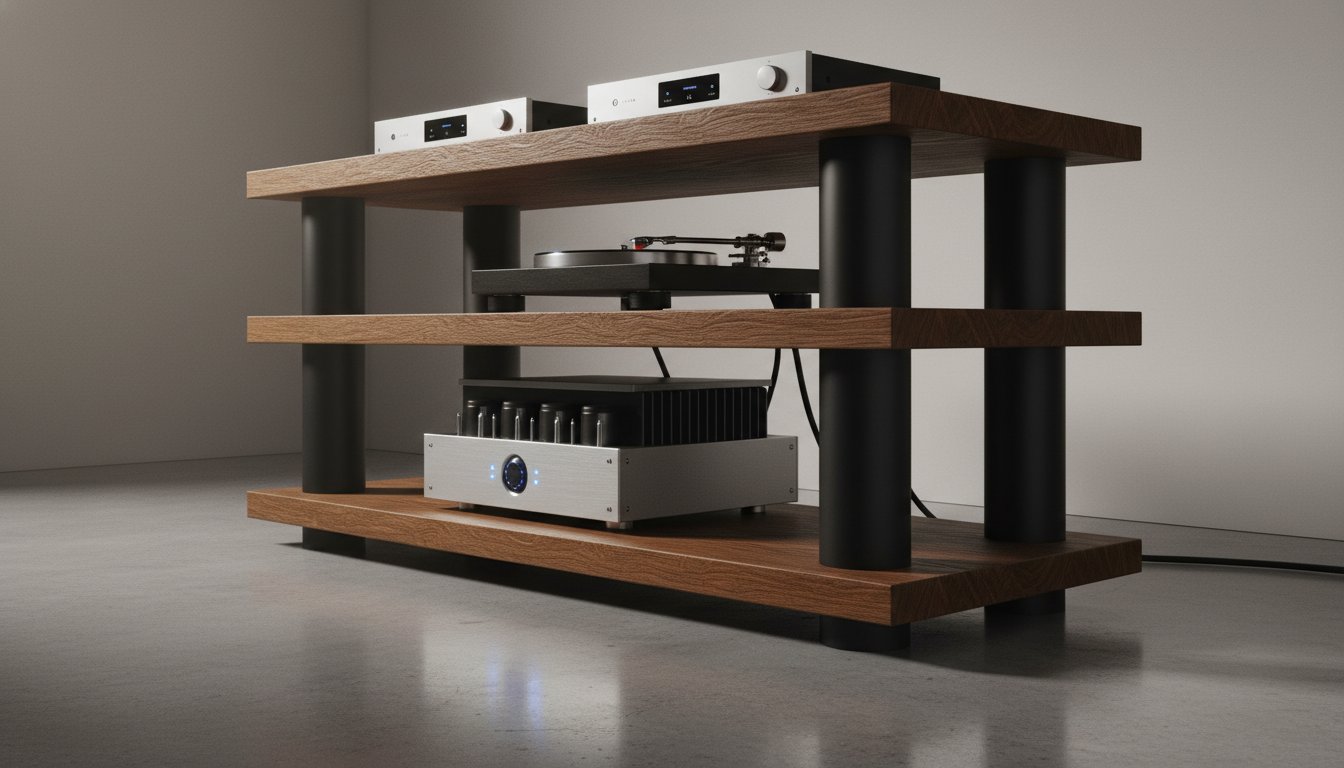
- Step 3: Component Loading. Gravity is your ally in the pursuit of stability. Place your heaviest components, such as power amplifiers that often weigh between 10 and 20 kg, on the lowest shelf. This lowers the center of gravity for the entire unit and increases its resistance to floor-borne vibrations.
- Step 4: Precision Leveling. Use the adjustable spikes to compensate for uneven floors. A perfectly level plinth is non-negotiable for accurate tracking; it prevents the stylus from favoring one side of the groove wall.
- Step 5: Cable Dressing. Prevent cables from touching the rack or trailing on the floor. Physical contact can introduce micro-vibrations directly into the signal path, clouding the fine details of your music.
Precision Leveling Techniques
Achieving a true level is a two-stage process. First, use a spirit level on the empty frame. Once your gear is loaded, re-check the level at the turntable platter. The 50 kg weight of a full system can cause subtle shifts in the floor or the rack's seating. Our Classic HiFi Rack features precision-engineered adjustment points to handle these fine calibrations with ease. Always check your levels again after the first 48 hours of setup to account for any initial settling of the wood and floor.
Cable Management for Isolation
Cables can act as antennas for electromagnetic interference, especially when they are cluttered. Separate your power lines from your sensitive phono cables by at least 15 cm. If they must cross, do so at a 90-degree angle to minimize noise. Proper dressing prevents "cable microphonics" from entering your signal. For those with limited floor space, a wall-mounted solution might be the best path forward. You can learn more in The Ultimate Guide to Choosing a Record Deck Shelf for High-Fidelity Sound. If you are ready to build a foundation that respects the art of sound, explore our collection of handcrafted HiFi racks.
Elevating Your Ritual: The Role of Handcrafted Furniture in High-End Audio
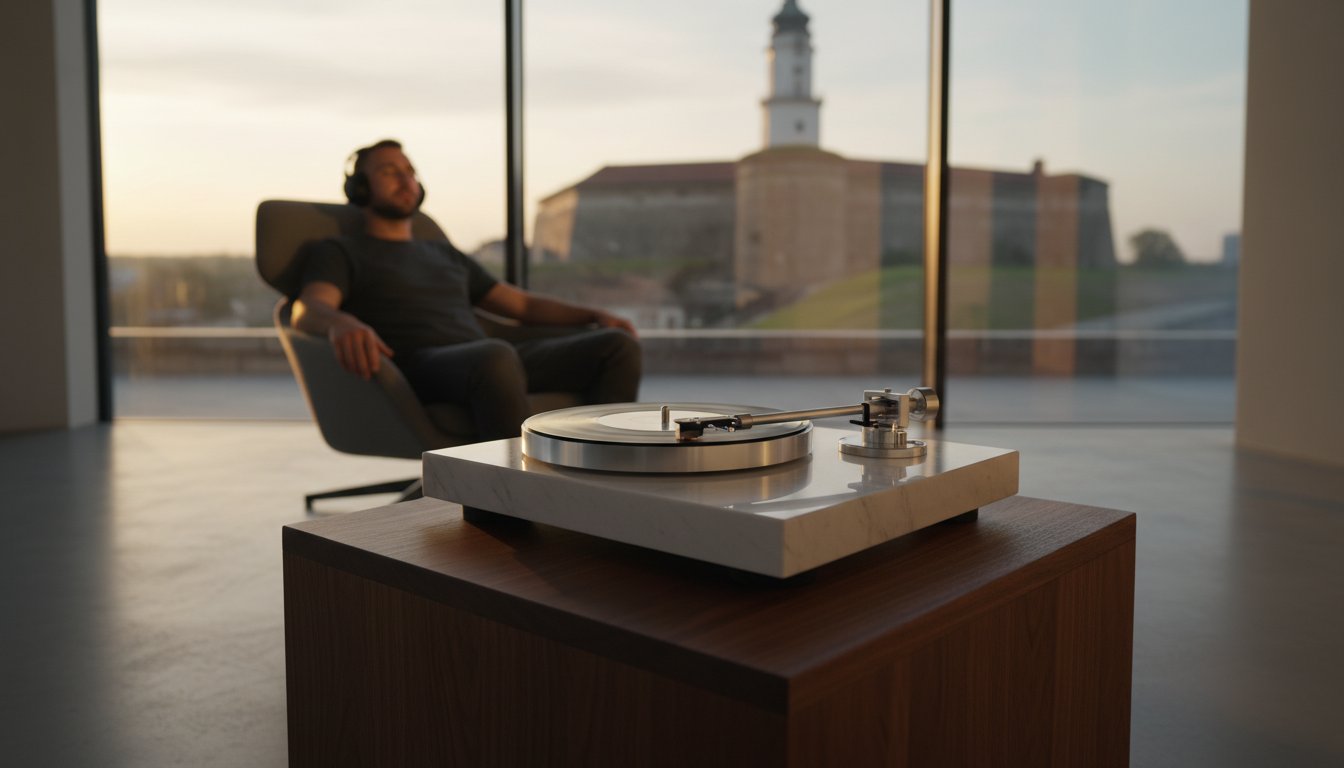
Beyond the technical rigors of isolation and mechanical grounding lies the emotional core of the listening experience. A dedicated space for music should feel like a personal sanctuary, not a storage room for electronics. While the technical success of your turntable rack placement audiophile strategy ensures clarity, the furniture itself provides the soul of the environment. We believe that where sound and style are one, the listener finds a deeper connection to the performance. A bespoke rack is more than a utility; it is a vital instrument that honors the artistry of the music you love.
High-end audio electronics frequently evolve. Cartridges are replaced, DACs are upgraded, and amplifiers are swapped in the pursuit of perfection. However, a solid wood rack remains the constant foundation of your system. Unlike mass-produced furniture that relies on synthetic veneers and chemical glues, handcrafted timber gains character over time. It is an investment in longevity that outlasts the digital components it supports. In our workshop in Novi Sad, Serbia, we embrace a "slow-made" philosophy. This ensures every joint and surface is finished with the artisanal pride required to support a lifetime of listening.
Customization for the Perfect Fit
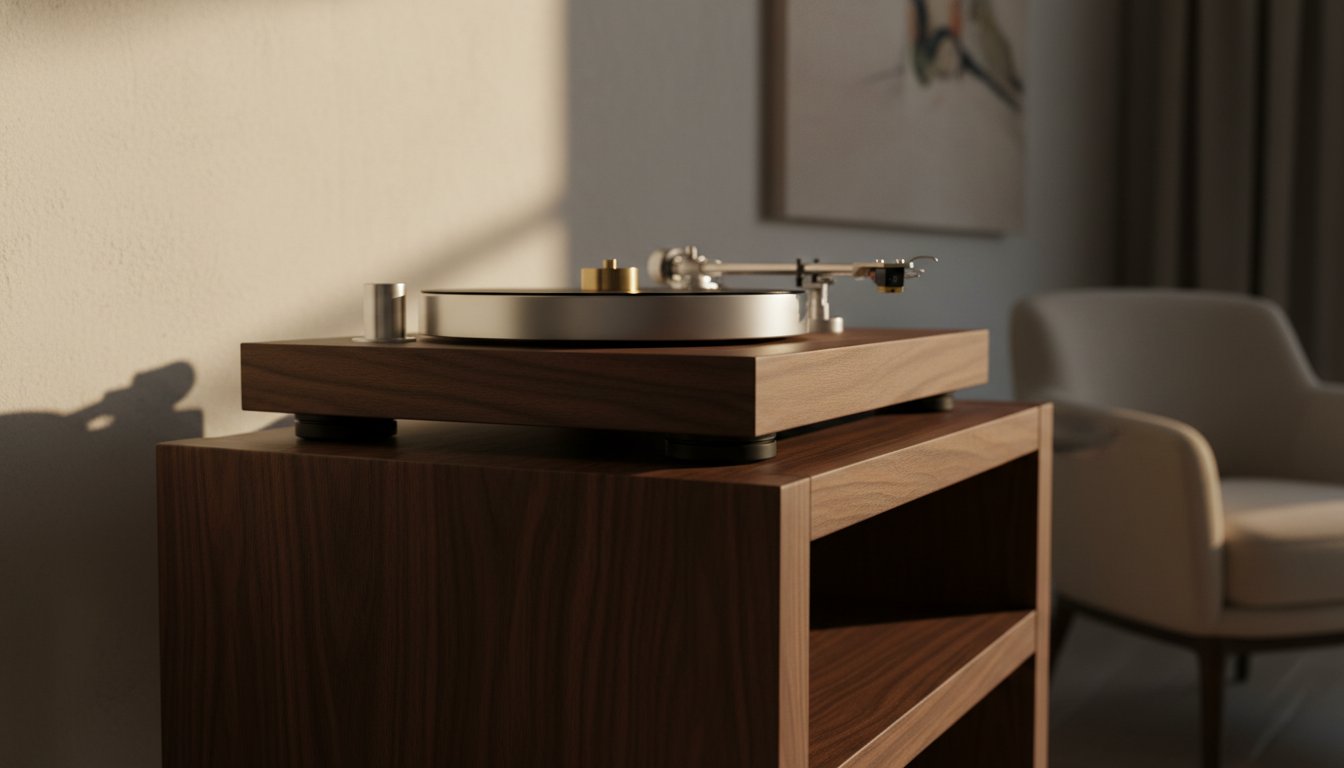
The ritual of vinyl is tactile. The height of your rack should allow for the effortless flipping of a record without straining your back or compromising the stability of the tonearm. By tailoring the dimensions of your support, you create an ergonomic environment that enhances the experience. We offer various wood finishes to ensure your rack complements your existing decor, creating a seamless aesthetic that feels intentional and authentic. If you are ready to select a piece that mirrors your personal style, consult our Solid Wood Record Player Stand for Sale: The Audiophile’s Buying Guide for 2026.
The HiFi Rack Commitment
Our dedication to the four-pillar mantra-CUSTOM | HANDMADE | NATURAL | AUTHENTIC-is woven into every piece we create. We refuse to use MDF or veneer because we know they cannot provide the signal integrity that a true music lover demands. By choosing materials that are Natural and Authentic, you are supporting a tradition of craftsmanship that values quality over mass production. This commitment to excellence is why handmade quality from Serbia is recognized by connoisseurs worldwide. It is time to treat your passion with the respect it deserves. Explore our handcrafted collections and find your foundation.
Anchor Your Passion with a Foundation of Excellence
Mastering your turntable rack placement audiophile strategy is the final step in bridging the gap between a casual hobby and a life-altering musical experience. You now understand that the purity of your analog signal depends on a silent foundation; one that absorbs micro-vibrations and rejects acoustic feedback. By choosing natural materials and following a precise setup protocol, you ensure that your stylus extracts every detail from the groove without interference. It's about more than just support; it's about creating the ideal environment for sound and style to become one.
At Myro HiFi Rack, we treat every piece as a vital instrument. Our racks are handmade in Novi Sad, Serbia, using only solid hardwood construction. We never use MDF or veneer because we know these materials cannot provide the authentic damping your system requires. Whether you need bespoke dimensions for high-end components or a sleek modern setup, our craftsmen are ready to help you live your passion. Discover the Myro Reference Collection; Handcrafted for Audiophiles and transform your listening room into a true sanctuary. Your records deserve a foundation built to last a lifetime.
Frequently Asked Questions
Where is the best place to put a turntable in a small room?
The best place in a small room is along a side wall, away from corners where bass energy accumulates. Corners often triple the intensity of low frequencies, which can cause significant acoustic feedback. Aim for a spot that is at least 1.5 meters from your speakers. This positioning ensures your turntable rack placement audiophile strategy remains effective even in restricted spaces.
Can I put my turntable on top of my receiver or amplifier?
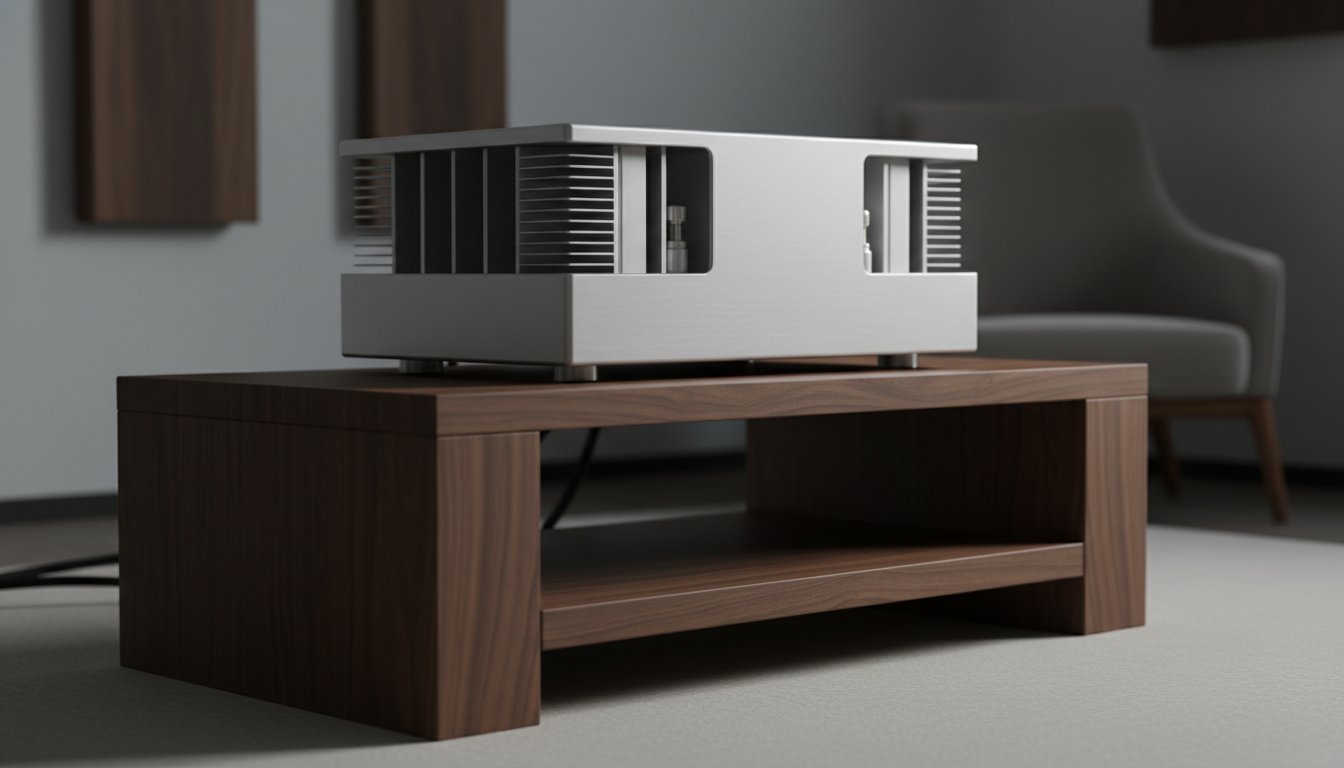
You should never place a turntable directly on top of a receiver or amplifier. Electronic components generate significant heat and electromagnetic interference that can degrade the sensitive analog signal. Additionally, the transformers inside these units produce micro-vibrations that the stylus will pick up as unwanted noise. Always use a dedicated rack to separate your components and preserve signal purity.
How far should my turntable be from my speakers to avoid feedback?
Your turntable should be at least 1.5 to 2 meters away from your speakers to prevent acoustic feedback loops. If the plinth is too close, the air pressure from the woofers can physically shake the tonearm and stylus. In smaller rooms, placing the turntable on a different wall from the speakers is a reliable way to break this resonance cycle and maintain clarity.
Is a wall-mounted shelf better than a floor-standing rack for turntables?
A wall-mounted shelf is superior for homes with bouncy, suspended timber floors, while a floor-standing rack is ideal for solid concrete foundations. Wall shelves isolate the deck from footfall vibrations entirely by anchoring to the building's structure. However, a high-mass, solid wood rack provides excellent dampening for structure-borne energy when wall mounting is not a practical option for your space.
Does the type of wood in a hifi rack actually change the sound?
Different wood species possess unique densities and grain structures that subtly alter the damping of high-frequency ringing. For example, Walnut is celebrated for a warmer character, while Oak offers a more neutral and detailed presentation. Natural timber provides an authentic resonance control that synthetic composites cannot replicate, which is why we avoid MDF and veneer to protect your listening experience.
What happens if my turntable is not perfectly level?
An unlevel turntable causes the stylus to favor one side of the record groove, leading to uneven wear and audible distortion. This imbalance increases inner-groove distortion and can even cause the tonearm to skate across the record surface. Use a spirit level to ensure the platter is perfectly horizontal to protect your stylus and your 46.8 million unit vinyl investment.
How do I stop my turntable from skipping when I walk across the floor?
To stop skipping, you must decouple the turntable from the floor's movement by increasing mass and stability. A solid hardwood rack weighing over 30 kg provides the inertia needed to resist sudden shocks from footsteps. If the problem persists on very bouncy floors, moving the rack closer to a load-bearing wall or using a dedicated isolation platform can provide the stability required for uninterrupted listening.
Should I use spikes or rubber feet for my turntable rack?
Use metal spikes for coupling a rack to a carpeted floor to ensure maximum stability and perfect vertical alignment. Rubber feet are better suited for hard surfaces where you need to decouple the furniture from high-frequency floor vibrations. Choosing the right contact point is a critical part of a successful turntable rack placement audiophile setup, ensuring your system remains isolated from external interference.