
With U.S. vinyl revenue crossing $1.04 billion in 2025, it is clear that our collective passion for analog is stronger than ever. Yet, many listeners still rest their 12kg turntables on generic furniture that vibrates with every footstep. You understand that every detail matters, from the stylus tip to the weight of the pressings. You have likely felt the frustration of a needle skipping or the disappointment of a muddy soundstage caused by mechanical feedback. Choosing the right record deck shelf is not about buying furniture; it is about selecting a precision acoustic component that respects the craft of your music.
You deserve to hear your collection exactly as the artist intended, free from the interference of bouncy floors or hollow resonances. This guide will show you how a dedicated, vibration-free platform unlocks the true sonic potential of your records while providing a beautiful, handcrafted anchor for your home. We will explore the structural benefits of solid wood over synthetic materials, compare wall-mounted versus floor-standing solutions, and help you find a stable foundation where sound and style are one.
Key Takeaways
- Understand why your shelf is a vital instrument in the signal chain, protecting sensitive cartridges from microphonic distortion.
- Determine whether a wall-mounted or floor-standing solution best suits your listening sanctuary and floor construction.
- Discover why a solid hardwood record deck shelf outperforms MDF by naturally sinking unwanted mechanical energy.
- Learn the technical requirements for a secure installation, ensuring your platform remains perfectly stable and vibration-free.
- Explore the value of bespoke, handmade craftsmanship in achieving a harmonious balance between high-fidelity sound and timeless style.
The Critical Role of a Record Deck Shelf in Vinyl Playback
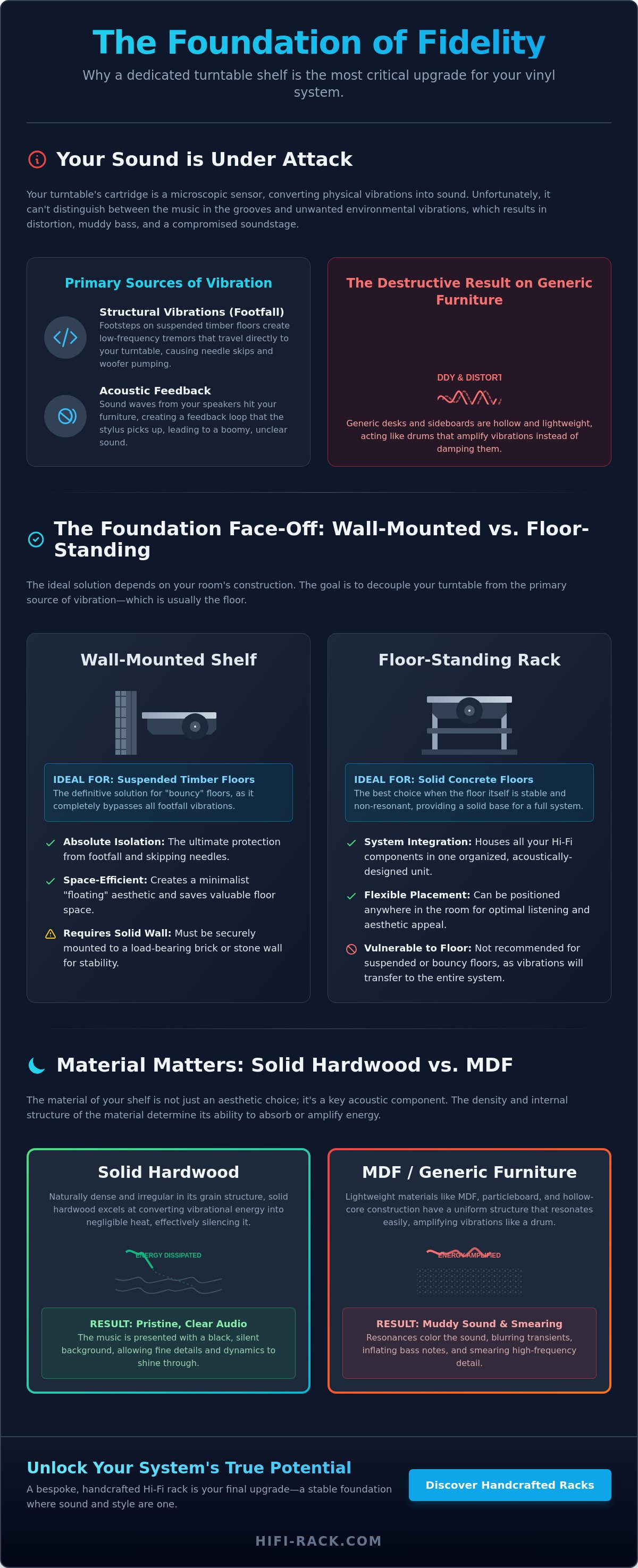
Analog playback is a physical art. Your cartridge is a microscopic transducer, sensitive enough to detect modulations smaller than a human hair. It's also microphonic by nature. This means it doesn't just "hear" the music; it hears everything that vibrates the record deck shelf it rests upon. Understanding the science of vibration isolation is essential because any external energy that reaches the stylus is treated as part of the audio signal. If your foundation is weak, your music will suffer from a lack of clarity and depth.
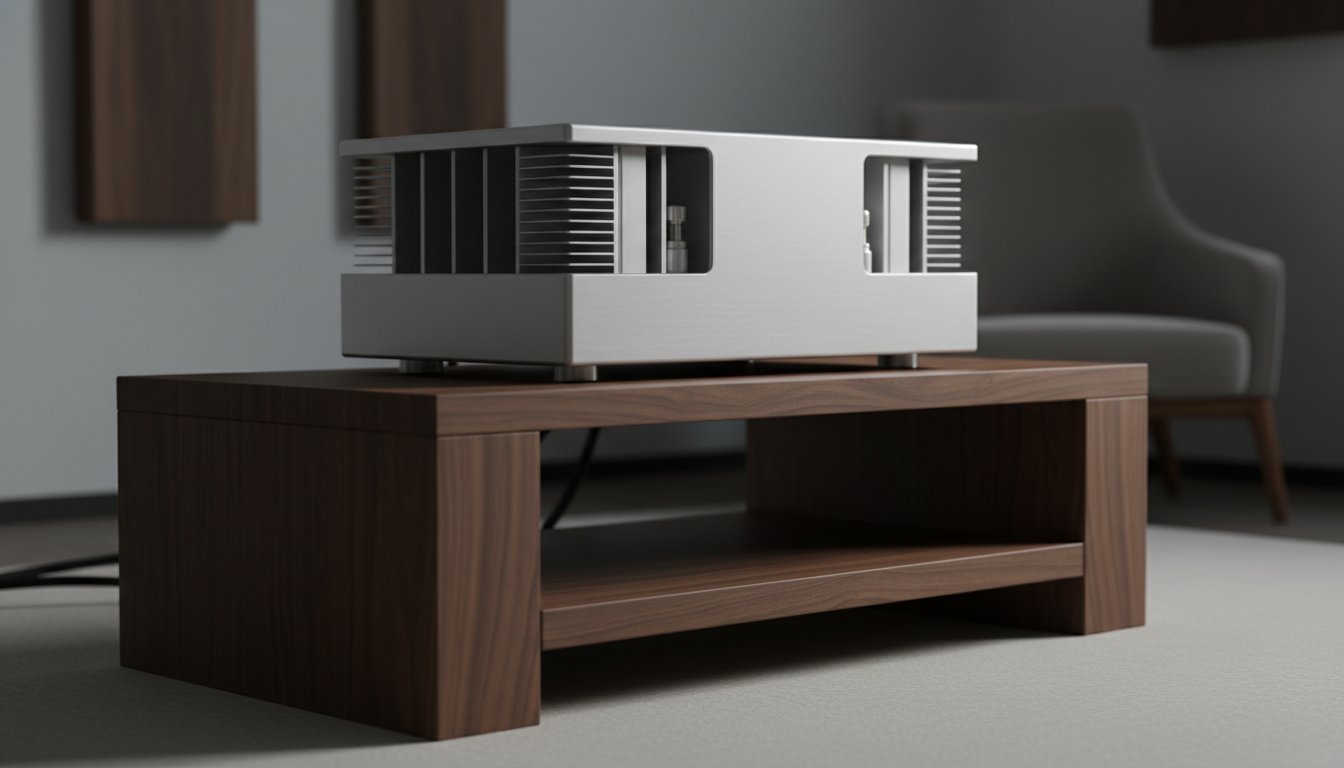
Standard household furniture often fails the audiophile test. Mass-market sideboards and thin veneer desks are built for aesthetics or storage, not for the 8-12 kg weight of a high-performance turntable. These surfaces act like sounding boards, amplifying ambient noise rather than absorbing it. When you invest in a dedicated platform from our HiFi shop, you're choosing a foundation designed specifically to handle these physical demands without introducing unwanted color to your sound.
To better understand this concept, watch this helpful video:
The Problem of Mechanical Feedback
Sound waves from your speakers hit every surface in the room. When these waves vibrate your turntable plinth, they create a destructive feedback loop. The stylus picks up the vibration, the amplifier boosts it, and the speakers push it back out with even more force. This loop creates "muddy" bass and smears the delicate high frequencies of your favorite pressings. Solid, dense materials are required to break this cycle. Unlike hollow furniture, a handcrafted solid wood record deck shelf provides the mass needed to dissipate this energy before it reaches your stylus.
Why Your Floor Might Be Ruining Your Sound
If you live in a home with suspended timber floors, you've likely seen your needle jump when someone walks past. Bouncy floors are the primary enemy of a stable soundstage, especially as your collection grows and the weight of your setup exceeds 50 kg. A dedicated shelf acts as a sanctuary, isolating your gear from these structural tremors. Acoustic decoupling is the process of separating a component from external vibration sources. By using a platform that doesn't share the floor's resonance, you ensure that the only movement your stylus tracks is the music itself. This is where the harmony between sound and style truly begins.
Wall-Mounted Shelves vs. Floor-Standing Racks: Which is Better?
Deciding where to place your turntable is a pivotal moment in your listening journey. It isn't merely a matter of interior design. It's a technical choice that dictates how much environmental noise enters your signal chain. While mass-market guides might suggest a generic bookshelf, a true audiophile knows that the record deck shelf must be chosen based on the architecture of the room itself. The decision between mounting to a wall or standing on the floor depends entirely on how your home handles energy.
The Case for the Wall-Mounted Record Deck Shelf
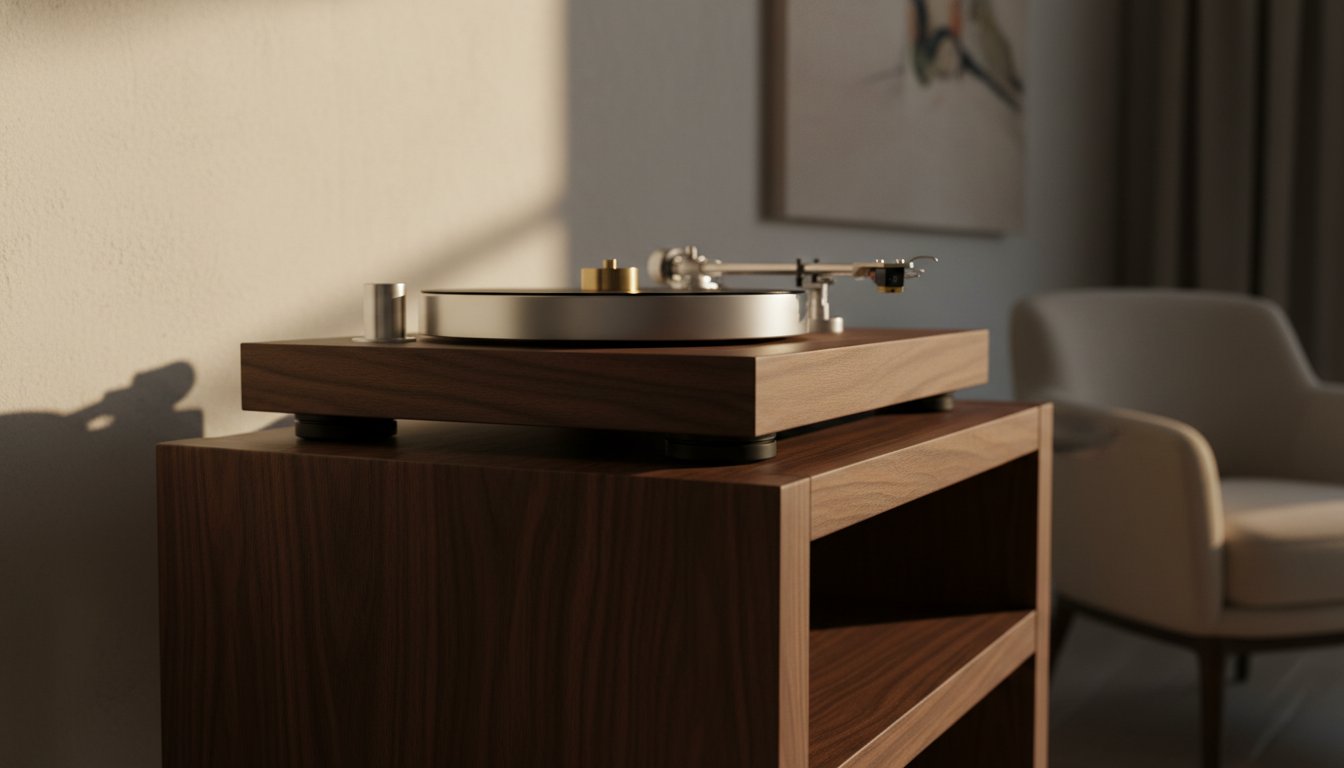
If you live in a home with suspended timber floors, a wall-mounted record deck shelf is often the only way to achieve true sonic purity. These floors act like trampolines, sending energy from every footstep directly into your turntable's sensitive suspension. By mounting your deck to a load-bearing brick or stone wall, you effectively bypass the floor's movement. This provides absolute isolation from footfall, which is the most common cause of skipping in older properties.
Beyond the technical gains, there's a certain soulful elegance to a "floating" turntable at eye level. It transforms your player into a focal point of the room while saving precious floor space in compact listening sanctuaries. It's a minimalist approach that emphasizes the beauty of the machine. For many, this setup creates a more intimate connection to the ritual of playing a record, as the equipment is physically elevated to match its importance in the room.
The Case for Floor-Standing HiFi Racks
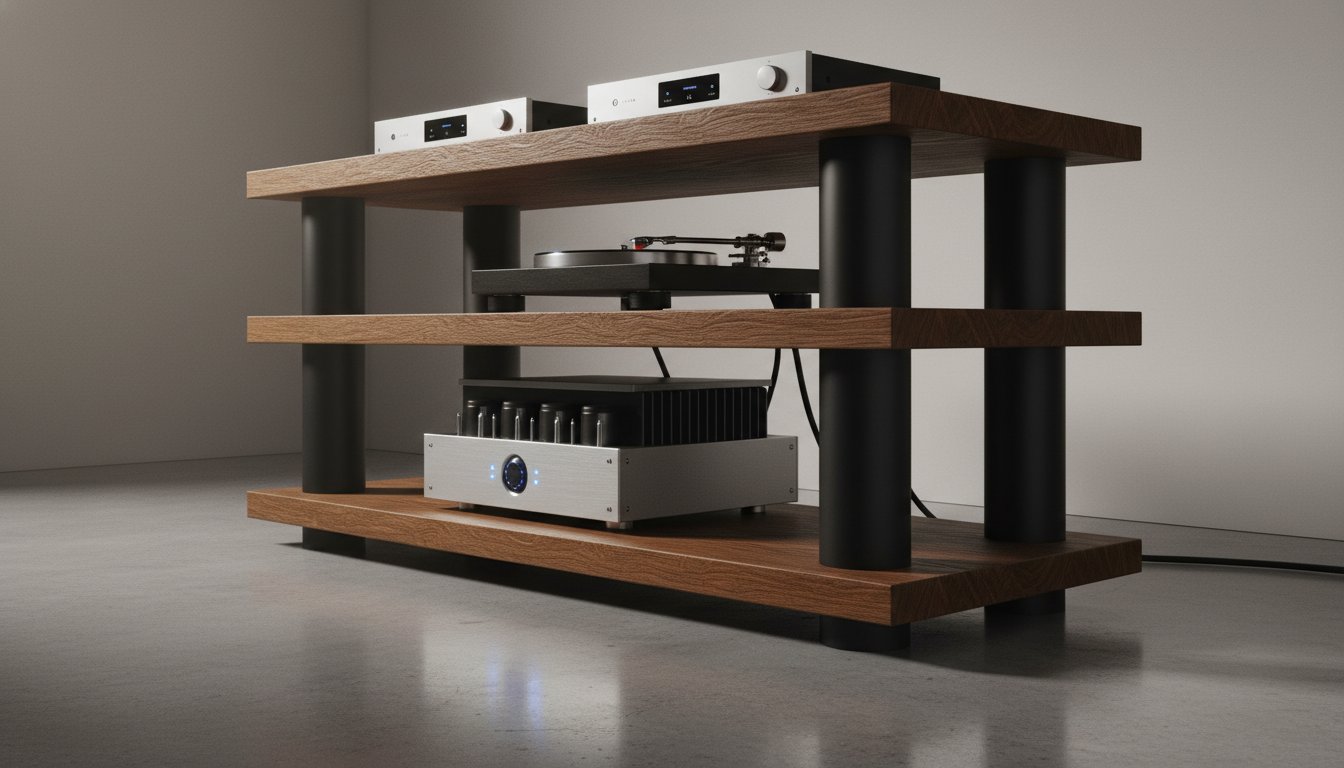
Floor-standing solutions become the superior choice when your listening room features a solid concrete foundation. In these environments, the floor doesn't bounce; instead, it provides a stable ground for mass-loading. A heavy, handcrafted rack uses its own weight to sink vibrations away from your equipment. For those with multi-component systems involving amplifiers and pre-amps, the Myro Classic offers a robust, floor-standing alternative that provides easier access for cable management and essential ventilation.
Choosing a floor stand also allows for a more comprehensive integration of your collection. Many enthusiasts prefer the look and feel of solid wood record player stands that combine the turntable platform with integrated record storage. This creates a dedicated station for your passion, where every element is designed to work in harmony. If your floor is solid and your system is growing, a floor-standing rack delivers the presence and performance you need. If you're unsure which path fits your home, exploring our full collection of artisanal racks can help you visualize the perfect foundation for your sound.
The Material Debate: Why Solid Hardwood Outperforms MDF
The choice of material for your record deck shelf is a fundamental acoustic decision. It acts as the final filter between your room's environment and the delicate movements of your stylus. While mass-market furniture relies on composite boards hidden under thin veneers, the discerning listener knows that solid wood is a vital instrument in the signal chain. We believe in the integrity of the material, which is why we avoid MDF and veneers entirely in our workshop. Our philosophy is rooted in a simple truth: natural materials provide the most authentic foundation for sound.
Natural hardwoods possess a unique ability to "sink" energy. This isn't marketing jargon; it's physics. Dense woods like European Oak or American Walnut have a complex, non-uniform cellular structure. This irregularity is a massive advantage in high-fidelity audio. It allows the shelf to absorb and dissipate mechanical vibrations before they can reach the turntable plinth. By converting this kinetic energy into trace amounts of heat within the grain, solid wood breaks the resonance patterns that plague synthetic alternatives.
Resonance Damping in Natural Oak and Walnut
Every species of wood carries its own sonic signature. Natural Oak is prized for its immense density and structural rigidity, providing a neutral and transparent base for heavy equipment. Walnut, while equally robust, often introduces a subtle "warmth" to the tonal balance that many audiophiles find deeply musical. This natural damping effect ensures that the music feels grounded and soulful. When you place a 12kg turntable on a 25mm thick solid wood slab, you aren't just supporting its weight. You're ensuring that the background remains black and the soundstage stays wide.
The Weakness of Mass-Produced MDF
Medium Density Fibreboard (MDF) is a staple of budget furniture, yet it's a poor choice for a high-end record deck shelf. Because MDF is a manufactured composite, it has a uniform, isotropic structure. This uniformity allows vibrations to travel through the material with ease, often storing energy rather than dissipating it. Over time, the structural integrity of MDF is also a concern. Under the constant pressure of a full setup that can exceed 50kg, composite boards are prone to sagging. This microscopic bowing can throw your turntable out of level, ruining your tracking angle and damaging your records.
Beyond performance, there's the question of longevity. We build our racks to be heirlooms that last a lifetime. Solid wood can be refinished, cherished, and passed down through generations. It is a sustainable choice that honors the responsibility we have toward the environment. By choosing a platform that is CUSTOM | HANDMADE | NATURAL | AUTHENTIC, you're investing in a piece where sound and style are one. It's a commitment to quality that mass-produced, glue-heavy composites simply can't match.
Choosing and Installing Your Turntable Shelf for Performance
Precision is the silent partner of musicality. Once you have selected a high-quality record deck shelf, the installation process becomes the final bridge to sonic perfection. It isn't just about finding a place for your gear. It's about creating a stable environment where physics and art can coexist. A poorly installed shelf can negate the benefits of even the finest solid wood, so we must approach this task with the patience of a master craftsman.
Wall selection is your first critical decision. For those mounting a shelf, a load-bearing brick or stone wall is the gold standard. These surfaces provide the mass required to remain indifferent to room resonances. If you're working with plasterboard, you must locate the timber studs or use specialized heavy-duty anchors. Considering most high-fidelity turntables weigh between 8kg and 12kg, the fixings must be uncompromising. A full setup with an amplifier and a modest record collection often results in total system weights surpassing the 50kg mark. Never guess the strength of your fixings; your collection's safety depends on it.
Cable management is often overlooked, yet it's a frequent source of "wire-borne" vibrations. Taut cables can act like guitar strings, carrying mechanical noise directly into the turntable's chassis. Ensure your interconnects have a slight "drip loop" to decouple them from the wall or rack. This small detail keeps the signal path clean and prevents external energy from creeping into your sensitive electronics.
Determining the Right Load Capacity
Safety starts with calculation. You must account for the weight of your deck, any additional isolation platforms, and the records themselves. We always recommend over-specifying your weight limit by at least 20 percent to ensure long-term structural integrity. If your equipment has unique footprints or extreme weight requirements, we offer custom sizing and bespoke builds at our HiFi Rack Shop. This ensures your foundation is as unique as your listening journey.
The Art of Perfect Levelling
A record deck shelf must be perfectly horizontal to within 0.1 degrees. Even a slight tilt disrupts the delicate balance of anti-skating and tracking force, leading to uneven record wear and distorted stereo imaging. While a traditional spirit level is a good start, many audiophiles now prefer digital inclinometers for absolute precision. If your shelf or rack requires fine-tuning, you can utilize specialized speaker feet or adjustable spikes to achieve a level surface. These components allow you to compensate for uneven floors while providing an additional layer of isolation. If you're ready to elevate your setup, browse our collection of Reference racks for a truly stable foundation.
Handcrafted Excellence: Why a Bespoke HiFi Rack Shelf is Your Final Upgrade
Selecting a record deck shelf is a journey that begins with technical necessity but ends with an emotional connection to your music. At our workshop in Novi Sad, Serbia, we don't just build furniture. We create vital instruments for the home. Each piece reflects our core pillars: CUSTOM | HANDMADE | NATURAL | AUTHENTIC. This isn't a mass-produced solution found in a big-box store. It's a deliberate choice to support your passion with a foundation that will last as long as your record collection itself. By choosing a bespoke platform, you're ensuring that every millimeter of the wood is optimized for your specific turntable.
Music is a life-altering passion. It deserves a home that respects its depth. We take the same acoustic engineering found in our Reference HiFi Rack and scale it to our wall-mounted platforms. This ensures that even the most compact setup benefits from the same energy-sinking properties as our flagship floor-standing units. The result is a total absence of mechanical noise. You'll hear details in the mix that were previously buried by the floor's resonance or the cabinet's vibration. It's a transformative experience that turns a simple listening session into a private concert.
The Myro Design Language
Our aesthetic is one of quiet confidence. We utilize minimalist lines that complement both the heavy, industrial look of modern decks and the warm timber of vintage players. Unlike mass-market brands that hide cheap materials under chemical lacquers, we treat our wood with natural oils. This preserves the sensory experience of the grain and allows the wood to breathe. Our commitment to environmental responsibility means we source our timber with integrity, ensuring your record deck shelf is as sustainable as it is beautiful. There is a palpable sense of soul in a piece that has been hand-finished by a master craftsman.
Your Next Steps to Analog Perfection
Visualize your setup as it should be. Imagine your turntable resting on a stable, vibration-free platform that perfectly matches your room's decor. There's no more skipping when you walk across the room. There's no more muddy bass. If you're looking for a sleek, understated solution, the Myro Minimal is designed for those who value performance in a compact form. We invite you to contact us for a custom quote to help you live your passion. Where sound and style are one, your music finally has the stage it deserves. Let's build a foundation that respects the art of listening.
Elevate Your Listening Sanctuary
Your journey toward analog perfection deserves a foundation that matches the depth of your passion. We have seen how a dedicated record deck shelf acts as the final arbiter of sound quality, protecting your stylus from the destructive interference of room resonance. By choosing solid hardwood over synthetic composites, you ensure that every note remains authentic and every frequency stays clear. This isn't just about furniture; it's about the preservation of musical truth.
We remain uncompromising in our craft. Every rack and shelf is handcrafted in Serbia using solid European timber. We never use MDF or veneer because your music deserves better than hollow substitutes. With global shipping available for audiophiles, we bring artisanal excellence directly to your personal sanctuary. It's time to move beyond generic furniture and invest in a platform where sound and style are one. CUSTOM | HANDMADE | NATURAL | AUTHENTIC. These aren't just words; they are the promise of a lifetime of listening.
Explore the Handcrafted Myro Collection at HiFi Rack
Your records are more than just plastic. They represent a lifetime of memories and artistry. Treat them with the reverence they deserve and let the music breathe.
Frequently Asked Questions
Can I install a record deck shelf on a plasterboard wall?
Yes, you can install a shelf on plasterboard, but you must anchor it directly into the timber studs for safety. Since a full turntable setup can easily exceed 15kg, standard drywall plugs are insufficient and may fail over time. Using heavy duty toggle bolts or securing the bracket to the internal wooden frame ensures your equipment remains stable and vibration free.
Does the type of wood used in the shelf actually change the sound of my records?
Wood species significantly impact how mechanical energy is dissipated. Dense hardwoods like European Oak provide a neutral and transparent foundation, while American Walnut often introduces a subtle warmth to the tonal balance. Unlike synthetic boards, the natural cellular structure of solid timber acts as a filter that breaks up resonance patterns before they reach your stylus.
How much weight can a standard wall mounted turntable shelf hold?
A properly installed record deck shelf should support a minimum of 25kg to 30kg. High end turntables often weigh between 8kg and 12kg, and you must also account for the weight of the shelf itself. We always recommend over specifying your load capacity by at least 20 percent to ensure the structural integrity of your listening sanctuary remains uncompromised.
What height should I mount my record deck shelf for the best ergonomics?
The ideal mounting height is typically between 90cm and 110cm from the floor, depending on your stature. This placement brings the turntable platter closer to eye level, allowing you to cue the stylus with precision. Proper ergonomics reduce the risk of accidental needle drops and make the ritual of playing your favorite records a more comfortable and intimate experience.
Do I still need an isolation platform if I have a dedicated wall shelf?
An isolation platform isn't strictly necessary if your shelf is made from high quality solid wood, but it can provide a secondary layer of decoupling. A wall shelf handles the primary structural tremors from the floor. If you still detect trace feedback at high volumes, adding a platform can help sink the remaining microscopic resonances for a truly black background.
How do I hide the cables coming from my wall mounted turntable?
The most elegant solution is to use internal wall trunking or slim, paintable cable channels. It is vital to leave a slight drip loop in the wires rather than pulling them taut. This prevents the cables from acting like guitar strings that carry mechanical vibrations from the wall directly into your sensitive audio electronics and turntable chassis.
What is the difference between a record storage cabinet and a record player stand?
A record player stand is a precision acoustic component designed to isolate your gear, while a cabinet is primarily for storage. Many mass market cabinets are made from resonant, hollow materials that store energy. A dedicated record deck shelf uses dense, solid materials to sink vibrations, ensuring your music sounds clear and life like rather than muddy and distorted.
Is it better to have a shelf with spikes or rubber feet for a turntable?
Spikes are generally superior for sinking mechanical energy into a high mass surface, while rubber feet are effective at absorbing high frequency vibrations. For a solid wood shelf, adjustable spikes or feet are essential for achieving the 0.1 degree precision leveling required for perfect tracking. This stability ensures your anti skating and tracking force remain perfectly balanced during playback.