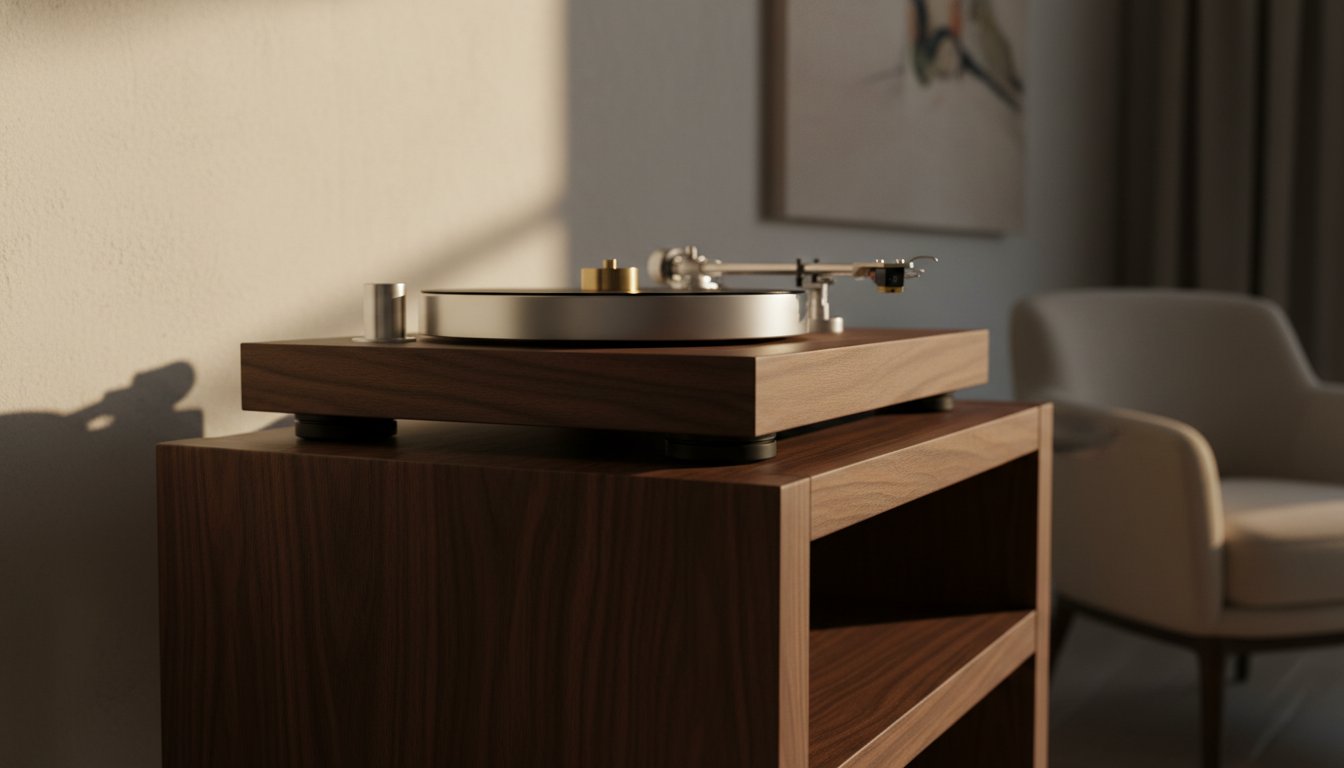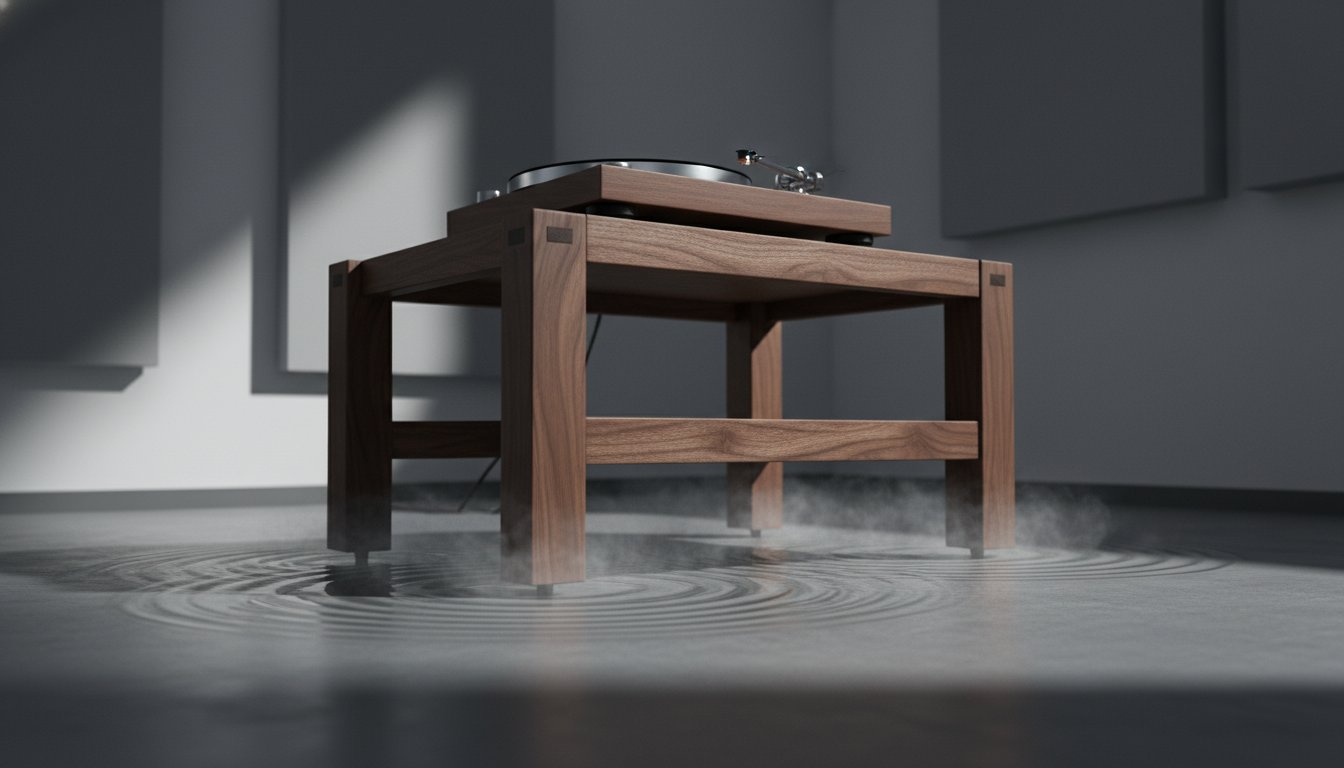
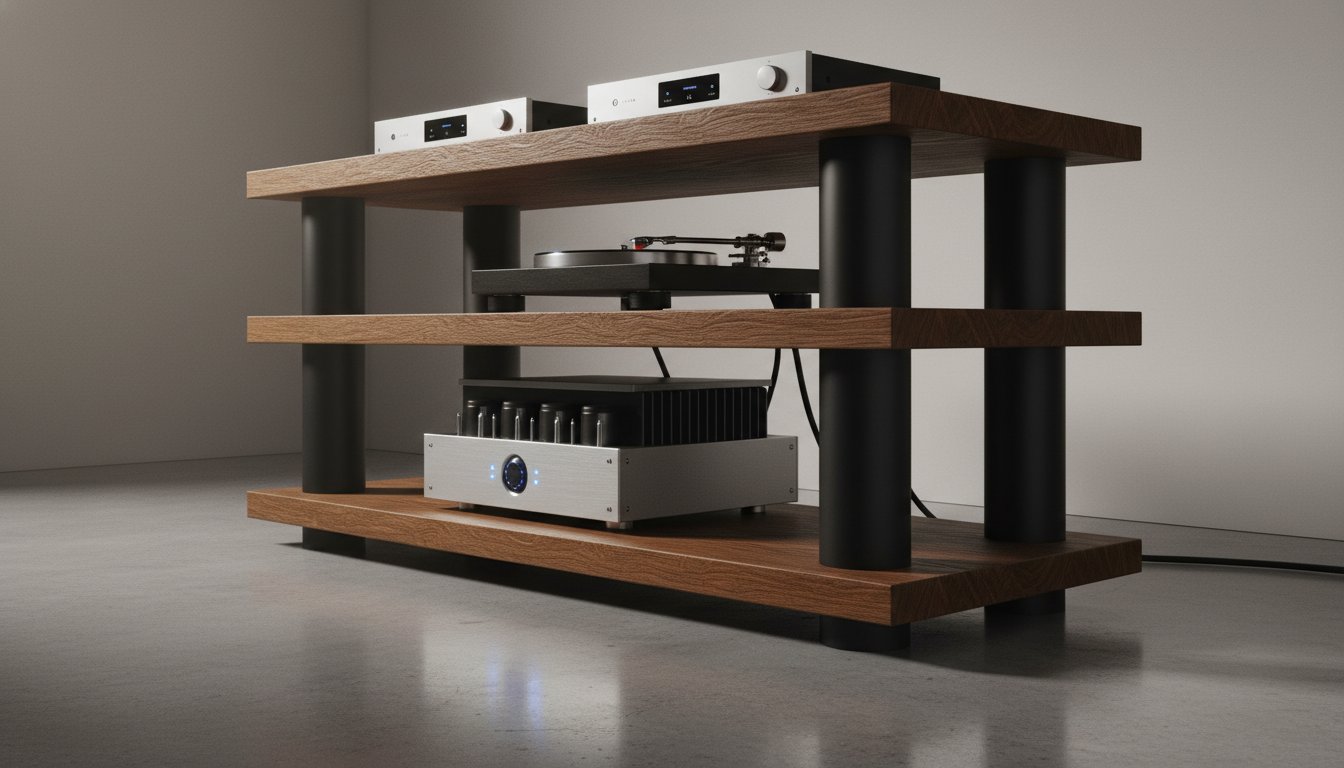
Mass is the ultimate ally of acoustic isolation, but only if the structure beneath it doesn't surrender to the pressure. Your high-end power amplifier might weigh forty kilograms, yet it's often resting on a shelf designed for paperbacks rather than performance. Finding an audio rack with high weight capacity that doesn't look like industrial scrap is a challenge every audiophile faces when trying to protect their investment from sagging or unwanted resonance.
We believe your furniture should be as much of a precision instrument as the components it carries. You'll discover how to select a platform that uses solid hardwood engineering to support your heaviest gear while actually enhancing its acoustic clarity. You don't have to settle for thin materials or shaky foundations to achieve a premium aesthetic that fits your lifestyle.
We'll explore how our Reference and Classic HiFi Racks provide a stable, vibration-free foundation that looks as beautiful as your system sounds. From understanding load limits to the natural damping properties of solid timber, you'll learn to give your equipment the permanent, soulful home it deserves.
Key Takeaways
- Understand how weight capacity serves as the dual foundation for both equipment safety and absolute sonic neutrality.
- Discover why solid hardwood engineering excels at dissipating unwanted energy through internal friction compared to the ringing resonance of hollow metal.
- Identify the essential structural criteria for an audio rack with high weight capacity, including the necessity of large-diameter pillars and thick, solid timber shelves.
- Master the "bottom-heavy" loading rule to ensure your heaviest high-end components remain stable while protecting the structural integrity of your system.
- Explore how handcrafted solutions like the Reference HiFi Rack provide a permanent, vibration-free home for the world's most substantial audio gear.
Why Weight Capacity is the Foundation of High-End Sound
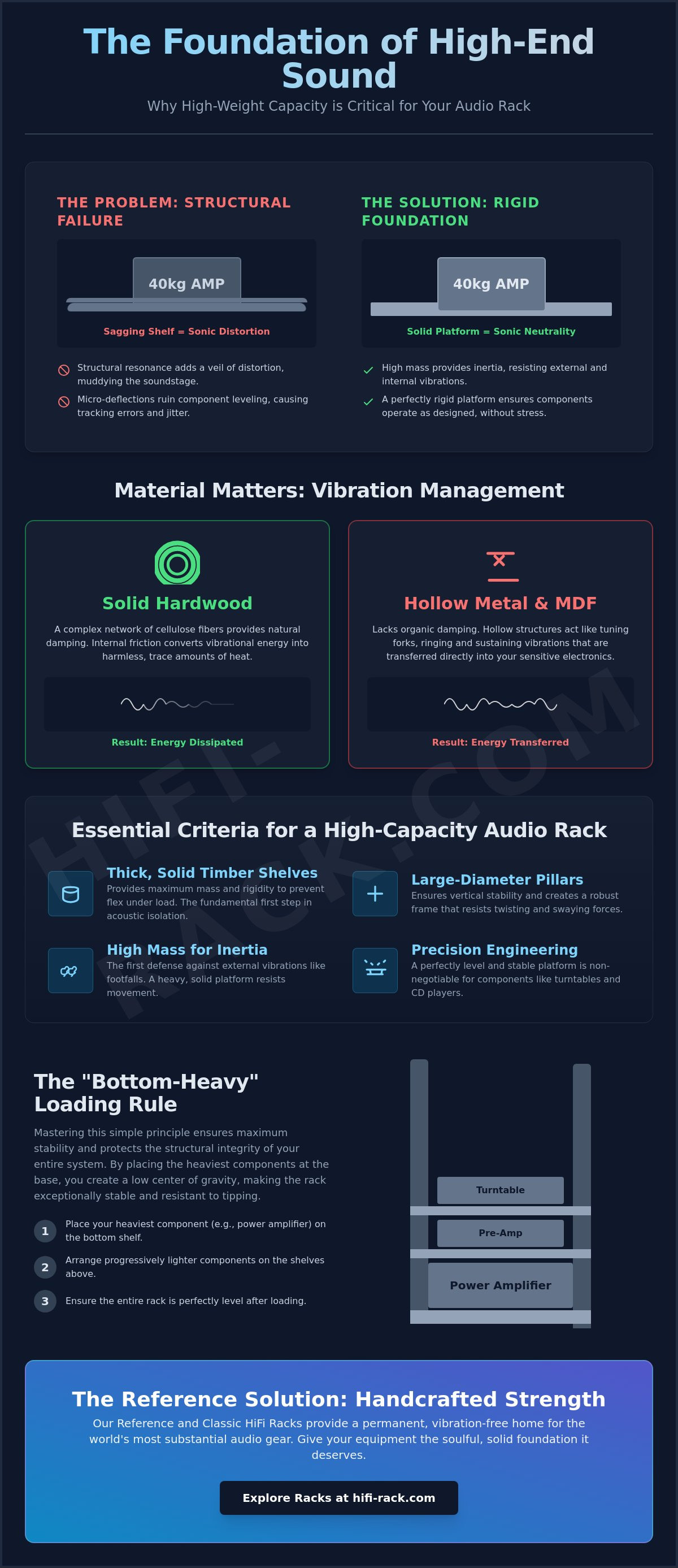
Weight capacity is often viewed through the lens of safety. While keeping forty kilograms of high-end circuitry from hitting the floor is vital, the true purpose of an audio rack with high weight capacity is sonic neutrality. Every component in your signal chain is a micro-environment of vibration. Massive power transformers and heavy heat sinks create localized stress points that can overwhelm a standard shelf. When a support structure lacks sufficient mass or rigidity, it enters a state of structural resonance. Essentially, the heavy amplifier begins to make the weak shelf sing along with the music, adding a veil of distortion that muddies the soundstage.
To better understand how structural design handles these extreme loads, watch this helpful video:
Mass provides inertia. This inertia is your first defense against external vibrations, such as footfalls or low-frequency energy from your speakers. A heavy, solid platform resists movement. It stays still while the world around it moves. This relationship between mass and damping is why we prioritize solid hardwood over hollow metal tubes or resonant glass. A rack that isn't built to sustain heavy loads will inevitably become a conduit for noise rather than a barrier against it.
Identifying High-Mass Audio Components
High-fidelity systems often rely on components that far exceed the weight limits of standard furniture. Many professional systems even utilize standardized equipment mounting to manage the bulk of high-current power supplies, a testament to why structural integrity is non-negotiable. Power amplifiers are the primary source of weight, often weighing thirty to fifty kilograms due to their massive iron-core transformers. Turntables also require immense stability. High-mass platters are designed to maintain rotational speed through inertia, but they only function correctly on an ultra-stable, perfectly level platform. Even power conditioners can be surprisingly heavy and require dedicated support to prevent them from becoming a source of vibration.
The Acoustic Cost of a Sagging Shelf
A sagging shelf is more than an aesthetic eyesore; it's a technical failure. Even micro-deflections in a shelf can alter the precise leveling required for sensitive components. For a turntable, a fraction of a degree of tilt can cause uneven stylus wear and tracking errors. In digital players, structural "give" can force the laser pickup mechanism to work harder to maintain focus, introducing jitter into the signal. A perfectly rigid platform is the fundamental first step in acoustic isolation. By eliminating the flex found in MDF or thin metal, a Reference HiFi Rack ensures that the only thing moving in your room is the air pushed by your speakers.
Solid Hardwood vs. Metal: Engineering for Extreme Loads
Metal is often the first choice for industrial strength. However, for high-fidelity sound, rigidity alone isn't enough. Hollow metal tubes act like tuning forks. They carry vibrations directly into your sensitive electronics, coloring the music with a metallic sheen that obscures clarity. An audio rack with high weight capacity must do more than just hold the weight. It must manage the energy that comes with it. Solid hardwood offers a "dead" response that metal simply can't match. It is a silent partner in your listening experience, providing a foundation that refuses to ring.
At a microscopic level, wood is a complex network of cellulose fibers. When mechanical vibrations enter the timber, these fibers rub against one another. This internal friction converts kinetic energy into trace amounts of heat. It is a natural damping system that dissipates resonance before it reaches your pre-amp. Metal lacks this organic damping. It rings. It sustains. It introduces a layer of noise that masks the finer details of a recording. By choosing solid timber, you ensure that the only character in the music is the one the artist intended.
The Failure of MDF and Veneer Under Pressure
Glue-based materials like MDF are fundamentally unsuitable for high-end audio support. Under the constant pressure of a heavy transformer, these materials undergo a process called "creep." This is a permanent, irreversible sag that ruins the level of your equipment. Because MDF is essentially compressed dust and glue, it has a honeycomb-like internal structure filled with air pockets. It cannot provide the high-mass isolation needed for true fidelity. MDF is a resonant material that compromises high-end signals by failing to provide a truly inert foundation. It is a budget solution that has no place in a high-performance system.
The Load-Bearing Giants: Oak, Walnut, and Cherry
Selection of species matters. We look to the Janka hardness scale to understand how different woods resist compression. Oak and Walnut provide the density required to support significant mass without flinching. When you move to a 40mm thickness of solid timber, you're entering the gold standard for supporting components over 50kg. Our Reference series modules are engineered to support up to 90kg per tier, providing a level of stability that few other materials can offer. This thickness ensures the shelf remains perfectly flat even under extreme stress.
Beyond the technical, there's the sensory reward. Organic materials bring a warmth to your listening sanctuary that industrial metal can't replicate. If you're planning on safely loading your audio equipment, starting with a foundation of solid oak is the most reliable choice you can make. You might find that our Classic HiFi Rack offers exactly that balance of timeless beauty and structural resolve. This is why a solid timber audio rack with high weight capacity remains the definitive choice for the serious listener.
Essential Criteria for Your High-Capacity Audio Rack
A superior audio rack with high weight capacity is defined by the sum of its structural choices. Pillars are the critical conduit for mechanical energy. While mass-market furniture relies on thin, hollow legs or adjustable pegs, a high-performance rack utilizes solid, large-diameter vertical supports. These pillars must provide a direct path for vibrations to travel from the equipment to the floor. If the vertical structure is weak, the rack will sway under the weight of a heavy amplifier, introducing lateral instability that compromises the focus of your soundstage.
Shelf thickness is equally vital. Most mass-market furniture uses shelves between 15mm and 20mm thick. This is insufficient for high-fidelity gear. When a power amplifier weighs forty kilograms, a thin shelf will flex, creating a curved surface that prevents the component's feet from making uniform contact. We've found that 40mm solid timber is the necessary threshold for maintaining a perfectly flat surface under extreme stress. This thickness also alters the acoustic properties of rack materials, pushing the resonance frequency of the shelf well below the audible range.
Heat dissipation is the silent requirement of high-mass gear. Heavy components, particularly Class A amplifiers or tube-based power supplies, generate significant thermal energy. An enclosed cabinet traps this heat, which can lead to component failure or reduced longevity. An open-architecture design allows air to flow naturally around the heat sinks. This keeps your electronics within their optimal operating temperature while ensuring the structural integrity of the wood isn't compromised by localized heat pockets.
Modular Design for Structural Integrity
Modular stacking is a hallmark of high-end engineering. Rather than using long, continuous uprights that can bow, a modular system uses individual tiers that lock together. This creates multiple points of mechanical grounding, significantly improving overall rigidity. It also offers the flexibility to evolve. As your collection of high-mass gear grows, you can add tiers without compromising the stability of the entire unit. Our Myro Reference HiFi Rack is built on this modular philosophy, ensuring that each tier remains an isolated, rock-solid platform for your most prized components.
Precision Leveling and Floor Interface
The interface between the rack and the floor is where the final battle against vibration is won. Precision-machined brass spikes are essential for an audio rack with high weight capacity. These spikes concentrate the mass of the entire system onto a tiny surface area, effectively "coupling" the rack to the floor. This allows vibration to drain away from the equipment. For those with hardwood floors, solid floor protectors provide the necessary isolation without causing damage. Achieving a perfectly level foundation is not a luxury; it is a technical requirement for the mechanical stability of your system.
How to Safely Load and Level Your Heavy-Duty Rack
Setting up your system is a ritual that requires precision. Before you begin assembly, perform a thorough structural audit of your components. Don't guess the weight of your gear. Consult the manufacturer's specifications for every piece, from the massive power amplifier to the delicate phono stage. An audio rack with high weight capacity is only effective if you respect its limits and distribute the mass according to the laws of physics. A planned approach ensures that your system remains safe while achieving its maximum sonic potential.
The "Bottom-Heavy" Rule is your most important guideline. By placing your heaviest components, typically power amplifiers and power conditioners, on the lowest tiers, you lower the entire system's center of gravity. This creates a rock-solid anchor that resists swaying and lateral movement. A top-heavy rack is a liability; it is more susceptible to external vibrations and accidental tipping. Positioning the bulk of the weight near the floor maximizes the stability of the entire structure.
Centering the load is equally critical for the longevity of the timber. Place your equipment so the center of mass sits directly over or as close as possible to the vertical pillars. This reduces shear stress on the center of the shelf and prevents even the slightest long-term bowing. Once the gear is in place, use a precision spirit level to ensure the rack is perfectly plumb across both the horizontal and vertical axes. A system that isn't level can cause uneven wear on turntable bearings and may even affect the cooling efficiency of heat sinks.
The final step is testing for "rock." Even a microscopic wobble can degrade bass definition and smear high-frequency details. Try to gently move the rack from the top tier. If you detect any movement, adjust the floor spikes individually until the rack feels like an extension of the floor itself. Every spike must bear an equal share of the weight to ensure the vibration-draining mechanism functions at full capacity. If you want to ensure your setup is truly optimized, explore our Reference and Classic collections to find a foundation built for this level of precision.
Cable Management for High-Mass Systems
Heavy audiophile power cables and interconnects are more than just signal paths; they are physical weights that exert torque on your equipment. A thick, high-gauge power cord can actually pull a lighter component out of level or strain the chassis connectors. Organize your cables so they don't hang freely. Support their weight to prevent "cable drag" from compromising your leveling work. Proper routing also ensures better airflow around hot-running gear and reduces electromagnetic interference between power and signal lines.
Long-Term Maintenance of Wood Racks
Solid wood is an organic, living material that settles over time under the constant pressure of a high-mass system. Check the tightness of your spikes and locking nuts every six months to account for this natural compression. Humidity also plays a role, as it can subtly shift the structural dimensions of the timber throughout the year. Maintaining a stable environment will help preserve the rack's integrity for a lifetime. For more insights on material selection, read The Ultimate Guide to Choosing a Solid Wood HiFi Rack.
The Reference Solution: Handcrafted Strength by HiFi Rack
Our philosophy is rooted in a refusal to compromise. While the market is flooded with mass-produced stands that rely on glue-bound MDF and thin veneers, we choose a more permanent path. We build with raw, solid timber because we understand that your high-fidelity system is an investment in sensory perfection. An audio rack with high weight capacity shouldn't just be a piece of furniture; it must be a vital instrument that supports your heaviest gear without adding its own voice to the performance. Our Reference Series is the culmination of this belief, engineered specifically to handle the most substantial audiophile components ever made.
Every rack we produce is a testament to artisanal pride. Handcrafted in our workshop in Serbia, these structures are born from a deep-seated passion for sound and a reverence for high-quality materials. We don't use faceless assembly lines. Instead, we rely on the skilled hands of master craftsmen who ensure every joint is precise and every pillar is true. This human element creates a sense of integrity and longevity that industrial alternatives lack. It's furniture built to last a lifetime, evolving alongside your passion for music.
Customization is central to our process. We recognize that high-mass gear comes in many forms, from oversized monoblocks to wide-chassis power conditioners. We offer the ability to tailor dimensions and wood types to your specific requirements. Whether you prefer the density of European Oak or the rich character of Walnut, we ensure your rack is a perfect fit for both your equipment and your personal sanctuary. This bespoke approach ensures that your audio rack with high weight capacity is as unique as the system it supports.
The Myro Reference: A Masterpiece of Stability
The Myro Reference represents our uncompromising commitment to excellence. Featuring 40mm solid wood shelves and massive, solid timber pillars, it provides the ultimate foundation for components weighing up to 90kg per tier. Its performance is defined by what you don't hear. By dissipating mechanical energy through the natural fibers of the wood, the rack effectively disappears from the acoustic signature of your room. It stays silent while your music breathes. If you're ready to build a system without limits, visit the HiFi Rack Shop to explore our custom configurations.
A Commitment to Longevity and Aesthetics
Solid wood is more than a structural choice; it's an heirloom-quality investment. Unlike metal or synthetic materials that date quickly, timber gains character and warmth with age. We take our role as stewards of this material seriously through our commitment to Responsibility and Sustainable Sourcing. We ensure that every piece of wood we use is harvested with respect for the environment. This dedication to ethics and aesthetics creates a product that feels premium, intimate, and deeply authentic. Elevate your listening experience today with a rack that handles the weight of your gear and the soul of your music with equal grace.
Secure the Future of Your High-Fidelity System
You've seen that mass is only as effective as the structure supporting it. By prioritizing solid hardwood over resonant metal and practicing strategic "bottom-heavy" loading, you protect your electronics while opening up the soundstage. A true audio rack with high weight capacity doesn't just hold your gear; it liberates it from the interference of structural vibration. It's the difference between a shelf that merely exists and a platform that performs as a precision instrument.
We don't believe in the compromise of MDF or veneers. Our modular designs are handcrafted in Serbia with multi-generational expertise, ensuring that each tier remains a rock-solid sanctuary for your most substantial components. This is the union of performance and aesthetics we promise to every listener. It's a commitment to longevity that ensures your furniture is as enduring as the music you love.
Your equipment deserves a home that matches its level of engineering and soul. Build your bespoke high-capacity rack in our shop and give your system the permanent foundation it deserves. We invite you to slow down, listen closely, and appreciate the finer details of a truly isolated performance.
Frequently Asked Questions
How much weight can a solid wood audio rack really hold?
A professionally engineered solid wood rack can support significant mass. Our Reference HiFi Rack is designed to hold up to 90kg per tier, while the Slimline models support up to 70kg. This capacity ensures that even the heaviest monoblocks or power conditioners remain perfectly stable. You don't have to worry about structural failure when using materials built for this level of performance.
Will a solid wood shelf sag over time if my amplifier weighs 50kg?
Solid wood resists permanent deformation when it is sufficiently thick. A 40mm solid oak or walnut shelf won't sag under a 50kg load because it lacks the glue-based "creep" found in composite materials. The natural density of the grain provides a rigid foundation that maintains its level for decades. It ensures your sensitive components stay perfectly plumb and vibration-free.
Is a modular rack more stable than a fixed-frame rack for heavy gear?
Modular designs offer superior stability because they provide multiple mechanical grounding points. Each tier acts as an independent, isolated platform that locks into the one below it. This stacking method prevents the lateral swaying often found in long, continuous uprights. It makes a modular audio rack with high weight capacity the preferred choice for extreme loads and precise acoustic isolation.
Why should I avoid glass or MDF racks for heavy high-end components?
Glass and MDF lack the internal damping necessary for high-fidelity sound. Glass is prone to ringing at audible frequencies, while MDF is a resonant material that sags permanently under heavy weight. Neither material can dissipate mechanical energy as effectively as solid hardwood. Timber converts vibrations into trace heat through internal fiber friction, protecting your signal from unwanted noise.
Do I need floor protectors if my heavy rack uses brass spikes?
Floor protectors are essential if you're placing a high-mass system on hardwood or stone surfaces. While brass spikes are vital for draining vibration, the immense pressure of a fully loaded rack can cause permanent damage to your flooring. Solid floor protectors preserve your room's aesthetic. They provide a stable interface that allows the isolation spikes to function correctly without leaving marks.
What is the best type of wood for a high weight capacity audio rack?
Dense, high-Janka hardwoods like Oak and Walnut are the definitive choices for structural stability. These species provide the necessary fiber density to resist compression and dissipate resonance. Their organic beauty complements the technical excellence of your gear. Using high-quality timber creates a listening environment that feels both premium and authentic, ensuring your system looks as good as it sounds.
How do I know if my floor can support a fully loaded high-mass audio rack?
Most modern residential floors support the concentrated weight of a high-end audio system without issue. If you're building an exceptionally heavy setup in a home with timber floors, try to position the rack directly over a supporting joist. This provides the most stable foundation. It also prevents any potential floor deflection that could ruin your leveling work or cause instability.
Can I customize the shelf height for my tall, heavy power amplifier?
Customization is a core part of our artisanal process. We can tailor the pillar lengths of our Reference and Classic racks to accommodate the specific dimensions of your largest gear. This ensures proper airflow for hot-running amplifiers while maintaining the precise center of gravity needed for an audio rack with high weight capacity. Bespoke heights allow you to optimize your system's layout without compromising on structural resolve.