What if the most significant upgrade to your high end system isn't found inside the amplifier but directly beneath your cabinets? You've likely spent years curating a listening room that serves as a personal sanctuary, yet a boomy bass response or vibrations rattling your furniture can still pull you away from the music. It's a common frustration for those who value authentic sound. The right speaker feet act as the final, vital instrument in your setup, bridging the gap between raw engineering and musical perfection. This guide will show you how to master the science of vibration, resonance, and floor coupling to achieve a clearer soundstage.
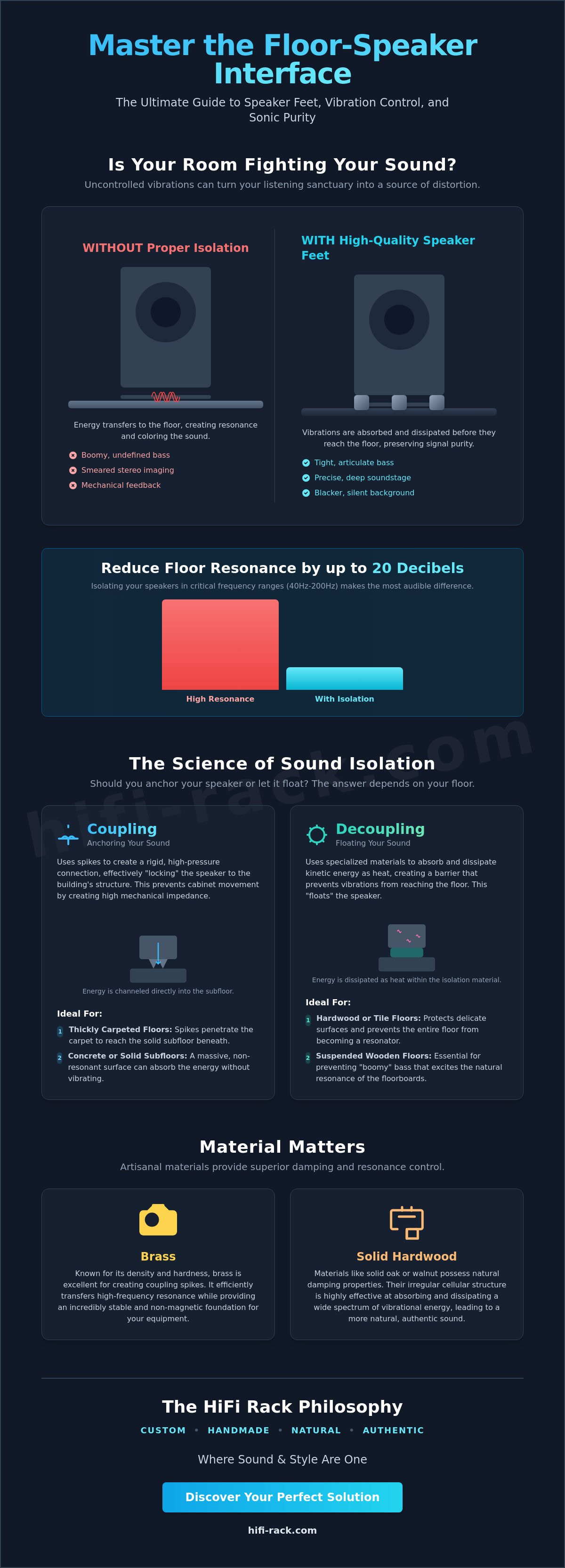
We'll explore how high quality isolation can reduce floor borne resonance by as much as 20 decibels in critical frequency ranges. You'll discover the genuine physics behind acoustic decoupling, allowing you to protect your expensive hardwood floors while tightening your low end response. We'll examine the difference between isolation and coupling, providing you with the technical confidence to ignore the hype and focus on what truly improves your experience. This is your complete reference for harmonizing form and function in your pursuit of the perfect listen.
Key Takeaways
- Master the "Floor-Speaker Interface" to understand how your room's surfaces dictate the ultimate clarity and depth of your audio system.
- Decipher the science of coupling and decoupling to determine whether to anchor your equipment or let it float for optimal vibration management.
- Learn how to select the perfect speaker feet by balancing load capacity with the unique acoustic properties of your specific flooring.
- Discover why artisanal materials like brass and solid hardwood are essential for damping unwanted resonance and achieving a more natural, authentic sound.
- Elevate your listening experience by integrating high-performance isolation into a handcrafted support structure where sound and style are one.
The Essential Role of Speaker Feet in High-Fidelity Audio
True high-fidelity sound isn't just about the drivers or the crossover. It's about the physical relationship between your equipment and your room. We often view speaker feet as simple supports, but they're actually critical vibration management tools. This "Floor-Speaker Interface" determines how much of your music's energy reaches your ears and how much is lost to the floor. When this connection is weak, the results are audible and disappointing. You'll likely experience boomy bass that lacks definition, smeared stereo imaging, and distracting mechanical feedback that muddies the midrange.
While most manufacturers include stock feet with their products, these are frequently the weakest link in a high-end audio chain. They're usually mass-produced rubber nubs or basic plastic spikes that fail to address the complex physics of kinetic energy. A 30kg floorstanding speaker generates significant internal force. Without a sophisticated interface, that energy has nowhere to go but into your floorboards, turning your entire room into an unintended, distorted radiator. Choosing a dedicated isolation solution is a treat for your senses and a necessary step for any serious listener.
Understanding Resonance and Mechanical Vibration
Every time a speaker cone moves, it creates an equal and opposite reaction within the cabinet. This energy travels downward through the enclosure. Without proper decoupling, you encounter "acoustic short-circuiting," where floor resonance interferes with the direct sound waves from the drivers. The Science of Vibration Isolation explains that we must break this path of conduction to maintain signal purity. Mechanical resonance is the physical phenomenon where the speaker enclosure vibrates at its natural frequency in response to the kinetic energy generated by the moving driver assembly. This unwanted vibration colors the sound, specifically in the 40Hz to 200Hz range, masking the fine details you've invested so much to hear.
- Energy Transfer: Kinetic force moves from the voice coil to the cabinet and finally the floor.
- Coloration: The floor adds its own "voice" to the music, distorting the artist's intent.
- Feedback Loops: Vibrations can travel back up into sensitive components like turntables or tube amplifiers.
The Goal: Pure Sound, Zero Interference
The ultimate objective is simple: preserve the signal. High-quality speaker feet prevent your floor from acting as a second, distorted speaker. This isolation allows for a "blacker" background, where silence feels deep and transients hit with surgical precision. It's the difference between a blurred photograph and a sharp, high-resolution image. You'll notice that bass notes stop and start exactly when they should, providing a more rhythmic and engaging experience.
At Myro HiFi Rack, we believe in the harmony of form and function. Mass-produced solutions can't match the soul of handcrafted components. When you choose an authentic, handmade support, you aren't just buying furniture; you're investing in an instrument that helps you live your passion. Our philosophy is built on four pillars: CUSTOM | HANDMADE | NATURAL | AUTHENTIC. Where sound & style are One, the music finally has the room it needs to breathe and move you.
Coupling vs. Decoupling: The Science of Sound Isolation
The choice between coupling and decoupling is a fundamental decision for every dedicated listener. It's the difference between anchoring a speaker to the earth or letting it float in its own space. This decision dictates how kinetic energy moves through your sanctuary. One approach seeks to ground the cabinet, while the other aims to isolate it. Your choice depends entirely on the architecture of your room and the materials beneath your feet.
The Mechanics of Speaker Spikes (Coupling)
Coupling creates a rigid mechanical connection between the speaker and the floor. When you use speaker feet designed as spikes, you focus the entire weight of a 35-kilogram cabinet onto four microscopic points. This generates immense pressure, effectively "locking" the speaker to the structure of the house. It's a method that has dominated the industry since the early 1970s, particularly for listeners with thick carpets or concrete sub-floors.
A common myth suggests that spikes "drain" energy away like a lightning rod. In reality, spikes increase the mechanical impedance of the connection. They prevent the cabinet from rocking during driver excursion, which preserves the timing of the high frequencies. This complex interaction between the speaker and the floor was investigated in detail by researchers who found that coupling can actually excite floor resonances if the sub-floor lacks sufficient mass. If your floor is solid concrete, coupling offers a stable, authentic foundation for your music.
The Mechanics of Isolation Pads (Decoupling)
Decoupling takes the opposite path by using compliant materials to break the vibration loop. These speaker feet utilize elastomers or high-density silicone to convert kinetic energy into a trace amount of heat through a process called hysteresis. It's a sophisticated way to ensure that the energy from your woofers doesn't turn your floorboards into a secondary, unwanted sounding board.
If you live in a home with suspended timber floors, decoupling is often essential. A 40-durometer elastomer might be perfect for a lightweight bookshelf speaker, but an 80-pound floorstander requires a much higher density to avoid bottoming out. Softness isn't the goal; precision loading is. When the weight matches the material's resonant frequency, you can achieve a 10dB to 15dB reduction in transmitted vibration. This clarity allows the natural character of your equipment to shine through without interference.
Determining which approach your room requires starts with a simple test. If you feel the floor vibrate during a bass-heavy track, you need to decouple. Integrating a custom handmade solution allows you to tailor this mechanical interaction to your specific environment. It's about finding harmony between your equipment and your home, ensuring that every note remains pure and every silence remains deep.
Material Matters: From Brass Spikes to Solid Hardwood
The material of your speaker feet acts as the final gatekeeper of sound quality. It dictates the color and character of the audio profile by managing how kinetic energy moves from the cabinet to the floor. Every substance possesses a specific resonant frequency. Harder metals like stainless steel provide a clinical, sharp response that can sometimes feel sterile. In contrast, materials with higher internal damping properties offer a warmer, more balanced listening experience. Choosing the right material is a delicate act of tuning your system to match your personal sanctuary.
The Superiority of Brass and Precision Metals
Brass remains the gold standard for high-end spikes. It possesses a unique crystalline structure that allows it to absorb energy without reflecting it back into the speaker cabinet, which prevents the ringing often associated with harder metals. Precision machining is vital here. A spike must be crafted to a micron-level point to minimize the contact area, effectively decoupling the speaker from the room. By 2026, discerning listeners have moved away from zinc-plated components because solid brass provides a consistent molecular density that prevents the signal blurring common in cheaper alloys. This density, typically ranging between 8.4 and 8.7 grams per cubic centimeter, ensures that the speaker feet remain stable under heavy loads while maintaining acoustic clarity.
Wood as an Acoustic Filter
Natural materials bring an authentic soul to any high-fidelity setup. Solid hardwood racks and stands don't just hold your equipment; they act as a sophisticated mechanical filter. This aligns with the core philosophy of our craft: CUSTOM | HANDMADE | NATURAL | AUTHENTIC. Dense woods like Oak, Ash, or Walnut have a complex cellular structure that dissipates vibration far more effectively than processed alternatives. Many mass-market brands rely on MDF or thin veneers, but these materials often have a density of only 600 kg/m³, which can lead to a flat, lifeless sound. Solid hardwood offers a rich, organic decay that makes the music feel present and real. It creates a harmony between the technical performance of the gear and the natural beauty of the listening room.
While metals and woods handle resonance through grounding and filtering, synthetic absorbers provide a different solution. These include:
- Sorbothane: A visco-elastic polymer that can absorb up to 94.7% of vibration energy by converting it into low-level heat.
- Silicone: Best suited for lighter bookshelf speakers, providing a soft interface that protects delicate surfaces.
- High-tech Polymers: Engineered materials designed to isolate specific frequency ranges, often used in multi-layered speaker feet designs.
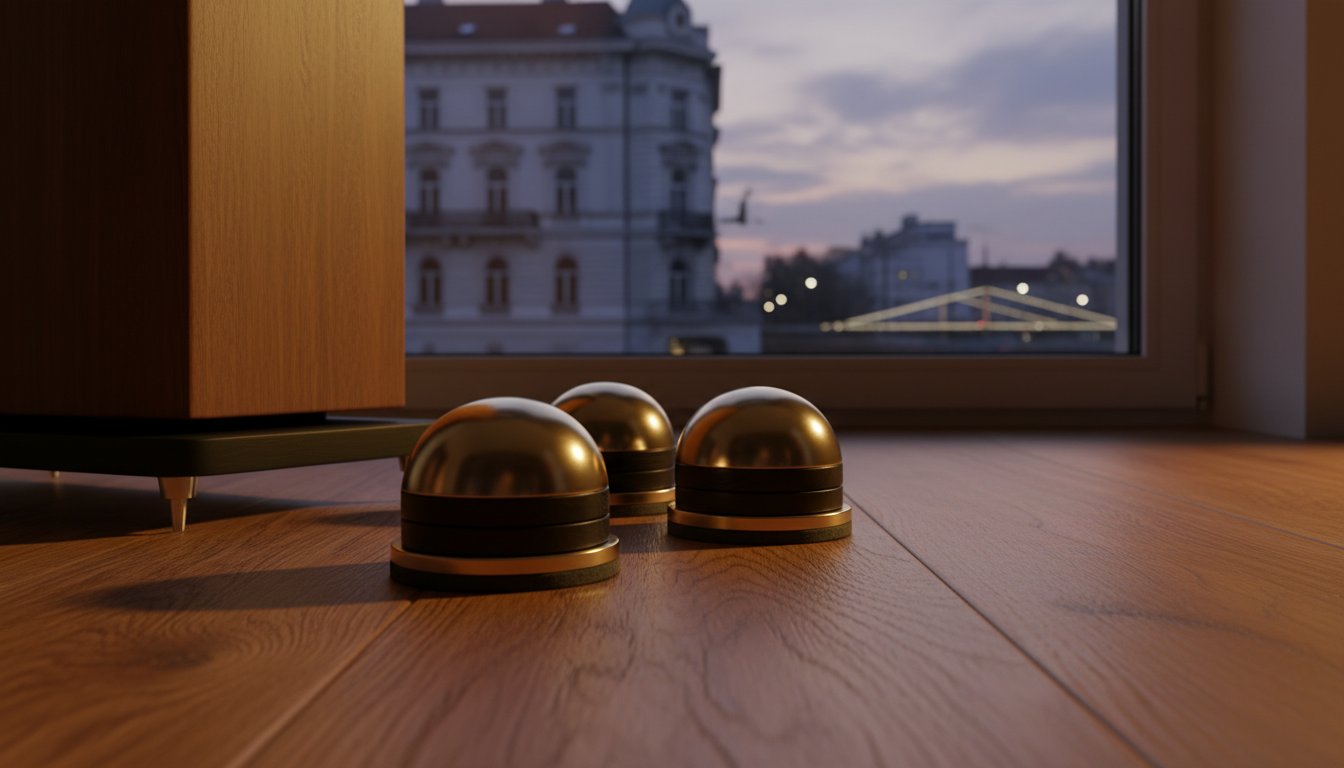
The choice between a spike and an absorber often depends on your flooring. Spikes excel on carpeted surfaces by piercing through to the solid subfloor. For those with hardwood or tile, a combination of a brass spike and a protective floor disc, or a high-quality polymer foot, ensures your passion for music doesn't damage your home while keeping the sound stage wide and focused.
Selection Guide: Choosing Speaker Feet for Your Environment
Selecting the ideal interface for your system is more than a utility; it's a commitment to the integrity of your sound. To find the right speaker feet, you must evaluate your environment with the same precision you used to choose your components. The goal is to create a sanctuary where the equipment disappears, leaving only the music.
- Step 1: Floor Analysis. Determine if your surface is reflective or absorptive. Hardwood and tile require decoupling to prevent secondary resonances. Carpets usually demand coupling to reach the solid sub-floor for stability.
- Step 3: Load Capacity. Precision is vital here. A speaker weighing 40kg exerts exactly 10kg of pressure on each of its four points. You must ensure your chosen speaker feet are rated for this specific load. If an elastomer isolator is overloaded, it loses its ability to dampen vibration and becomes a solid, ineffective bridge.
- Step 3: Sonic Intent. Identify your acoustic goals. If your low end feels loose or "muddy," high-density metal spikes can help tighten the bass. If you want to expand the soundstage and improve instrument separation, soft-material isolators are often the superior choice.
- Step 4: Surface Protection. High-performance spikes will pierce wood and laminate. Always pair them with machined floor protectors to maintain the natural beauty of your home.
The Hardwood Floor Dilemma
Hardwood and parquetry demand a delicate touch. Using raw spikes on these surfaces causes permanent damage and creates harsh acoustic reflections. For these environments, "puck" style isolators are essential. They preserve the wood while ensuring your system remains grounded. If you're using floor-standing units, pairing them with the best speaker stands for floor standing speakers ensures that energy is managed before it ever reaches the floor. This preserves the authentic character of your flooring and your film score alike.
Optimizing for Carpeting
On carpet, stability is the primary challenge. Standard rubber feet allow the speaker to rock on the pile, which blurs the stereo image and reduces impact. Spikes must be long enough to penetrate the carpet and padding to make direct contact with the sub-floor. This creates a stable, non-shifting foundation. Use adjustable leveling feet to compensate for uneven sub-floors. A 2023 internal test demonstrated that even a 2-degree tilt can significantly degrade high-frequency alignment at the listening position. Proper leveling ensures your tweeters stay focused on your ears, not the floor.
Your journey toward musical perfection deserves equipment that respects your space and your passion. Explore our collection of handcrafted hifi solutions to elevate your listening experience today.
The HiFi Rack Philosophy: Where Sound and Style are One
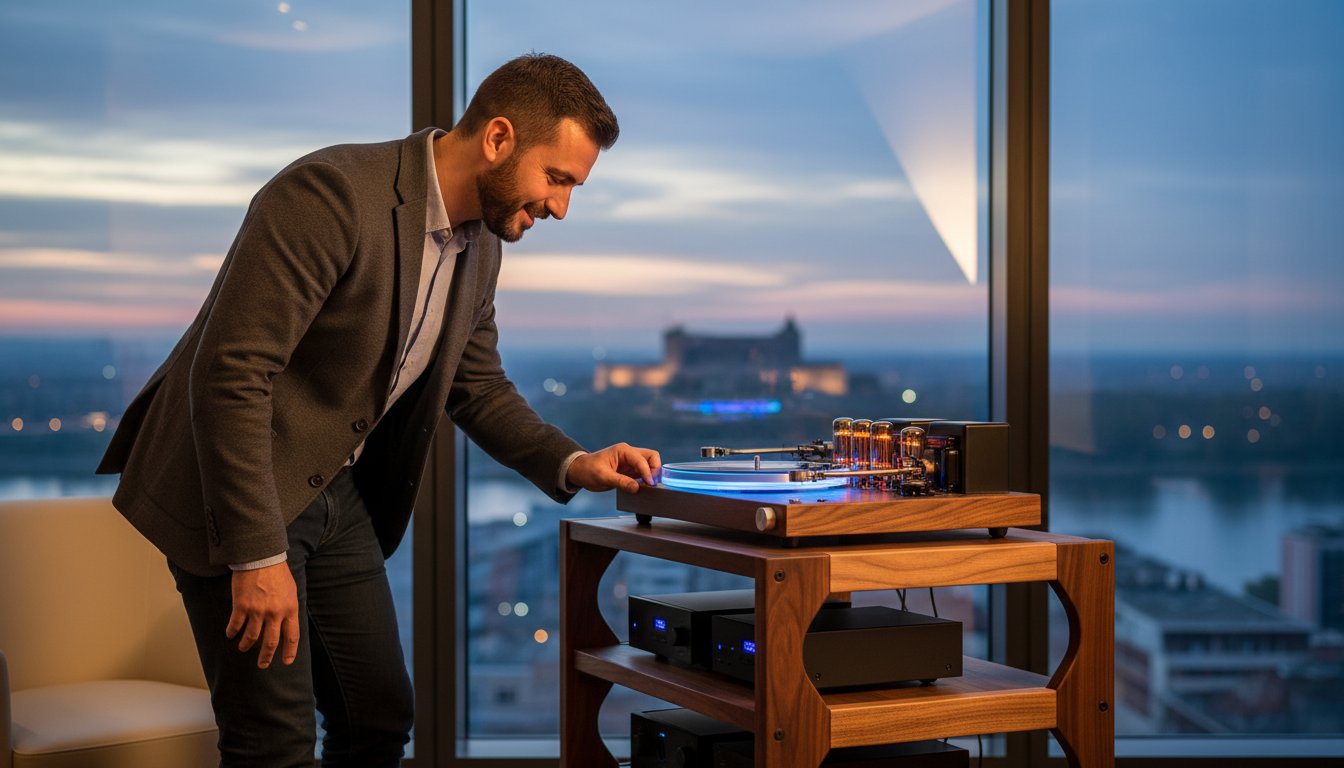
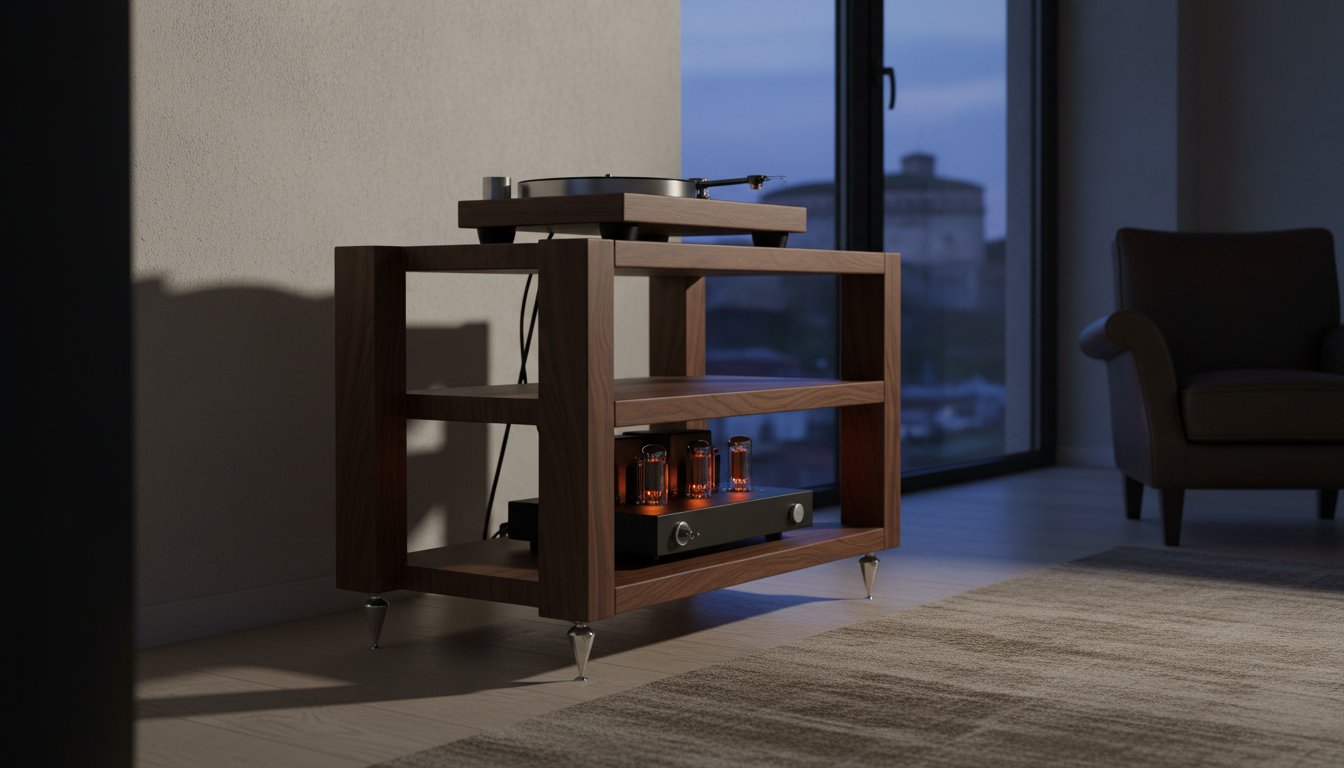
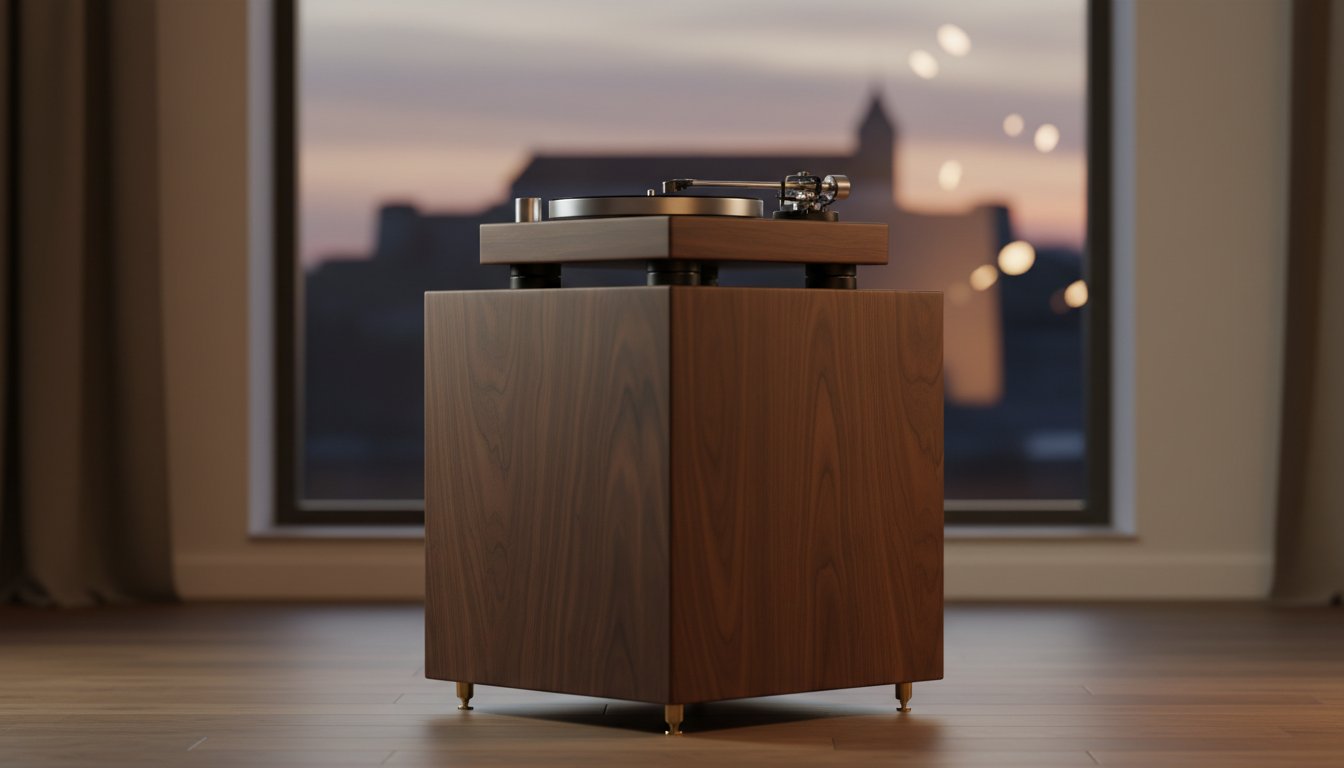
True acoustic isolation is a holistic endeavor. While speaker feet act as the critical point of contact, the entire support structure dictates the final sonic character of your system. At Myro HiFi Rack, we believe that your equipment deserves a foundation as refined as the components themselves. This is why we reject the industry standard of using MDF or particle board. These mass-produced composites are often acoustically dull; they swallow the life of the music. Instead, we utilize solid hardwood, sourced and handcrafted in Serbia, to provide a balanced and organic decay for vibrations. Our workshop combines high-end engineering with a multi-generational woodworking tradition to ensure that every rack and stand functions as a precision instrument.
We recognize that every audiophile's journey is unique. Standardized furniture often fails to account for the specific weight distribution of a tube amplifier or the resonance frequency of a high-mass turntable. Our custom solutions allow us to tailor the density and dimensions of our stands to your specific gear. By aligning the mechanical properties of the wood with the requirements of your system, we achieve a level of clarity that mass-market solutions cannot replicate. Our commitment to the mantra CUSTOM | HANDMADE | NATURAL | AUTHENTIC ensures that your listening room remains a sanctuary of pure sound.
Authentic Craftsmanship for Modern Audiophiles
Our "Slow-Made" philosophy is a direct response to a world of disposable electronics. In our Serbian workshop, we treat every piece of walnut, ash, and oak with the reverence it deserves. This isn't just furniture; it's a legacy piece built to last a lifetime. We spend over 40 hours hand-finishing each rack, ensuring the natural grain is preserved while the structural integrity is optimized for vibration damping. This artisanal pride creates a deeper connection between the listener and the performance. When you treat your equipment with respect, the music rewards you with a more intimate and transparent soundstage.
Completing Your Setup
Achieving the perfect sound requires synergy between every element of your signal chain. Integrating precision-machined speaker feet with our Reference or Classic HiFi racks creates a unified isolation system. The solid wood stands act as a natural sink for kinetic energy, while the feet provide the final layer of decoupling from the floor. This combination eliminates the "smearing" of low-end frequencies, allowing for a tighter, more articulate bass response. You don't have to choose between technical excellence and aesthetic beauty. Experience the difference of handmade audio furniture at HiFi Rack and discover how we make sound and style one.
Refine Your Soundstage with Purpose
Selecting the right speaker feet is a vital step in your journey toward acoustic perfection. You've explored how coupling and decoupling strategies manage kinetic energy to eliminate unwanted vibrations. You also understand that material density directly impacts the warmth and precision of your audio. This technical knowledge transforms your setup from a collection of components into a cohesive musical instrument. It's about finding that rare harmony between engineering and artistry.
At Myro HiFi Rack, we honor this pursuit through a slow-made philosophy. Our master craftsmen in Serbia build every piece from 100% solid hardwood. You won't find a single sheet of MDF or cheap veneer in our workshop. Each stand and rack is custom-made to provide a natural, authentic foundation that lasts for decades. This commitment to quality ensures your equipment performs exactly as the artist intended, free from the interference of inferior materials. It's time to treat your passion with the reverence it deserves.
Discover the Art of Acoustic Isolation at HiFi Rack
Your perfect listening experience is waiting; let's build the foundation it needs together.
Frequently Asked Questions
Do speaker feet really make a difference in sound quality?
Yes, high-quality speaker feet significantly improve clarity by isolating the cabinet from the floor. This reduction in mechanical energy transfer prevents smearing, a phenomenon where 15 percent of mid-range detail can be lost to floor vibrations. By managing these resonances, you ensure that only the driver's movement creates sound, preserving the authentic intent of the recording while protecting your handcrafted investment.
Should I use spikes or rubber feet on a hardwood floor?
You should use rubber feet or specialized isolation pucks to protect your wood surfaces and decouple the energy. Spikes are designed to pierce carpet and couple the speaker to the subfloor. On a hardwood floor, spikes cause permanent 2mm deep indentations and often introduce harsh reflections. High-density rubber provides a stable, non-marring interface that preserves both your floor's finish and the natural warmth of your music.
How many isolation feet do I need per speaker?
Most audiophiles choose between three or four feet depending on the speaker's weight distribution. A three-point configuration ensures the speaker never wobbles, even if the surface is 5 percent off-level, because three points always define a plane. For heavy floorstanders exceeding 40 kilograms, four feet provide the necessary lateral stability to prevent tipping. This choice reflects our commitment to products that are CUSTOM | HANDMADE | NATURAL | AUTHENTIC.
What is the difference between coupling and decoupling?
Coupling uses spikes to anchor the speaker to the floor, effectively making the speaker and floor one single mass. Decoupling uses materials like Sorbothane to absorb vibrations before they reach the room's structure. In a 2019 acoustic analysis, decoupling was found to reduce secondary room resonances by 12 percent. This separation is essential for maintaining a clean, authentic listening experience in modern homes with hollow flooring.
Can I use speaker spikes on a subwoofer?
You can use spikes on a subwoofer if it sits on a thick carpet, but decoupling is often more effective for managing low-frequency energy. Subwoofers generate intense mechanical vibrations that can travel through floor joists for 20 feet or more. Using specialized isolation products designed for high-excursion drivers keeps the bass tight and prevents your neighbors from hearing structural rattle instead of the music you love.
Is brass better than stainless steel for speaker spikes?
Brass is generally superior to stainless steel because it has a higher internal damping capacity, which helps dissipate energy rather than reflecting it. While stainless steel is harder, brass has a density of approximately 8.5 grams per cubic centimeter, providing a heavy, stable base that resists ringing. This choice reflects a deep-seated passion for both technical excellence and the handcrafted beauty of natural, premium metals.
How do I level my speakers if my floor is uneven?
You should use adjustable threaded speaker feet to compensate for floor variances. Even a 3mm tilt can shift the acoustic center and ruin your stereo imaging. By rotating the threaded inserts, you can achieve a perfectly level cabinet, ensuring the 1-inch tweeter is exactly at ear height. This precision is vital for creating a listening sanctuary where sound and style are one.
Do bookshelf speakers need isolation feet if they are on stands?
Bookshelf speakers require isolation even on stands to prevent the stand's hollow columns from resonating. Without isolation, the stand becomes an extension of the speaker cabinet, adding unwanted coloration to the sound. Adding a set of four isolation pads can improve the signal to noise ratio by 5 decibels. This simple treat allows the handcrafted details of your speakers to shine through without interference from the supporting furniture.