A high-mass turntable is more than a piece of audio equipment; it is a sensitive instrument that perceives every tremor in its environment. If your deck rests on an inadequate surface, you aren't hearing the record. You're hearing the floor. Finding the best support for a heavy turntable is a critical step in reclaiming the purity of your analog signal. It's about choosing a structural partner that anchors your music against the invisible vibrations of your home.
We know the disappointment of a muddy bass response or the sharp sting of a needle skip caused by a simple footstep. These moments pull you out of the music and remind you that your foundation isn't quite right. I've spent years refining the balance between structural integrity and aesthetic grace to solve these exact pains. In this guide, you'll discover why massive decks require specialized foundations to achieve resonance-free playback. We will walk through the essential elements of total acoustic isolation, helping you find a support that brings both low-end clarity and visual harmony to your sanctuary.
Key Takeaways
- Understand why high-mass decks require a specialized structural foundation that manages kinetic energy rather than reflecting it back into the platter.
- Learn to evaluate materials based on their unique sonic fingerprints, prioritizing the organic resonance of solid hardwood over the compromises of MDF.
- Discover the four essential criteria for the best support for a heavy turntable, including the critical mass ratio and the necessity of precision leveling.
- Determine whether a floor-standing rack or a heavy-duty wall shelf is the right solution for your room's specific vibration challenges.
- Appreciate how a handcrafted HiFi Rack acts as a vital instrument in your pursuit of sensory perfection and acoustic clarity.
The Structural Physics of High-Mass Analog Playback
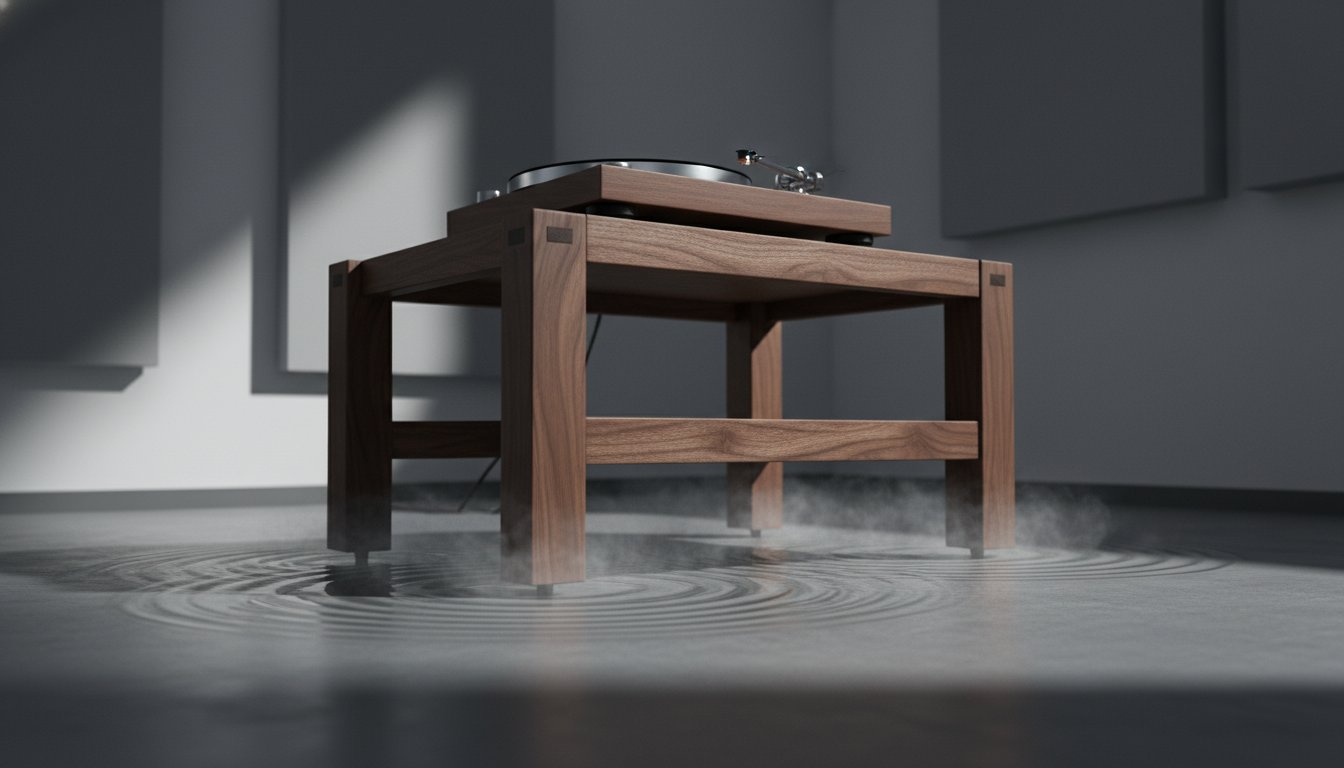
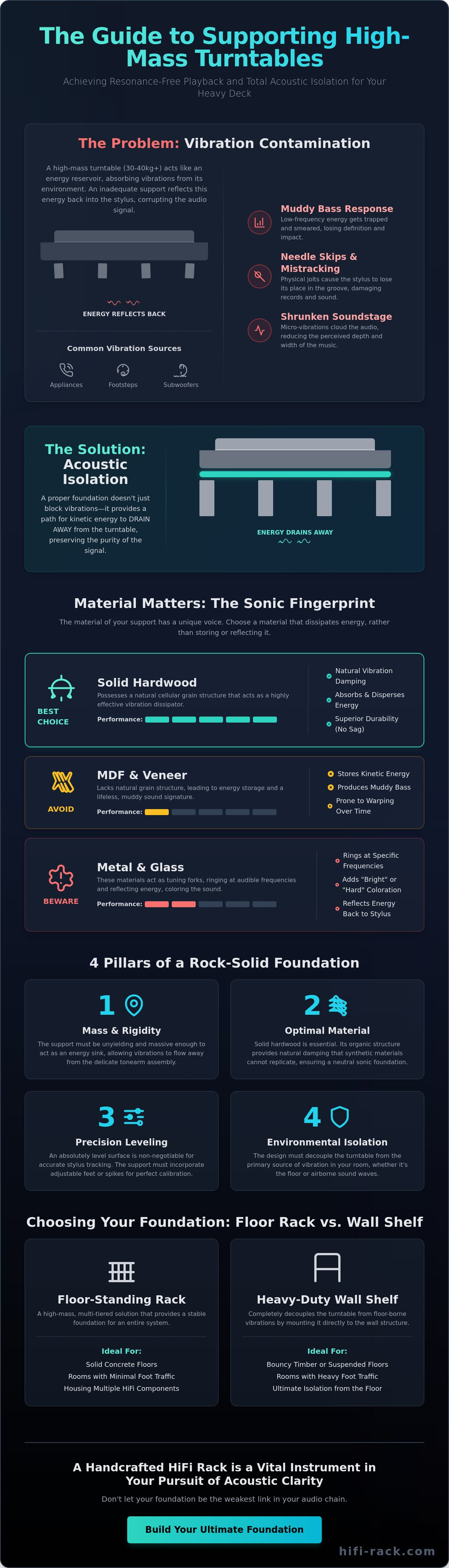
The relationship between a high-mass deck and its environment is a study in The Structural Physics of High-Mass Analog Playback. When you place a 30kg or 40kg platter on a surface, you aren't just managing static weight. You're managing kinetic energy. High-mass turntables are designed to maintain speed through inertia, but that same mass makes them incredibly effective at absorbing and storing external vibrations. Finding the best support for a heavy turntable means finding a foundation that prevents this energy from reflecting back into the stylus.
While many enthusiasts suggest soft rubber feet or gel pads, these often fail the high-inertia test. Soft materials might block high-frequency chatter, but they can't evacuate the massive low-frequency energy trapped in a heavy plinth. True performance requires a path for drainage rather than just isolation. A rigid, massive foundation allows vibrations to flow away from the delicate tonearm assembly. If the support is weak, the tonearm loses its microscopic tracking accuracy, and the music loses its soul.
To better understand how the right foundation affects the listening experience, watch this helpful video:
Mass vs. Resonance: The Heavy Deck Dilemma
High-mass decks are beautiful energy reservoirs. They store resonance longer than lightweight models. If the support structure lacks structural rigidity, the deck will oscillate at a frequency that interferes with the stylus-to-groove relationship. Bouncy supports are the enemy of high-inertia playback. They create a feedback loop that blurs the transients and softens the impact of the low end. We believe the best support for a heavy turntable must be unyielding, acting as a silent partner to the turntable’s own mechanical design.
Identifying Your Environment’s Vibration Profile
Every room has a unique sonic signature that dictates your support needs. Bouncy timber floors act like drumheads, amplifying every footstep into a seismic event for your deck. Rigid concrete slabs are more stable, but they still carry low-frequency feedback from subwoofers directly into the heavy plinth. Micro-vibrations are the nearly invisible tremors from household appliances and nearby traffic that cloud the background of your music and shrink the perceived depth of the soundstage. Identifying these factors is the first step toward achieving total acoustic isolation with a Reference HiFi Rack.
Evaluating Materials: Why Solid Hardwood Outperforms the Rest
Every material has a voice. In high-fidelity audio, we call this the sonic fingerprint. When searching for the best support for a heavy turntable, the material choice isn't just about weight capacity. It's about how that structure manages the energy passing through it. Glass is reflective and bright. Metal often acts as a tuning fork, ringing at specific audible frequencies that color your music. I've found that these materials often fight against the turntable rather than supporting its purpose.
We strictly avoid MDF and veneer. These materials lack a natural grain structure, which leads to energy storage and a muddy bass response. They feel dead because they are. In contrast, solid hardwood possesses an internal cellular structure that acts as a natural vibration dissipator. This isn't just a subjective preference; it's grounded in acoustics and vibration research. The organic nature of wood allows it to absorb and disperse micro-vibrations that would otherwise reach your stylus.
Durability is another cornerstone of our philosophy. A high-mass system, often weighing 100kg or more when fully loaded with records and electronics, requires a foundation that won't sag or warp over decades. Solid wood provides the structural integrity needed for a lifetime of listening. It is a material that ages with grace, much like the music it helps preserve.
The Problem with MDF and Metal
MDF is essentially compressed dust and glue. It has no path for energy to travel. This causes resonance to linger, blurring the transients in your favorite recordings. Metal racks, while strong, have high Q-factors. They ring. This ringing introduces a subtle harshness into the signal path that can fatigue the ear over time. We believe your foundation should be silent, providing a neutral stage for your equipment to perform. By choosing non-resonant materials, you ensure that the only character you hear is that of your records.
The Hardwood Advantage: Walnut, Oak, and Ash
Premium hardwoods like Walnut, Oak, and Ash offer specific density profiles that are ideal for audio use. Their complex, organic fibers ground the turntable to the floor, effectively evacuating unwanted energy. This grounding is vital for maintaining the microscopic stylus-to-groove relationship we discussed earlier. These materials aren't just functional. They provide a visual harmony that complements the craftsmanship of high-end analog gear. If you're ready to elevate your listening experience, our Classic HiFi Rack provides the organic foundation your music deserves.
4 Essential Criteria for the Best Heavy Turntable Support
Selecting the best support for a heavy turntable requires a shift from aesthetic appreciation to engineering rigor. While the beauty of solid wood is undeniable, its performance is measured by how it handles the immense pressure of high-mass components. A high-end deck doesn't just sit. It exerts a constant downward force that can compress inferior materials, leading to energy reflection. I've found that four specific criteria define a truly reference-grade foundation.
First, consider structural integrity. A support should ideally handle twice the weight of the turntable it holds. This 2:1 ratio ensures the wood remains within its elastic limit, allowing it to dissipate energy rather than storing it as tension. Second, precision leveling is non-negotiable. Even a 1% tilt can cause uneven bearing wear and disrupt the delicate anti-skate settings of your tonearm. Third, the strategy of coupling vs decoupling must be addressed. For high-mass decks, coupling the turntable to a massive solid wood shelf via spikes is often superior to "soft" decoupling; it provides a direct path for energy drainage. Finally, modularity allows your foundation to grow as you add external power supplies or second tonearms.
Step 1: Calculating Your Total Load Capacity
Don't just weigh the plinth. You must account for the external motor, the heavy platter, and the phono stage if it shares the shelf. While a total rack limit is helpful, the individual shelf loading limit is the critical metric. Reference-grade audio furniture, like our Reference HiFi Rack, is engineered to support substantial loads. These tiers often support over 70kg without compromise. This overhead is what preserves the silent background in your music.
Step 2: Mastering the Level
A heavy platter acts like a gyroscope. If it isn't perfectly level, the stylus will favor one side of the groove wall, introducing distortion and premature record wear. I recommend using precision-machined spikes that allow for micron-level adjustments. This ensures your system remains perfectly horizontal even on uneven floors. You can find detailed steps on how to level your modular HiFi Rack to ensure you're extracting every bit of performance from your investment. A level deck is a happy deck, and a happy deck delivers the truth of the recording.
Wall Shelves vs. Floor Stands: Which foundation wins?
The choice between a wall shelf and a floor stand isn't just about space. It's about the physics of your home. I often suggest the "Footfall Test" to my clients. If your needle jumps or the bass muddies when you walk across the room, your floor is acting like a trampoline. In these cases, even the best support for a heavy turntable cannot overcome the kinetic energy of a suspended timber floor. You must decouple the system from the floor entirely to find peace in your playback.
Wall-mounting a 40kg turntable is a significant structural commitment. It requires mounting directly into load-bearing masonry or deep into solid timber studs. A standard anchor will fail under the constant stress of a high-mass platter. When executed correctly, a wall shelf bypasses floor-borne vibrations entirely. It provides a silent, immovable stage. For a deeper look at these specialized solutions, I recommend reading The Ultimate Guide to Turntable Isolation Platforms and Shelves.
However, floor-standing racks offer their own unique advantages. A massive vertical pillar design provides a "mechanical sink" for internal vibrations. These racks use their own weight to anchor the turntable, creating a stable center of gravity that resists external movement. For those with concrete floors, a floor stand is often the superior choice. It allows for easier access and a more commanding presence in the listening room.
When to Choose a Wall-Mounted Shelf
If you live in a historical home with flexible floor joists, the wall is your best friend. By anchoring your deck to the primary structure of the building, you eliminate the "swing" of the floor. This setup is essential for maintaining the microscopic stylus-to-groove relationship I've emphasized throughout this guide. It ensures your listening experience remains uninterrupted by the movement of others in the house. It's a professional solution for a common architectural problem.
The Power of the Reference Floor Rack
A dedicated floor stand, like our Reference HiFi Rack, uses spiked feet to pierce through carpet and reach the solid subfloor. This direct coupling allows energy to drain away from the turntable and into the earth. The massive solid wood pillars act as a buffer, absorbing micro-vibrations before they can reach the sensitive tonearm. It's a solution built for longevity and uncompromising performance. If you're seeking the ultimate foundation for your high-mass system, I invite you to view our collection of handcrafted HiFi Racks.
Crafting the Ultimate Foundation: The HiFi Rack Approach
In our Serbian workshop, we honor a multi-generational legacy of woodworking. It's a place where time slows down. Here, we don't just build furniture; we create instruments of silence. Providing the best support for a heavy turntable requires more than just thick planks. It requires an intimate understanding of how organic fibers respond to the weight of a high-mass deck. Our "No MDF, No Veneer" pledge isn't a marketing slogan. It's a commitment to pure acoustic performance. We know that these composite materials act as barriers to energy drainage, trapping resonance within the shelf. By using only solid hardwood, we ensure that every vibration has a natural path to the ground.
Every high-mass turntable has its own story and its own footprint. A standard shelf rarely suffices for a 50kg platter or an oversized plinth. We offer bespoke dimensions to ensure your deck sits perfectly centered, both physically and sonically. This tailoring is part of our definitive promise: the union of performance and aesthetics. It's a philosophy that transforms your listening room into a personal sanctuary where every detail is intentional. When your equipment is supported by a foundation that matches its engineering, the music finally breathes.
Reference vs. Classic: Choosing Your Performance Tier
Choosing between our tiers depends on the demands of your system. Our Reference series is engineered for extreme mass. It provides the maximum isolation needed for the world's most ambitious analog front-ends. For standard high-end systems that still demand organic clarity, our Classic series offers a balanced foundation. You can explore these custom configurations in our Shop to find the right match for your collection. Each piece is built to order, ensuring it meets the specific needs of your environment. We believe the rack should be as uncompromising as the turntable itself.
The Longevity of Solid Wood
Solid hardwood is a lifetime investment. Unlike mass-produced alternatives, it ages with grace. Premium Walnut and Oak develop a deeper character over the decades, mirroring the timeless nature of your record collection. Maintenance is simple, requiring only occasional care to preserve the wood's natural luster. This is more than a purchase; it's an heirloom for your audio sanctuary. It's a commitment to a life-altering passion. We invite you to Explore our handcrafted Reference Racks and discover the transformative effect of a true structural foundation. Your music deserves nothing less than perfection.
Elevate Your Analog Sanctuary
Supporting a high-mass deck is a commitment to the truth of your music. We've explored how structural rigidity and energy drainage outperform soft isolation. You now understand that the best support for a heavy turntable must be as uncompromising as the instrument it holds. By choosing solid hardwood over resonant metals or lifeless MDF, you provide a neutral stage for every microscopic detail to emerge. Your system deserves a foundation that respects the physics of sound while honoring the beauty of your home.
Our Reference HiFi Rack is the culmination of this philosophy. Handcrafted in Serbia from premium solid hardwood, these foundations are tested with the world's heaviest high-end decks to ensure total acoustic isolation. We offer bespoke manufacturing tailored to your equipment's specific dimensions, ensuring a perfect union of form and function. Discover the Reference Series: The Ultimate Foundation for Heavy Turntables.
It's time to let your records breathe. Reclaim the clarity, depth, and soul of your analog collection with a foundation built for a lifetime of sensory perfection.
Frequently Asked Questions
Why does a heavy turntable need a different support than a light one?
High-mass turntables require a foundation capable of managing immense kinetic energy rather than simply holding weight. While a lightweight deck might rely on internal suspension to block vibrations, a heavy platter stores resonance deep within its structure. Without a rigid, massive foundation to evacuate this energy, those stored vibrations reflect back into the stylus. This ruins the soundstage and softens the impact of your low end.
Can I use a granite slab on a standard rack for a heavy turntable?
Granite is a highly reflective material that lacks the internal damping properties required for high-fidelity playback. While it adds mass, it often behaves like a mirror for vibrations, bouncing energy back into the turntable plinth. This leads to a hard or sterile sonic character. A dedicated solid wood shelf provides a superior path for energy drainage, ensuring the best support for a heavy turntable and a more natural presentation.
How do I know if my floor is too bouncy for a floor-standing rack?
You can identify a problematic floor by performing a simple footfall test near your equipment. If your turntable needle skips or you hear a low-frequency thump through your speakers when walking, your floor joists are likely too flexible. In these environments, a wall-mounted shelf anchored to a load-bearing wall is the ideal solution. It bypasses the floor's movement entirely to provide an immovable, silent stage for your records.
Is solid wood really better for sound than metal or glass?
Solid wood is acoustically superior because its complex cellular structure naturally dissipates micro-vibrations. Metal racks often ring at audible frequencies, acting like tuning forks that color the signal path. Glass is highly reflective and can introduce a bright, fatiguing edge to the music. Premium hardwoods like Walnut and Oak offer a neutral, organic foundation that preserves the warmth and integrity of the original recording.
What is the maximum weight a Reference HiFi Rack can support?
Our Reference HiFi Rack is engineered to support the world's most substantial high-mass decks. Each tier is built to handle loads exceeding 70kg without structural compromise or shelf bowing. This high weight capacity ensures the wood remains within its optimal damping range. It provides a silent and stable stage for even the heaviest platters and external motor assemblies, ensuring your investment remains secure for a lifetime.
Do I need isolation feet if I have a high-quality solid wood rack?
A high-quality solid wood rack provides the primary drainage path for energy, often making soft isolation feet unnecessary. Adding squishy feet can sometimes decouple the turntable too much, preventing the rack from acting as a mechanical sink. However, precision-machined spikes are excellent for fine-tuning the leveling. These rigid points ensure a direct connection for the best support for a heavy turntable while maintaining the microscopic stylus-to-groove relationship.
How does humidity affect solid wood audio furniture?
Solid wood is a living material that breathes with its environment. While premium hardwoods are seasoned to ensure stability, significant shifts in humidity can cause the wood to expand or contract slightly. We recommend maintaining a stable environment in your listening room to protect both your records and your furniture. This natural movement is a hallmark of authentic, raw materials and does not affect the rack's long-term structural integrity or acoustic performance.