What if the very foundation of your audio system is secretly blurring the music you love? It is a common realization for enthusiasts who find their soundstage lacking depth or their turntable prone to feedback on bouncy floors. Learning how a solid wood hifi rack reduces vibration is the first step toward reclaiming the purity of your recordings and lowering that stubborn noise floor. I believe your furniture should be as refined as your electronics, yet many listeners settle for ringing glass or resonant metal that introduces micro-distortions into the signal path.
In this article, you will discover the mechanical science behind solid hardwood isolation and how it purifies your audio signal by eliminating parasitic resonances. We will explore why the organic cellular structure of timber acts as a natural mechanical filter, which is a stark contrast to the way synthetic MDF reflects energy back into your gear. From our Reference HiFi Rack to our Slim designs, you will see how a commitment to artisanal craftsmanship and technical performance transforms your listening room into a true sanctuary of sound.
Key Takeaways
- Identify the invisible enemy of micro-phonics and understand how physical stability lowers the noise floor to reveal hidden musical details.
- Uncover the organic science behind how a solid wood hifi rack reduces vibration through internal friction and cellular energy dissipation.
- Compare the acoustic properties of natural hardwood against synthetic composites to see why MDF often reflects resonance back into your sensitive gear.
- Distinguish between coupling and decoupling techniques to properly ground your system and eliminate the feedback that causes turntable skipping.
- Connect with an artisanal philosophy that favors solid materials and handcrafted integrity over mass-produced, veneer-covered alternatives.
Understanding the Invisible Enemy: Micro-Distortions and the Noise Floor
In the pursuit of sensory perfection, we often focus on the visible components: the glowing tubes, the polished platters, and the intricate wiring. Yet, a silent saboteur often lingers beneath these instruments. Micro-phonics is the technical term for a simple but destructive phenomenon where physical vibrations are converted into electrical noise within your audio circuits. When your equipment vibrates, even at a microscopic level, it introduces a ghost-like signal that competes with your music. This interference raises the "noise floor," a threshold of background hum and haze that obscures the delicate textures and low-level details of a recording. To hear the breath of a vocalist or the trailing decay of a piano note, your system requires absolute physical stillness.
Vibrations reach your gear from two primary directions. Floor-borne or seismic vibrations travel through the structure of your home, often caused by footfalls, traffic, or even the hum of a nearby refrigerator. Air-borne vibrations, known as Acoustic resonance, occur when the sound waves from your speakers physically strike your equipment. Without a dedicated strategy for isolation, these forces turn your sensitive electronics into unintended microphones. Understanding how a solid wood hifi rack reduces vibration is essential because it addresses both of these pathways, acting as a sophisticated mechanical filter that keeps the signal path pure.
To better understand this concept, watch this helpful video:
Acoustic Feedback and the Turntable Struggle
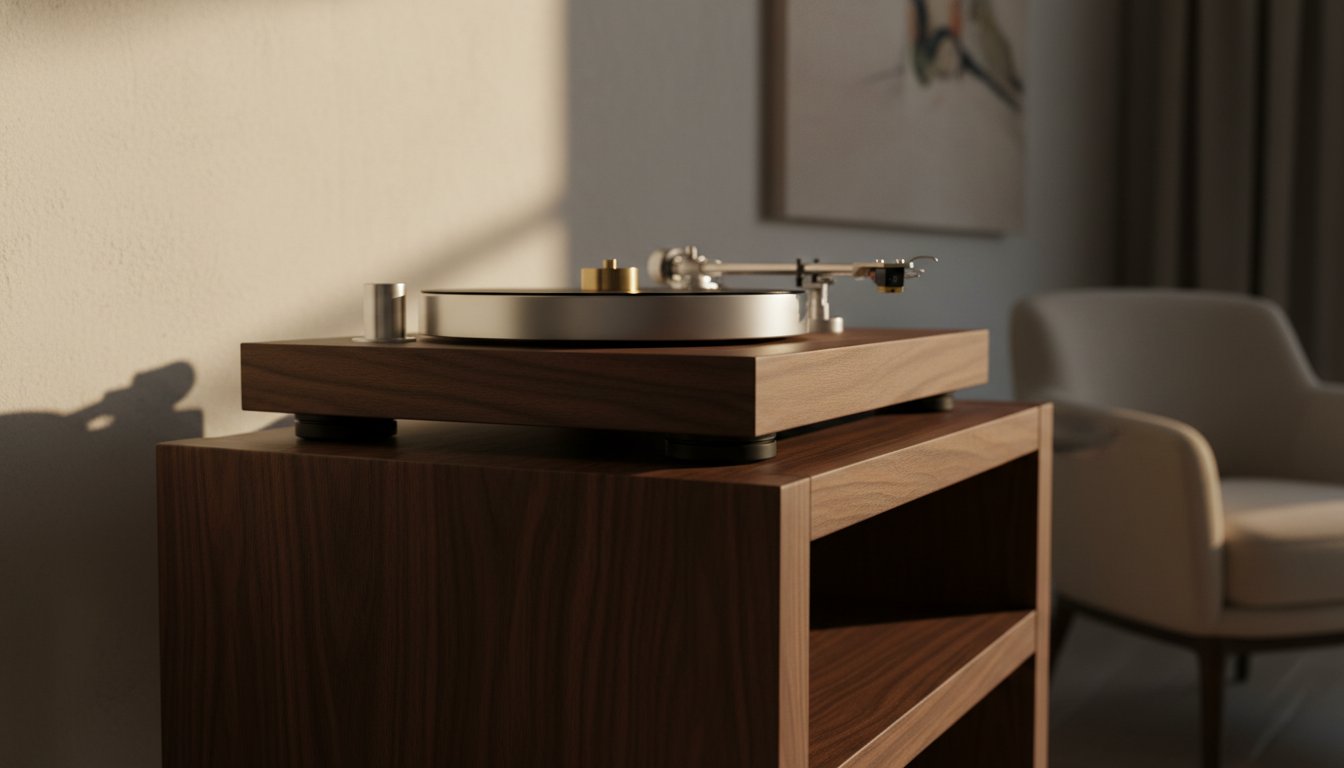
For the analog enthusiast, the turntable is the most vulnerable point in the chain. The stylus is designed to detect microscopic grooves in vinyl, making it a highly sensitive vibration sensor. When floor vibrations reach the platter, they create a muddy low-end response and a loss of rhythmic precision. A Reference HiFi Rack provides the heavy, non-resonant foundation needed to break the feedback loop between your speakers and the record player. This solid wood base ensures that the only movement the stylus tracks is the music itself.
Micro-phonics in Solid-State Electronics
It is a common misconception that only turntables or vacuum tubes suffer from mechanical interference. In reality, digital-to-analog converters (DACs) are highly susceptible to "jitter" caused by mechanical resonance, which disrupts the precise timing of digital signals. Even massive solid-state amplifiers benefit from a stable support. Internal components like capacitors and resistors can exhibit micro-phonic behavior when agitated, adding a layer of electronic "grain" to the sound. By choosing a supporting structure that prioritizes organic damping, you ensure that every component in your system operates at its peak potential.
The Physics of Resonance: Why Solid Hardwood Acts as a Mechanical Filter
The effectiveness of any support system lies in its ability to manage energy. While metal or glass might offer structural stability, they often suffer from high resonance; they essentially act as tuning forks for your equipment. Understanding how a solid wood hifi rack reduces vibration requires a look into the microscopic architecture of the timber itself. At a cellular level, hardwood is composed of tracheids and vessels. These organic structures do more than transport nutrients. They function as a vast network of microscopic shock absorbers. When mechanical energy enters the wood, these cells flex and compress, absorbing the impact before it can reach your sensitive electronics.
This process is known as internal friction. Instead of allowing energy to bounce back into your gear, the wood converts kinetic vibration into trace amounts of heat. This dissipation is vital for mitigating the effects of vibration on high-end audio, where even the smallest resonance can color the sound. Wood is also anisotropic, meaning its physical properties vary depending on the direction of the grain. This allows the rack to steer energy away from the component feet and toward the floor, providing a natural path for mechanical grounding. By utilizing the natural growth patterns of the tree, we create a filter that synthetic materials simply cannot replicate.
Energy Dissipation vs. Energy Storage
In audio engineering, we often discuss the Q-factor, which describes how long a material continues to ring after being struck. Metals have a high Q-factor, storing energy and releasing it slowly. Hardwood possesses a low Q-factor, meaning it dampens energy almost instantly. Because natural grain has varied density, it prevents the rack from having a single, dominant resonant frequency. Mechanical impedance is the measure of how much a structure resists motion when subjected to a given harmonic force. By matching the impedance of your equipment to the natural damping of solid wood, you create a harmonious environment for signal processing.
The Sonic Signature of Hardwood
Each species of timber brings its own character to the listening experience. Oak is prized for its immense density and grounding presence, while Walnut is often favored for its ability to add a sense of organic warmth. Ash, being slightly more elastic, can provide a faster, more detailed response. I believe in using solid sections of these materials rather than thin strips or laminates. A HiFi Rack from our workshop strictly avoids veneer because thin decorative layers don't provide the same mechanical filtration as a solid board. If you're ready to experience the difference that organic materials make, you might explore our Classic HiFi Rack for your primary system.

Solid Wood vs. MDF: Why Composite Materials Fall Short for High-End Audio
Many enthusiasts assume that because MDF is a standard material for speaker cabinets, it must be the ideal choice for an equipment rack. This is a fundamental misunderstanding of mechanical requirements. While a speaker enclosure needs to be inert to prevent cabinet coloration, an equipment support must act as a conduit for energy. MDF is essentially wood dust suspended in a high volume of synthetic resin. This uniform density creates a reflective energy path. Instead of dissipating vibrations, the high resin content in MDF often bounces them back into the sensitive feet of your components, muddying the signal you've worked so hard to refine.
Understanding how a solid wood hifi rack reduces vibration involves recognizing the difference between energy storage and energy dissipation. Scientific research into the acoustic vibration performance of wood shows that natural fibers possess a unique ability to absorb harmonic energy through internal friction. Composite materials like MDF lack the intricate cellular tracheids found in real timber, leading to what many describe as a "dead" or lifeless sound. By over-damping the system with synthetic glue and compressed fibers, you risk stripping the music of its natural bloom and micro-dynamic detail. Solid wood allows the music to breathe, providing stability without sacrificing the soul of the performance.
The Structural Integrity of Real Timber
Beyond acoustics, the physical longevity of your sanctuary matters. MDF is prone to a phenomenon known as "creep," where the material permanently deforms under constant pressure. Heavy class-A amplifiers or massive power supplies can cause composite shelves to sag over time, compromising the level foundation your turntable requires. Solid oak and walnut possess a superior load-bearing capacity. They maintain their form and damping properties for decades. I choose solid timber because it offers a sense of permanence and integrity that mass-produced fiberboard simply cannot match.
Aesthetics and the Audiophile Sanctuary
Your listening room is a personal sanctuary. The materials you surround yourself with have a profound psychological impact on the listening experience. Veneer is often used to hide cheap MDF, but it creates a thin, plastic-like barrier that disrupts the acoustic flow and eventually peels at the edges. I believe that true beauty and technical performance are inseparable. Choosing solid materials is an investment in both your system's sound and your home's character. For a deeper look at these material differences, read The Audiophile’s Guide to Custom Hardwood Audio Furniture to separate common marketing myths from acoustic reality.
Beyond the Material: Structural Rigidity and Isolation Features
While the internal cellular structure of timber provides the filter, the physical architecture of the support system provides the primary defense. A significant part of how a solid wood hifi rack reduces vibration comes down to the law of inertia. Mass matters. A heavy, rigid structure is fundamentally harder to set into motion than a lightweight one. By utilizing thick sections of solid oak or walnut, I ensure the rack possesses the necessary "gravitas" to resist seismic energy. This physical presence creates a stable environment where your components don't have to fight against the swaying or ringing of their own support.
Precision leveling is another critical factor that is often overlooked. For a turntable, a perfectly horizontal surface isn't just about aesthetics; it's a requirement for the longevity of the platter bearing. If a rack is even slightly out of plumb, the bearing wears unevenly, introducing friction and mechanical noise directly into the playback. I design every tier to be independently adjustable, allowing you to achieve a level of precision that protects your investment and ensures the stylus tracks the groove with absolute symmetry.
The Role of Brass Spikes and Floor Protectors
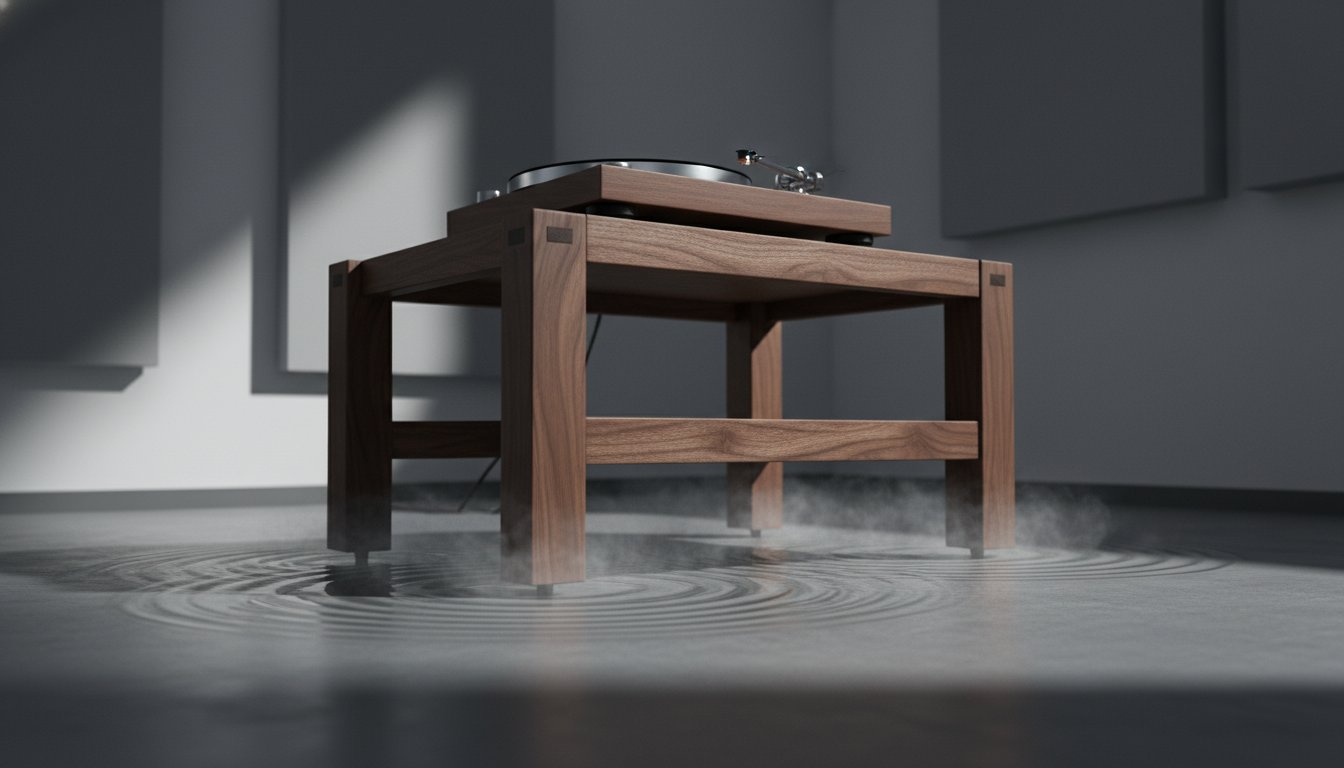
Isolation is a game of management rather than simple elimination. We use solid brass spikes to create high-pressure contact points that effectively "drain" energy from the rack into the floor. This is a form of mechanical grounding. By concentrating the weight of the system onto a tiny surface area, we prevent floor-borne vibrations from traveling back up into the shelves. It is a sophisticated way to decouple the music from the room's own resonances. For a deeper exploration of this mechanic, see Speaker Feet and Acoustic Isolation: The Complete Audiophile Reference.
Modular vs. Fixed Construction
I believe that a fixed, one-piece rack is a missed opportunity for isolation. In a modular design, each shelf is an independent unit, physically separated from the one below it. This "breaks" the vertical path of vibration, making it much harder for the hum of a power amplifier on the bottom shelf to reach the sensitive DAC or turntable at the top. The Reference HiFi Rack utilizes this independent shelving system to ensure maximum isolation between components. This modularity also allows you to customize shelf spacing, providing the airflow needed to maintain thermal stability for high-bias equipment. If you're ready to elevate your system's performance, you can view our full collection of handcrafted racks to find the perfect match for your listening room.
Investing in Sonic Purity: The HiFi Rack Philosophy
I view the equipment rack not as an accessory, but as the very foundation of the signal chain. Choosing a support system is a declaration of your commitment to the music. My philosophy is simple: no MDF, no veneer, and no compromises. By focusing on the raw, organic beauty of solid hardwood, I ensure that every piece serves a technical purpose. Understanding how a solid wood hifi rack reduces vibration is about more than just physics; it is about the reverence we hold for the art of listening. When you remove the parasitic resonances that blur your soundstage, you are left with the pure, unadulterated intent of the artist.
Each rack is handcrafted in our workshop in Novi Sad. Here, we bridge multi-generational woodworking traditions with the exacting needs of modern high-fidelity audio. This isn't mass production. It's a deliberate, slow process that respects the material and the listener. We treat every shelf as a high-performance audio component, engineered to last a lifetime. This dedication to longevity is our version of sustainability and responsibility. We build furniture that you will never need to replace, ensuring your personal sanctuary remains undisturbed for decades. We don't just build racks; we build legacies of sound.
Choosing Your Foundation: Reference, Classic, or Slim?
Selecting the right support depends on the scale of your ambition and the constraints of your room. For those with ultimate systems where every micro-detail counts, the Myro Reference offers the highest level of mass and modular isolation. If you seek a balanced blend of sculptural form and acoustic function, the Myro Classic provides a timeless aesthetic without sacrificing performance. In space-constrained listening rooms, the Myro Minimal, also known as our Slim HiFi Rack, delivers the same solid wood benefits in a more compact, punchy footprint.
The Final Step: Protecting the Analog Signal
Even with a world-class rack, the most sensitive components benefit from an extra layer of defense. A Turntable Isolation Platform is the ultimate upgrade for the analog purist. It acts as a final barrier, ensuring the stylus remains isolated from the last vestiges of environmental resonance. This harmony between artisanal craft and high-fidelity sound is what we strive for in every piece we create. I invite you to explore our full range of solid wood HiFi racks and discover how a dedicated foundation can transform your relationship with the music you love.
Reclaiming the Soul of Your Music
The journey toward high-fidelity perfection often leads back to the very foundation of your system. We've examined the silent battle against micro-phonics and the technical reasons why synthetic materials often fall short. Understanding how a solid wood hifi rack reduces vibration is the final piece of the puzzle for many enthusiasts. By utilizing the natural damping properties of real timber, you transform your equipment support into a vital mechanical filter. This filter protects the delicate integrity of your audio signal and reveals the hidden textures within your favorite recordings.
Our workshop in Serbia continues to uphold a strict zero MDF and zero veneer policy. We draw upon a multi-generational woodworking heritage to ensure every rack meets the "Reference" standard of engineering. This commitment to solid materials ensures your sanctuary is free from the muddy reflections and structural sagging of mass-produced alternatives. If you're ready to lower your noise floor and experience the full potential of your system, please browse our collection of handcrafted solid wood HiFi racks. Your passion for sound deserves a foundation that is as uncompromising as the music itself.
Frequently Asked Questions
Is solid wood really better than metal for a HiFi rack?
Solid wood is superior because it possesses natural damping properties that metal lacks. While metal structures often have a high Q-factor and ring like a tuning fork, the cellular structure of hardwood absorbs energy. This organic architecture converts kinetic vibration into trace amounts of heat through internal friction, preventing resonance from reaching your sensitive audio components.
Does the type of wood actually change the sound?
The density and grain structure of different species definitely influence the final sonic character. Oak provides a grounded, authoritative presence due to its immense density. Walnut is often favored for its organic warmth and rich tonal balance. Ash tends to offer a faster, more detailed response, allowing you to tailor the rack to your system's specific needs.
Why shouldn’t I just use a regular bookshelf for my audio equipment?
Standard furniture lacks the structural rigidity and mass required to manage high-fidelity resonance. Most bookshelves are made of thin, resonant materials like MDF or plywood that act as sounding boards for vibration. A dedicated rack is engineered as a technical instrument, providing independent shelving and mechanical grounding that a common bookshelf simply cannot provide.
Do digital components like DACs really need vibration isolation?
Digital components are highly susceptible to jitter caused by mechanical interference. When you understand how a solid wood hifi rack reduces vibration, you see that even DACs and streamers benefit from a lower noise floor. Removing micro-phonics from the digital signal path improves timing, spatial imaging, and the overall clarity of the conversion process.
How do spikes help reduce vibration in a wooden rack?
Spikes create high-pressure contact points that act as a mechanical drain for unwanted energy. By concentrating the weight of the rack onto a tiny surface area, they effectively decouple the system from the floor. This prevents seismic vibrations from entering the rack while allowing internal resonances to exit into the ground, ensuring a pure signal.
Can a solid wood rack help stop my turntable from skipping?
A massive, solid wood foundation is the most effective way to stabilize a sensitive turntable. By providing a non-resonant platform, the rack breaks the feedback loop between your speakers and the stylus. This is especially critical on bouncy wooden floors where footfalls or low-frequency energy can easily cause the needle to jump or mistrack.
Is MDF better than solid wood because it is more consistent?
MDF is consistent only in its ability to reflect energy back into your gear. The high resin and glue content in composite boards creates a uniform path that allows vibrations to bounce rather than dissipate. Solid wood's varied natural density is actually an advantage, as it prevents the structure from having a single, dominant resonant frequency that colors the sound.
How do I know if my current rack is causing micro-distortions?
If your soundstage feels "hazy" or you lose fine musical detail at higher volumes, your rack may be the culprit. A simple test is to gently tap the shelf while music is playing; if you hear a ringing or hollow thud through your speakers, the rack is introducing micro-phonics. Upgrading to a solid wood hifi rack reduces vibration and immediately clarifies these obscured details.