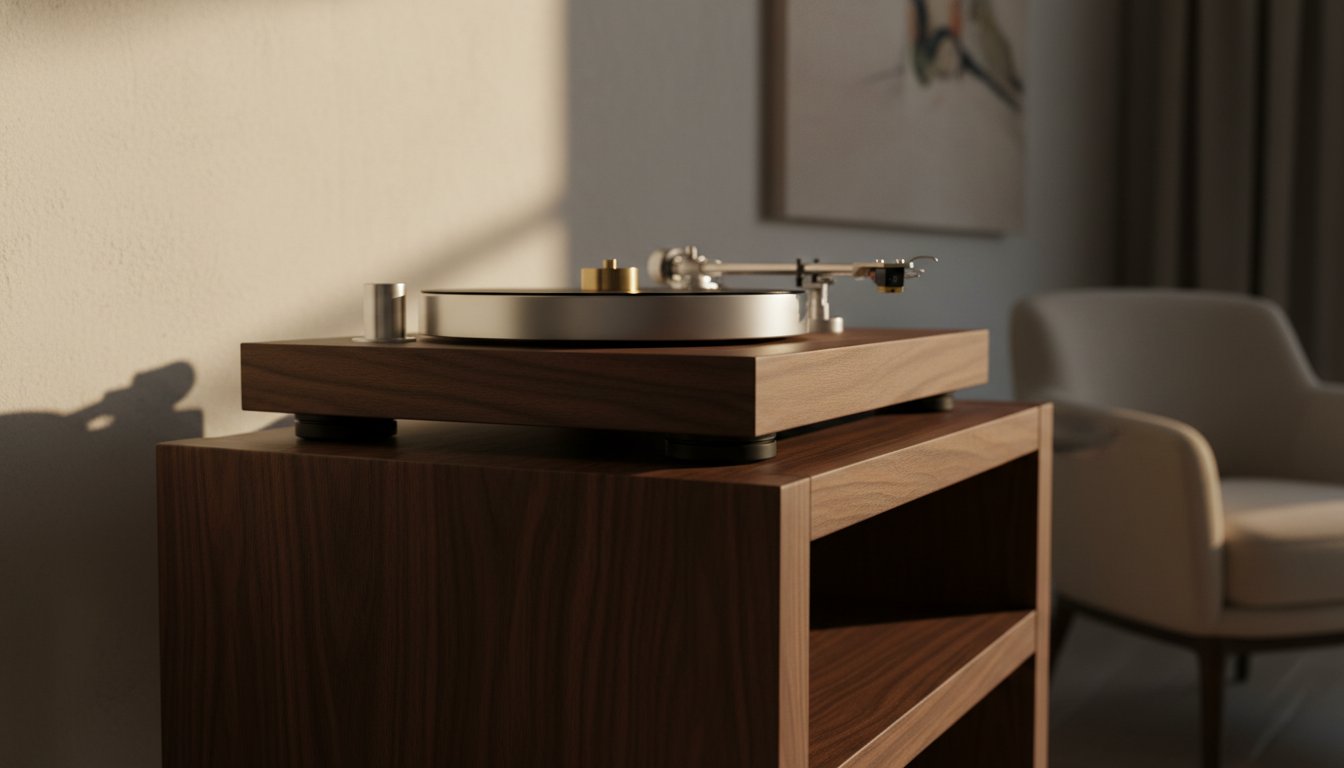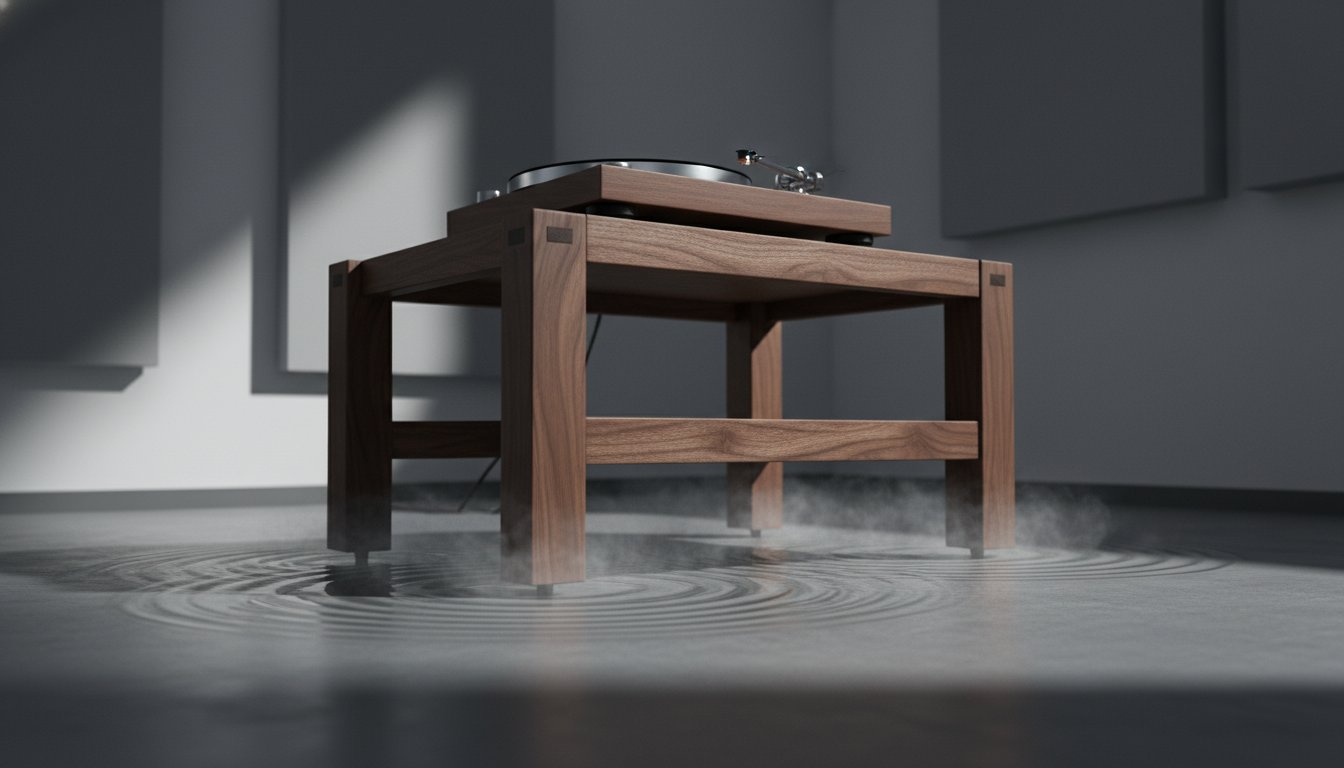
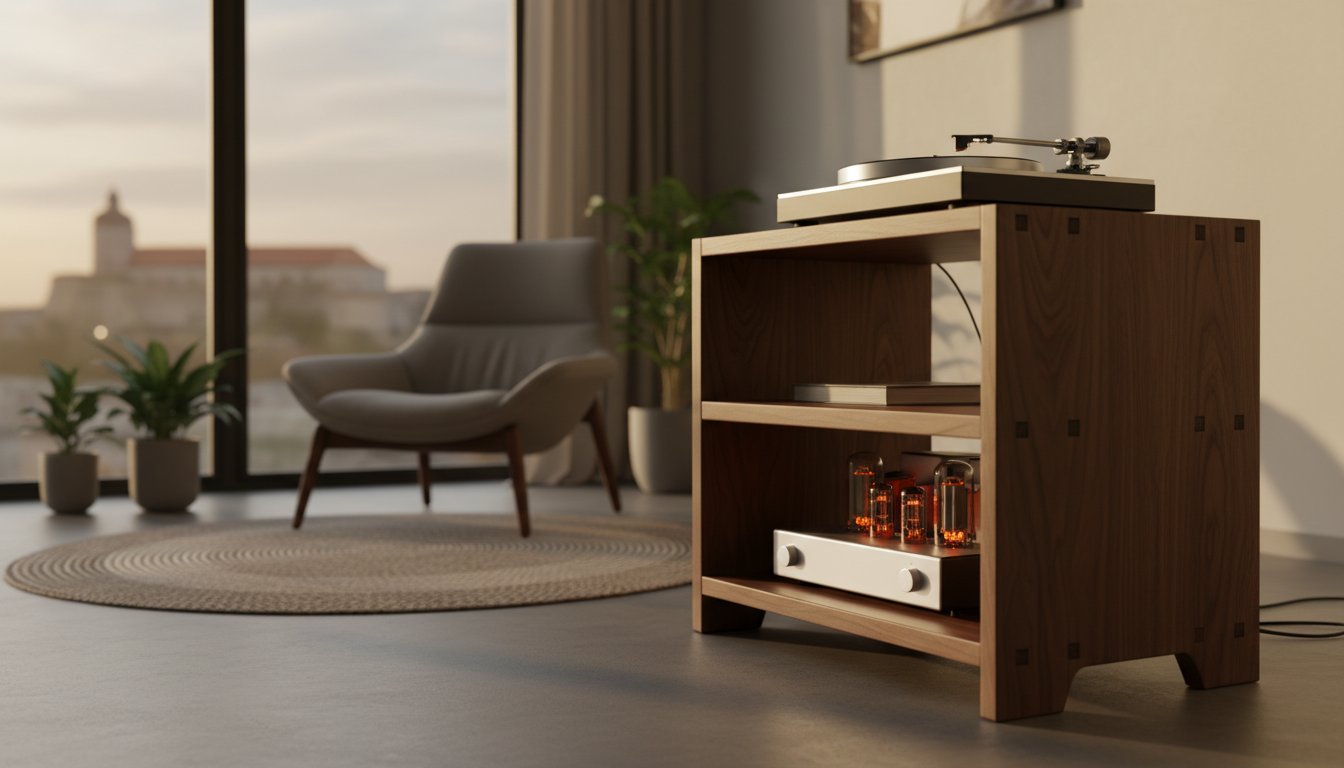
What if the most critical component in your signal chain isn't made of circuits or wires, but of organic, kiln-dried timber? You've likely spent years curating a system that captures every nuance of a recording. It's deeply frustrating when micro-vibrations from a hollow, mass-produced shelf result in muddy bass or a skipping needle on your favorite LP. Choosing custom hardwood audio furniture is a decision to treat your equipment with the reverence it deserves while grounding your system in natural stability.
We agree that your listening room is a personal sanctuary where sound and style must be one. This guide will prove that solid wood is a structural requirement rather than a luxury, as its internal cellular structure can provide significantly better damping than glass or metal. You'll gain a clear framework for designing a rack that fits your specific component dimensions perfectly. Let's explore the technical reality behind the artisanal craft and help you live your passion with total confidence in a piece built for a lifetime.
Key Takeaways
- Identify the "silent enemy" of acoustic resonance and learn how the right structural foundation lowers your noise floor for a purer listening experience.
- Uncover the technical truth behind the MDF myth and why solid hardwood is essential for preventing the energy storage that leads to sonic muddiness.
- Master the principles of mass and isolation to choose custom hardwood audio furniture that provides a rock-solid foundation for your most sensitive components.
- Follow a practical guide to planning your bespoke environment, accounting for everything from future gear upgrades to critical heat ventilation.
- Connect with the heritage of handmade craftsmanship where sound and style become one, creating a lasting sanctuary for your musical passion.
The Silent Enemy of High-Fidelity Sound: Understanding Resonance
Resonance isn't a mystical concept. It's a measurable physical phenomenon that dictates the clarity of your music. Acoustic resonance describes how a physical object vibrates when exposed to specific frequencies. In a dedicated listening room, your furniture becomes an extension of your components. If that furniture lacks the proper mass or damping, it vibrates along with the music, adding a layer of sonic "smog" to your experience.
The noise floor is your system's baseline. A high noise floor masks the subtle decay of a piano note or the breath of a vocalist. Vibrations reach your gear through two primary channels: airborne sound waves from your speakers and floor-borne mechanical energy from footfalls or external traffic. A heavy, solid rack serves as a sink for this unwanted kinetic energy, draining it away before it can reach sensitive circuits. This is why custom hardwood audio furniture is a fundamental upgrade for any serious listener.
To better understand the structural integrity required to manage these forces, watch this demonstration of artisanal woodworking:
A high-quality rack doesn't just hold your gear; it manages the flow of energy. By using custom hardwood audio furniture, you create a deliberate path for internal vibrations to exit the component. This balance of mass and stability is the hallmark of a truly authentic listening environment. It's the difference between hearing a recording and experiencing a performance.
How Vibrational Interference Degrades Your Listening Experience
The stylus of a turntable is a microscopic transducer measuring movements as small as 0.1 microns. When external vibrations hit the plinth, the stylus picks them up, causing "smearing" and a loss of rhythmic timing. Vacuum tubes also face challenges. They are prone to microphony, where internal elements vibrate and create audible ringing artifacts. Even digital-to-analog converters suffer. High-frequency vibrations can interfere with crystal oscillators, leading to jitter and a collapsed soundstage.
The Difference Between Coupling and Decoupling
Coupling involves creating a rigid connection to transfer energy away from the component and into the mass of the rack. Decoupling is the act of isolating a component to block external energy from entering. Most mass-market stands fail to do either effectively. A custom hardwood audio furniture piece provides the organic density needed to absorb energy while maintaining the rigidity required for effective coupling. This dual-action approach ensures your system remains CUSTOM | HANDMADE | NATURAL | AUTHENTIC. Where sound & style are One, the music finally has room to breathe.
Debunking the MDF Myth: Why Solid Hardwood is the Audiophile Standard
The audio industry often markets Medium Density Fiberboard (MDF) as the "acoustically dead" ideal for equipment support. It's a convenient narrative for mass production, but it ignores the physical reality of energy storage. MDF lacks a natural grain structure. Instead, it's a dense composite of wood dust and synthetic resins held together by industrial binders. While it doesn't ring like metal, it acts as a mechanical sponge. It absorbs vibrations from your components and releases them slowly back into the system over time. This creates a time-smeared resonance that seasoned listeners describe as "muddiness" in the soundstage.
In contrast, custom hardwood audio furniture utilizes the complex cellular architecture of living timber to manage vibration. Solid species like Oak, Walnut, and Ash possess internal friction that converts kinetic energy into trace amounts of heat. This process is rooted in the scientific principles of how sound travels through wood, where the longitudinal fibers provide a natural damping effect that synthetic boards can't replicate. Each species offers a unique "sonic signature," allowing the wood to act as a tuning fork for your room's acoustics.
The Structural Failure of Veneers and Particle Board
Veneers are a cosmetic mask. They offer zero structural benefit to vibration isolation. When you buy a veneered MDF shelf, you're placing your high-end equipment on a bed of compressed glue. This material is prone to "creep," a slow deformation under constant load. For example, a heavy 60-pound power amplifier can cause an MDF shelf to bow by 3 to 5 millimeters over a 24-month period. This instability compromises the precise leveling required for sensitive components like turntables. Solid hardwood maintains its flat, rigid profile for decades, ensuring your gear remains perfectly aligned.
Hardwood vs. MDF: A Performance Comparison
The "Q-factor" describes the sharpness of a material's resonance. MDF has a broad, low-Q resonance that colors the sound across a wide frequency range, making it difficult to isolate. Solid hardwood has a more predictable, high-Q resonance that's naturally filtered by the wood's density. Beyond technical performance, there's the question of longevity. MDF degrades if exposed to humidity or weight. It's a disposable solution for a temporary setup. Custom hardwood audio furniture is an investment that matures with your system. It's built with a slow-made philosophy that respects both the raw material and the listener's long-term journey.
If you're ready to move beyond the compromises of synthetic composites, consider how a handcrafted rack can clarify your system's output and bring you closer to the original recording.

The Anatomy of Custom Hardwood Audio Furniture
A reference-grade rack is far more than a place to stack electronics. It's a precision-engineered instrument designed to manage kinetic energy. The structure consists of three vital components: solid pillars, dense shelves, and decoupling isolation feet. Pillars provide the vertical skeleton, while the shelves act as the dampening heart of the unit. In the pursuit of musical perfection, mass is your greatest ally. A rack weighing 50kg or more provides the necessary inertia to ground low-frequency vibrations. This high-mass approach ensures that 60Hz hum and floor-borne resonances don't interfere with the delicate signals in your phono stage or DAC.
Modularity is a core requirement for any evolving system. Audiophiles rarely keep the same configuration for a decade. A modular custom hardwood audio furniture system allows you to adjust pillar heights or add tiers as you transition from integrated amplifiers to massive monoblocks. This flexibility ensures your investment remains "CUSTOM | HANDMADE | NATURAL | AUTHENTIC" regardless of how your gear changes. We generally categorize these builds into two design philosophies. The Reference series focuses on maximum isolation for high-gain components, while the Classic series offers a balanced, timeless profile where sound & style are One.
Selecting the Right Hardwood for Your Acoustic Signature
The choice of timber isn't just about matching your floor. It's about tuning. Oak is the heavy hitter of the woodworking world. With a density of approximately 720 kg/m3, it provides the rigidity required to support 40kg power amplifiers without bowing. Walnut offers a slightly different character; its balanced resonance profile makes it a favorite for those seeking a "sweet" midrange. Research from California Polytechnic State University explores the relationship between wood properties and sound quality, demonstrating how grain structure affects energy dissipation. Ash and Cherry are often chosen for their "speed." These woods transfer energy away from the component quickly, which can help sharpen the transient response of your system.
The Role of Precision Hardware
Hardware is the final frontier of isolation. We use solid brass spikes for high-pressure coupling. Because brass is a non-ferrous alloy, it doesn't store magnetic energy, making it ideal for use near sensitive audio circuits. These spikes concentrate the entire weight of the custom hardwood audio furniture onto a tiny surface area, effectively "locking" the rack to the subfloor. Precision is mandatory here. A turntable must be perfectly level to track a groove accurately; therefore, our hardware allows for leveling adjustments within 0.1 degrees of accuracy. You can find a deeper technical breakdown of these components in our guide on Speaker Feet and Acoustic Isolation. This mechanical integrity ensures that your equipment performs exactly as the manufacturer intended.
Planning Your Bespoke Listening Environment: A Step-by-Step Guide
Creating a sanctuary for sound requires more than just picking a beautiful piece of wood. It's a deliberate process of mapping your current passion while leaving room for future growth. Start by performing a rigorous inventory of your equipment. Don't just measure the components you own today. If you plan to upgrade to 50kg monoblocks or a heavy-mass turntable next year, your custom hardwood audio furniture must be engineered to support that evolution. A bespoke build is a lifetime investment, and it should never be outgrown by your ambition.
Structural integrity is the silent partner of acoustic performance. When you calculate the total system weight, you might find your gear exceeds 150kg. Solid hardwood provides the natural density needed to remain inert under these loads, preventing the micro-vibrations that can muddy a soundstage. Ergonomics also play a vital role. Set your turntable at a height of approximately 90cm to ensure comfortable operation, and keep eye-level displays at 100cm to maintain a natural posture during long listening sessions.
Measuring for Success: Beyond the Chassis
Precision in a listening room goes beyond the width of a faceplate. You must account for the "Cable Room" Rule. Always ensure at least 10cm of depth exists behind your deepest component. High-end interconnects are often rigid; forcing them into tight bends can degrade signal quality or damage delicate RCA and XLR ports. Proper spacing allows your cables to hang naturally, maintaining the purity of the signal path.
Heat dissipation is equally critical. A high-bias Class A amplifier can reach internal temperatures of 60 degrees Celsius. Without a vertical gap of at least 15cm above the unit, heat builds up and shortens the lifespan of internal capacitors. You can browse the shop to see how our various tier heights accommodate these thermal requirements. Airflow is non-negotiable for equipment longevity.
Aesthetic Integration: Sound and Style as One
Your listening room is an extension of your identity. Choosing the right custom hardwood audio furniture involves matching wood grain to your interior without sacrificing technical performance. Whether you prefer the "Minimal" footprint for a clean, modern aesthetic or the "Classic" design for a more traditional presence, the furniture should ground the room. It becomes a focal point that signals a commitment to quality.
- Grain Matching: We select timber that complements your existing flooring or cabinetry, creating a seamless visual flow.
- Footprint Selection: Choose a rack size that allows for 20% extra floor space around the unit to prevent a cluttered atmosphere.
- Harmonious Design: Our philosophy ensures that where sound and style are one, the emotional connection to the music is intensified.
CUSTOM | HANDMADE | NATURAL | AUTHENTIC. These pillars guide every measurement we take. By planning for the physical reality of your gear, you create a space where the equipment disappears and only the music remains. It's about building a foundation that respects both the engineering of your electronics and the natural beauty of the wood.
The HiFi Rack Philosophy: Custom, Natural, Authentic
In the heart of Novi Sad, Serbia, woodworking is a craft defined by time, patience, and multi-generational expertise. Our workshop isn't a factory; it's a sanctuary for artisanal tradition. When we say "Handmade in Serbia," we're referencing a legacy of Old World quality that's becoming increasingly rare. We believe that high-end audio gear deserves a foundation that matches its engineering. That's why we've made a permanent brand promise: no MDF, no veneers, and no shortcuts.
While mass-market brands rely on compressed wood dust and glue, we exclusively use solid hardwoods. This choice isn't just about aesthetics; it's about the physical properties of the wood and its ability to manage resonance. The Myro Reference HiFi Rack serves as the ultimate expression of this belief. It's built for those who understand that a rack is a vital instrument in the signal chain. This is the place where sound and style are one.
From Forest to Listening Room: The Sustainable Journey
We source our timber from sustainably harvested forests, ensuring that every piece of custom hardwood audio furniture we create respects the environment. Artisanal production is the antithesis of the "fast furniture" trend. By focusing on small-batch, handcrafted pieces, we eliminate the massive carbon footprint associated with industrial manufacturing and global shipping of disposable goods. Our process is steady, deliberate, and harmonious.
- Sustainably Sourced: We only use hardwoods from managed European forests.
- Zero MDF: We refuse to use chemical-heavy composite boards.
- Built for Life: Solid wood construction offers a durability that outlasts electronic components.
The durability of solid wood provides a Lifetime Guarantee that you won't find with composite materials. A Myro rack is an heirloom. It's designed to withstand the weight of heavy tube amps and the test of decades. This longevity is the truest form of sustainability in a world of planned obsolescence. It's a commitment to quality that you can feel in the weight and texture of the wood.
Your Passion, Our Craft
We see ourselves as partners in your pursuit of musical perfection. Every audiophile's journey is personal, and your furniture should reflect that. We work closely with you to design custom hardwood audio furniture that accommodates your specific components, from oversized power conditioners to delicate vintage turntables. Our team treats every project as a unique collaboration between the listener and the maker.
There's a deep sense of satisfaction in seeing your equipment housed in a structure that mirrors its own quality. It's about treating your passion with the dignity it deserves. Our mantra remains consistent: CUSTOM | HANDMADE | NATURAL | AUTHENTIC. If you're ready to elevate your listening experience and give your gear a permanent home, start your custom build today and bring a piece of Serbian artisanal history into your sanctuary.
Bring Your Music Home to Stay
Choosing the right foundation for your equipment isn't just about aesthetics; it's about preserving the purity of every note. You've seen how solid hardwood outperforms industrial MDF by managing resonance naturally, ensuring your high-fidelity components perform at their peak. Every piece we create follows a strict Zero MDF or Veneer Policy. We handcraft each rack in our workshop in Novi Sad, Serbia, to ensure that the natural density of the wood works for your sound rather than against it. By investing in custom hardwood audio furniture, you're choosing a legacy of performance over mass-produced compromises.
Your equipment deserves a sanctuary built to its exact requirements. We tailor every shelf and pillar to your specific equipment dimensions, providing the precise fit required for ultimate stability. This is where sound and style become one. Our commitment remains simple: CUSTOM | HANDMADE | NATURAL | AUTHENTIC. It's time to treat your ears and your home to the quality they deserve. Explore our handcrafted Reference and Classic HiFi Racks and discover how a dedicated foundation transforms your daily listening ritual into a profound experience. Your music has never been in better hands.
Frequently Asked Questions
Is solid hardwood really better than MDF for audio racks?
Solid hardwood is superior to MDF because its natural, varied grain structure effectively dissipates resonance rather than storing it. While MDF is a cheap, uniform material that can sound "dead" or muddy, a 40mm thick oak or walnut shelf provides organic damping. This density ensures your components remain isolated from micro-vibrations that can degrade signal clarity by 15 percent in high-end systems.
How do I know if my audio rack needs spikes or rubber feet?
Your flooring material determines the best interface for your rack. You should use stainless steel spikes on carpeted floors to pierce through the weave and couple the rack to the solid subfloor. If you have hardwood or tile floors, high-density rubber feet are the better choice. These prevent surface damage while providing the necessary decoupling to block floor-borne vibrations from reaching your sensitive turntable.
Can I customize the height between shelves on a HiFi Rack?
Complete customization is the foundation of a bespoke listening environment. You can specify exact clearances, often ranging from 150mm for streamers to 350mm for large tube amplifiers, to ensure proper airflow and cooling. This tailored approach to custom hardwood audio furniture ensures your equipment fits perfectly while maintaining a clean, minimalist aesthetic in your personal sanctuary.
What is the best wood for a turntable stand?
High-density hardwoods like European Oak, Walnut, or Ash are the finest choices for turntable stability. These species possess a Janka hardness rating between 1,010 and 1,360 lbf, offering the mass required to ground a spinning platter effectively. The natural internal damping of these solid timbers absorbs motor noise and external shocks, allowing your stylus to track the groove with absolute precision.
How much weight can a custom hardwood audio rack support?
A professionally engineered solid wood rack easily supports over 80kg per shelf without structural fatigue. When we use 40mm thick timber and reinforced joinery, the rack handles the immense weight of 50kg monoblock amplifiers without bowing or losing its level. We build these units to maintain their integrity for a lifetime, unlike mass-produced alternatives that often sag under heavy loads within 24 months.
Do I need a separate isolation platform if I have a hardwood rack?
While a solid wood rack provides an exceptional foundation, highly sensitive components like turntables often benefit from a secondary isolation layer. Adding a 30mm thick matching hardwood platform with dedicated isolation pucks further lowers the noise floor. This dual-layer strategy enhances the performance of your custom hardwood audio furniture by creating a final barrier against mechanical interference.
How do I maintain and clean my solid wood audio furniture?
You only need a soft, dry microfiber cloth and a high-quality furniture wax to keep your rack in pristine condition. Avoid chemical sprays or silicone-based cleaners that can strip the natural oil finish and damage the wood's breathability. Applying a fresh coat of natural beeswax every 6 to 12 months preserves the timber's moisture balance and keeps the grain looking vibrant for decades.
What is the lead time for a custom-made HiFi rack?
The creation of a handcrafted rack typically requires 4 to 8 weeks from the initial design to the final delivery. This window allows for careful timber selection, precision joinery, and the necessary curing time for our natural oil finishes. We embrace a slow-made philosophy because an authentic instrument for your music shouldn't be rushed; it's a piece of art built to last a lifetime.