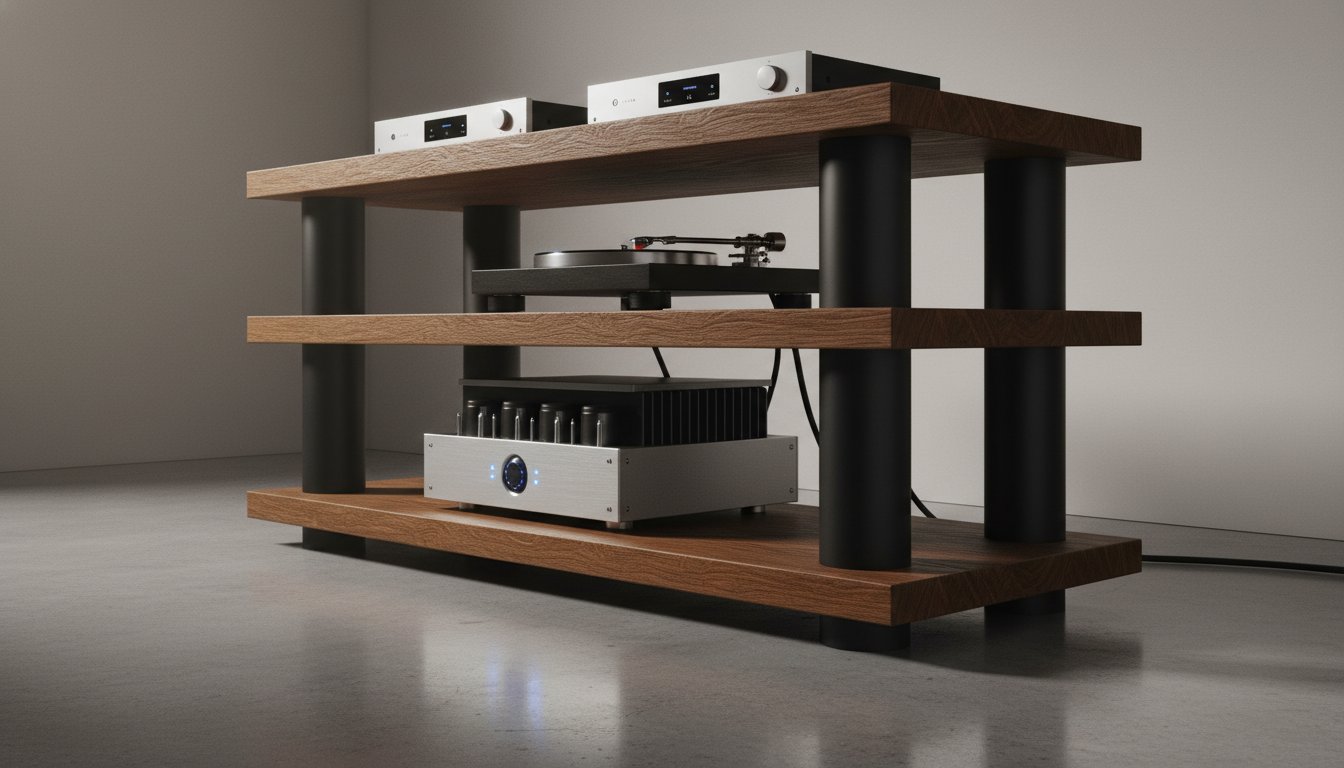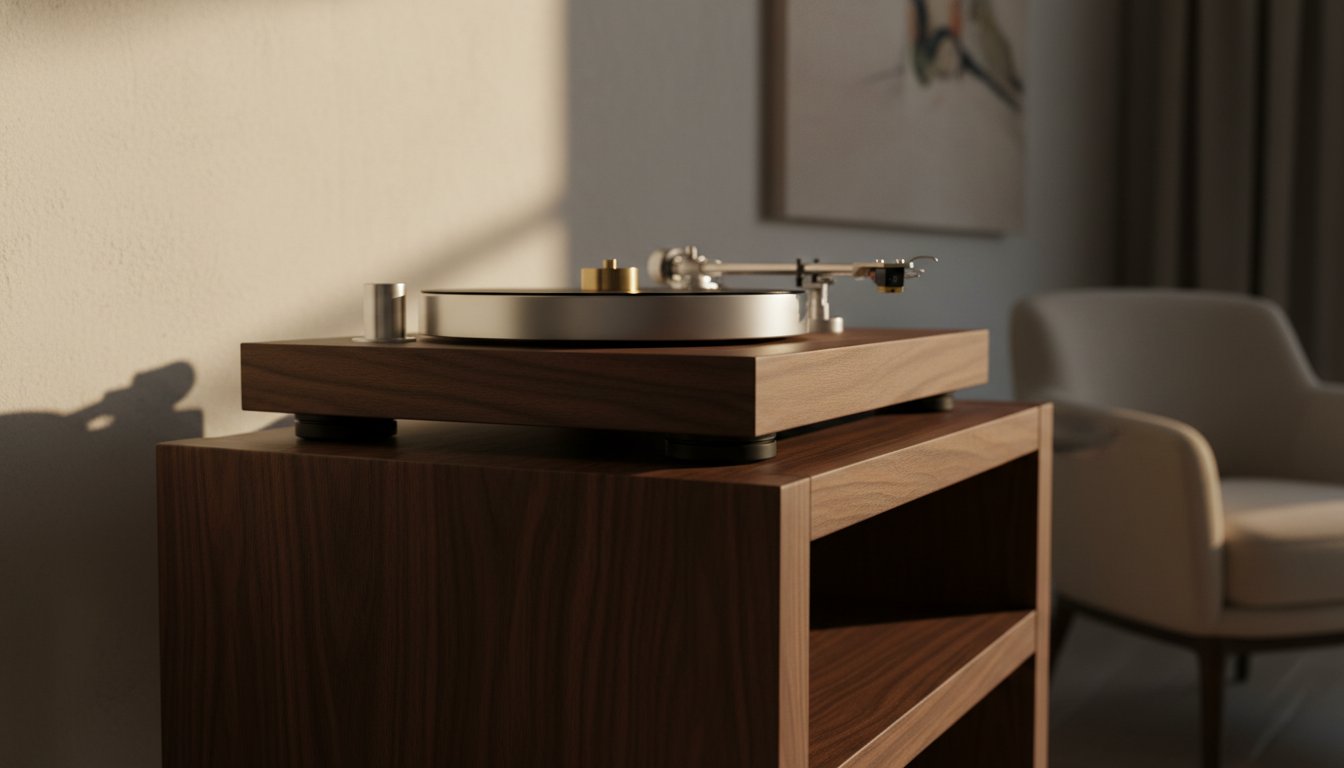
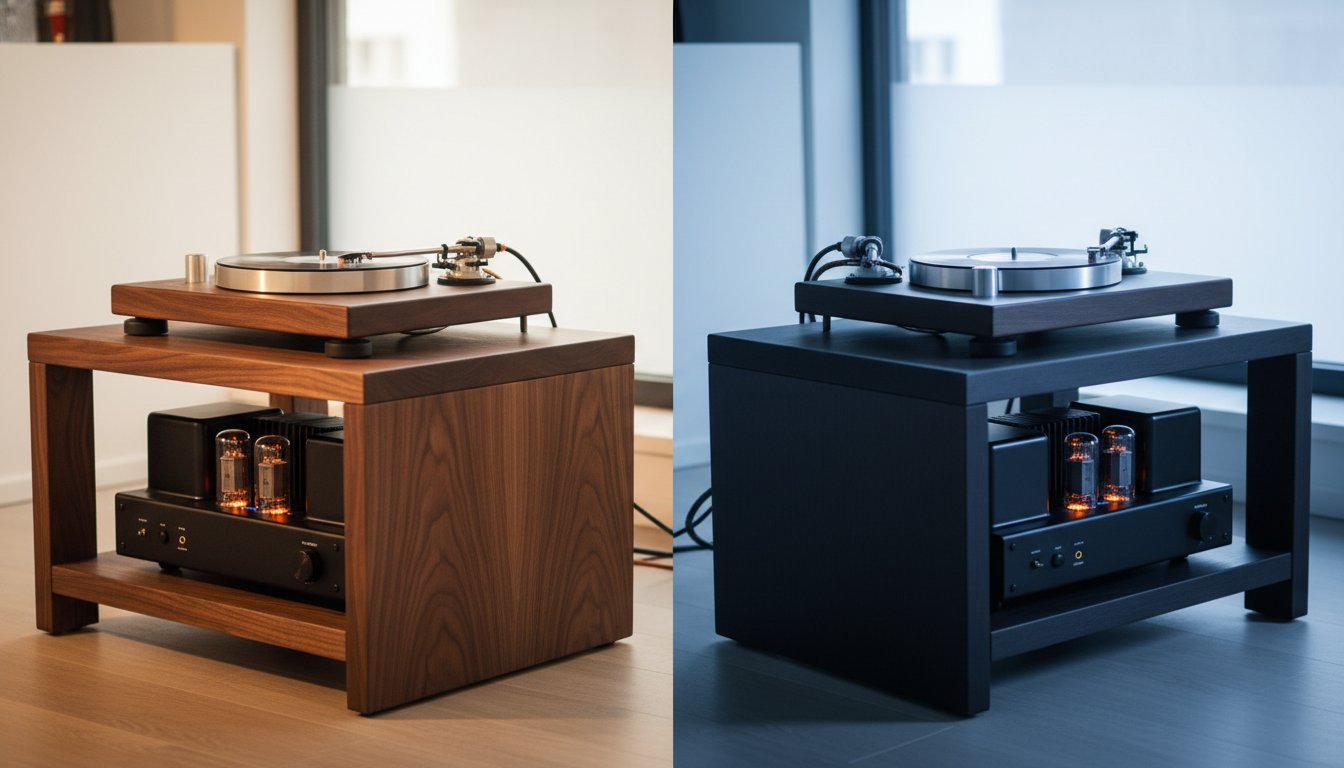
A perfectly inert material is often praised as the holy grail of audio support, yet total stillness is frequently the enemy of musicality. While industrial composites aim to kill vibration, they often end up deadening the soul of the performance along with it. The debate over solid wood vs mdf audio rack sound quality isn't just about aesthetics; it's about how energy moves through your system.
We understand the quiet frustration of hearing micro-vibrations blur a delicate soundstage or seeing a shelf sag under the weight of a reference amplifier. You've invested in your gear, and your stand should be its equal. This guide will show you how organic grain structures manage resonance to deliver blacker backgrounds and sharper transient response. We'll explore the technical damping of MDF and the harmonic integrity of solid hardwood, helping you select a lifetime piece that honors form, function, resonance, and soul.
Key Takeaways
- Define your audio rack as a critical mechanical component that anchors your soundstage and prevents micro-vibrations from clouding musical detail.
- Examine the trade-offs of industrial MDF, understanding how its high internal damping can inadvertently stifle the dynamic energy of your playback.
- Discover why the natural grain of hardwood serves as a superior vibrational filter, fundamentally shifting the solid wood vs mdf audio rack sound quality in favor of clarity.
- Protect your turntable and heavy amplifiers from feedback loops and structural sagging with materials designed for high-fidelity resonance management.
- Learn to treat your support system as an instrument-grade investment that elevates the emotional impact of every listening session.
The Science of Resonance: Why Your Audio Rack is a Component
In our pursuit of high-fidelity sound, we often treat the rack as a secondary consideration; a piece of furniture rather than a vital instrument. This is a mistake that limits the potential of even the finest electronics. We view the audio rack as the mechanical ground for your entire system. Just as an electrical ground provides a path for unwanted noise to exit a circuit, a proper rack provides a path for mechanical energy to dissipate. Without this foundation, your components sit in a sea of chaotic energy that obscures the very details you've paid to hear.
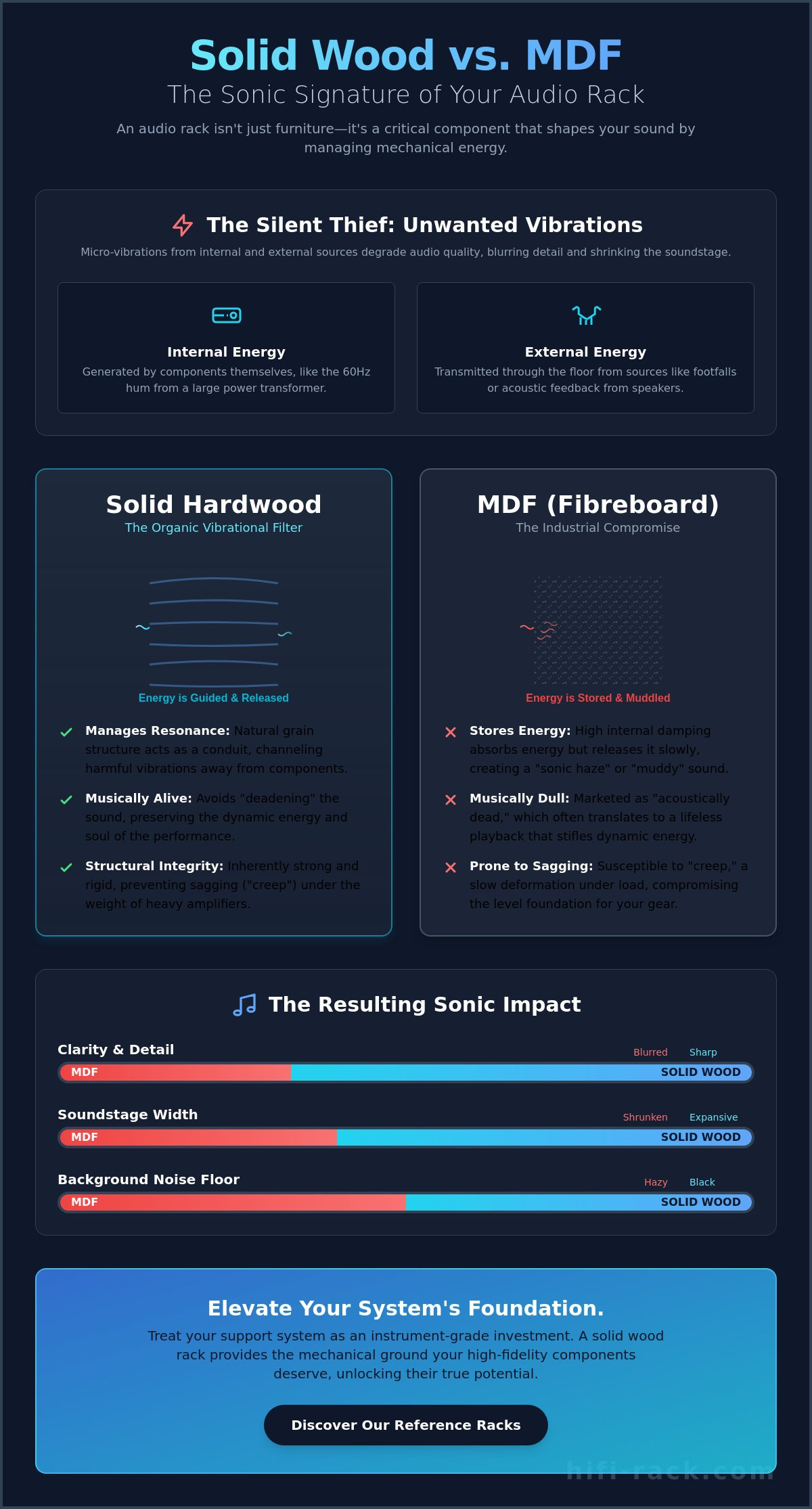
Micro-vibrations are the silent thieves of sonic clarity. They don't just shake the equipment; they blur the stereo image and shrink the soundstage. These vibrations enter your system from two directions. External energy, such as footfalls or acoustic feedback from your speakers, travels through the floor. Internal energy, like the 60Hz hum of a massive power transformer, originates within the gear itself. To understand how materials influence this interaction, we must look at The Science of Resonance and how it applies to our equipment supports.
To better understand how different materials behave under stress, watch this comparison:
Understanding Microphonics in Electronics
The gap in most discussions about solid wood vs mdf audio rack sound quality is the focus on speakers while ignoring electronics. Sensitive components like vacuum tubes and ceramic capacitors are microphonic. When mechanical vibration hits them, they convert that motion into a small electrical signal that mixes with your music. This creates a smearing effect, particularly in digital-to-analogue converters and phono stages. A stable foundation reduces this noise floor. When you successfully drain this energy, you experience "blacker" backgrounds, where the silence between notes becomes tangible and the music emerges from a place of absolute stillness.
Energy Storage vs. Energy Release
The core of the debate often centers on damping. Many industrial materials are designed to be "acoustically dead," meaning they absorb vibration. However, materials that are too dense often store energy for too long, releasing it back into the component slowly and causing a "thick" or muddy sound. The speed of sound through a material dictates its character. We find that "acoustically dead" often results in "musically dull" playback. Instead of just stopping vibration, we prefer to manage its release. By choosing the right shelving from our Reference HiFi Rack collection, you're not just supporting your gear; you're providing a conduit that allows resonance to flow away from the delicate signal path.
MDF in Audio: The Industrial Compromise
Medium Density Fibreboard (MDF) is the omnipresent choice for mass-produced furniture. It's consistent, predictable, and cost-effective for manufacturers. In the audio world, it's often marketed as "acoustically dead" because its dense structure doesn't ring like a bell. However, this stillness is achieved through a significant compromise. By binding wood fibers with heavy resins and glues, the material loses the ability to transmit energy efficiently. When we analyze solid wood vs mdf audio rack sound quality, we find that MDF often absorbs the life of the music along with the vibrations.
The acoustic signature of MDF is generally described as "darker" or "bass-heavy." It lacks the speed and transparency required to resolve fine details in high-end systems. This happens because the material doesn't just stop vibration; it stores it. This stored energy eventually leaches back into your components as a subtle sonic haze, blurring the transients that give music its emotional bite. You can learn more about the acoustic properties of MDF and wood to see how these differences manifest in real-world listening environments.
Beyond acoustics, MDF faces significant physical challenges. High-end amplifiers and power conditioners are heavy. Over time, MDF shelves succumb to "creep," a slow-motion deformation where the material permanently sags under a constant load. This isn't just an aesthetic failure. A sagging shelf compromises the level foundation required for sensitive equipment like turntables, where even a fraction of a degree in tilt can affect tracking and channel balance.
The Glue Factor: Damping at a Cost
MDF is essentially a composite of wood dust and formaldehyde glues. These resins act as a barrier to energy flow. Instead of "draining" resonance away from your gear, the material traps it. This is why many enthusiasts find they need to add expensive isolation spikes or pads to make an MDF rack sound acceptable. It lacks the natural structural rigidity found in long-fibre hardwoods. Those natural fibers provide a clear, uninterrupted path for mechanical energy to exit the system, whereas the resin-heavy structure of MDF acts like a vibrational sponge that never quite rings dry.
Longevity and Environmental Impact
The edges of MDF are notoriously fragile. A single knock during a move can lead to crumbling corners that can't be easily repaired. It's also highly susceptible to moisture. Even high humidity can cause the fibers to swell and ruin the finish. This leads to a cycle of "disposable" furniture that doesn't belong in a curated sanctuary. We believe in a different approach, focusing on sustainability and responsibility by using materials that last generations. If you're ready to move beyond industrial compromises, consider exploring our handcrafted support systems designed for permanent excellence.
Solid Wood: The Organic Vibrational Filter
While industrial composites act as a vibrational sponge, solid hardwood functions as a biological filter. The difference lies in the cellular level. Wood is not a uniform mass; it is a complex network of longitudinal cells and lignin. These microscopic tubes act like natural conduits for energy. When we compare solid wood vs mdf audio rack sound quality, we see that hardwood allows mechanical energy to travel along the grain and exit the system. This process is often called "energy drainage." It prevents resonance from reflecting back into your sensitive audio components.
Grain orientation is a critical part of this drainage. By aligning the natural fibers of the wood, we can direct unwanted vibrations away from the equipment shelves and down toward the floor. This is a level of resonance management that manufactured boards cannot replicate. It's why we strictly avoid veneers and MDF in all our Reference designs. We believe that for a rack to be a true component, it must be made of a singular, honest material that respects the laws of physics.
Hardwood Density Comparison
Different wood species offer unique "tuning" possibilities for your system. Walnut, with a Janka hardness of approximately 1,010 lbf, often provides a rich, balanced character. Oak and Ash are harder, measuring around 1,360 lbf and 1,320 lbf respectively. These denser woods offer a higher mass-to-volume ratio. This increased density translates to faster transient speeds. In practical terms, a harder wood shelf helps a snare drum hit with more "snap" and prevents the low-end frequencies from becoming bloated. You aren't just choosing a color; you're choosing the speed of your system's foundation.
The "Live" vs. "Dead" Debate
The audiophile community often argues over whether a rack should be "live" or "dead." We choose to reframe resonance as something to be managed rather than killed. An "acoustically dead" MDF shelf often mutes the natural harmonics of a recording. It cuts off the delicate decay of a piano note or the lingering reverb of a cathedral setting. Solid wood preserves these fine details. It manages the energy without stripping away the musicality. This creates a more "live" and engaging performance. Beyond the sound, there is a deep sensory benefit to handcrafted materials. The warmth of the grain and the integrity of the joinery create a connection to the music that synthetic materials simply can't provide.
Real-World Performance: Turntables and Heavy Gear
Analog playback is unforgiving. A turntable is essentially a precision instrument designed to measure microscopic variations in a groove; this means it also measures every vibration traveling through its support. When your stylus is tracking at less than two grams, the nuances of solid wood vs mdf audio rack sound quality become most apparent. A support that fails to manage energy will allow footfalls and acoustic feedback to enter the signal path, resulting in a bloated low end and a loss of low-level detail.
The physical demands of high-end audio extend beyond vibration management. Reference-grade power amplifiers and linear power supplies often weigh 50kg to 100kg or more. Supporting this mass requires more than just a thick shelf. It requires a material that won't deform under pressure. In this context, understanding solid wood vs mdf audio rack sound quality is about more than just resonance; it's about structural integrity and the long-term stability of your system's foundation.
Turntable Isolation Strategies
A turntable requires a platform that is both high-mass and energy-dissipative. While an MDF shelf might provide a basic level of damping, it often lacks the low-frequency stability needed to protect the stylus from floor-borne energy. Solid hardwood platforms offer a superior mass-to-volume ratio that grounds the turntable. This grounding provides a "drain" for the energy generated by the motor and the bearing. For a deeper dive into optimizing your analog front end, see our Ultimate Guide to Turntable Isolation Platforms. By using solid wood, you ensure that the only movement the stylus tracks is the music itself.
Managing Heavyweight Amplification
Power transformers are a primary source of internal vibration. In a heavy amplifier, these transformers can create a subtle chassis rattle that degrades the signal-to-noise ratio. A rigid, solid wood foundation helps to sink this energy. Unlike industrial composites that might flex or "creep" over time, solid wood handles 100kg+ loads with ease. This rigidity improves the "PRaT" (Pace, Rhythm, and Timing) of your system. When the foundation is stable, the music feels more cohesive and driven. To achieve a holistic result, consider integrating Speaker Feet and Acoustic Isolation to manage energy across your entire floor space.
A high-performance system deserves a foundation that matches its caliber. If you're tired of furniture that sags under the weight of your passion, explore our Reference HiFi Racks and discover the difference that artisanal solid wood makes in your listening room.
Choosing Your Path: The HiFi Rack Philosophy
We believe the search for the perfect sound eventually leads every enthusiast back to the foundation. Choosing a support system is a deeply personal decision that marks the transition from simply owning equipment to curating an experience. We don't view our work as utility furniture. Instead, we see it as building instrument-grade supports that honor the pursuit of sensory perfection. When you move beyond the industrial standard, you're investing in a piece of handcrafted Serbian manufacturing that's built to outlast your current amplifier, your speakers, and perhaps even your own listening room.
The components in your signal path will inevitably change over the years. You'll upgrade your digital-to-analogue converter, swap out vacuum tubes, or experiment with new cartridges. However, a solid wood rack remains a constant. While industrial composites might sag or crumble over a decade of use, solid hardwood matures. It gains character while maintaining the uncompromising structural rigidity required for high-fidelity playback. This longevity is where the true value lies; it's a lifetime piece that matches the quality of the gear it supports.
Customization is at the heart of our philosophy. We understand that high-end systems often involve bespoke dimensions or unconventional footprints. By working with organic materials, we can tailor the foundation to your specific needs, ensuring a perfect harmony between form and function. This artisanal pride is reflected in every joint and finish, creating a sanctuary for your music that feels both premium and deeply authentic.
Reference, Classic, or Slim?
Selecting the right tier depends on your equipment's demands and your room's aesthetic. For standard high-end setups, the Myro Classic offers a perfect balance of mass and understated elegance. It provides the resonance management discussed in previous sections without overwhelming your space. If you're working in a space-conscious listening room where every inch matters, the Myro Minimal provides the same vibrational integrity in a more compact, punchy footprint. For those at the pinnacle of the hobby, our Reference series serves as the definitive mechanical ground.
Final Verdict: The Sonic Choice
The debate over solid wood vs mdf audio rack sound quality usually ends the moment a listener hears the difference. It's a shift from a "dead" or "thick" sound to one that is vibrant, detailed, and emotionally resonant. By viewing the rack as a permanent part of your signal path, you're ensuring that your gear can finally perform at its limit. A solid wood rack is the final support system you'll ever need. We invite you to browse the full shop and find the foundation your music deserves.
Elevate Your Listening Sanctuary
The journey toward sonic perfection often begins with the components we can see, but it's defined by the foundation we cannot hear. We've explored how resonance management separates a mere equipment stand from a true high-fidelity instrument. When comparing solid wood vs mdf audio rack sound quality, the difference is found in the life and decay of the music. While industrial composites might offer initial damping, they lack the organic grain structure required to drain energy away from your sensitive electronics.
A support system should be as enduring as your passion for sound. Don't settle for industrial compromises when you can have a legacy piece. Our designs prioritize reference-grade acoustic isolation through the use of pure, organic materials. We never use MDF or veneer; every piece is handcrafted in Novi Sad, Serbia, to ensure resonance, integrity, longevity, and soul. It's time to provide your system with the mechanical ground it deserves. We invite you to Explore the Handcrafted Solid Wood Collection and discover a foundation built for a lifetime of listening. Your music has never been in better hands.
Frequently Asked Questions
Does a HiFi Rack really make a difference in sound quality?
Yes, a dedicated Rack is a critical component that acts as the mechanical ground for your system. It provides a path for unwanted vibrations to exit your electronics, which lowers the noise floor. When you ground your gear properly, you'll notice a clearer soundstage and sharper instrument separation. Without this foundation, micro-vibrations blur the delicate transients that give music its emotional life.
Why is solid wood more expensive than MDF for audio furniture?
Solid wood is a premium natural resource that requires artisanal skill to shape and season. Unlike MDF, which is manufactured from industrial wood fibers and synthetic resins, hardwood must be harvested and dried over years. Crafting a Rack from solid timber involves managing natural grain movement and creating precision joinery. This labor-intensive process ensures a lifetime of service that mass-produced boards simply can't match.
Can I just put a solid wood board on top of an MDF rack?
Adding a solid wood board provides a better interface for your gear, but it doesn't solve the structural issue. The underlying MDF frame still stores energy and lacks a clear path for vibrational drainage. While you might hear a slight improvement, the solid wood vs mdf audio rack sound quality gap remains wide. A complete hardwood structure is necessary to fully ground your system and prevent energy from reflecting back into your gear.
Which hardwood is best for audio isolation?
Walnut, Oak, and Ash are the most effective hardwoods for resonance management. Walnut is prized for its balanced acoustic character and organic beauty. Oak and Ash are denser, offering higher Janka hardness ratings that translate to faster transient speeds and tighter bass control. These species possess the ideal cellular structure to act as a natural vibrational filter, making them superior to industrial composites.
Do I still need isolation feet if I have a solid wood rack?
Isolation feet can be a valuable secondary layer for your most sensitive components. While our Racks do the heavy lifting by grounding the system, items like tube amplifiers or turntables may still benefit from dedicated decoupling. Think of the Rack as the foundation and the feet as the suspension. Together, they create an environment of absolute stillness that allows your music to flourish without interference.
How does a solid wood rack help with turntable feedback?
A solid wood rack uses its natural fiber network to direct motor and floor-borne energy away from the stylus. Turntables are incredibly susceptible to acoustic feedback loops that muddy the low end. Hardwood's unique ability to "drain" this energy prevents it from reflecting back through the platter. This results in a much quieter background and improved tracking accuracy for your analog front end.
Is plywood better than MDF for audio racks?
Plywood is generally superior to MDF because its cross-layered construction helps dissipate energy better than a uniform mass. Baltic Birch is a common choice for budget-conscious audiophiles. However, it still contains significant amounts of glue between the veneers. When evaluating solid wood vs mdf audio rack sound quality, solid hardwood remains the gold standard for its purity and superior energy transmission properties.
How much weight can a solid hardwood HiFi Rack support?
A solid hardwood Rack is incredibly robust and can support reference-grade gear weighing over 100kg per shelf. Unlike MDF, which can "creep" or sag under a constant heavy load, the long-fiber structure of hardwood maintains its integrity for decades. This rigidity ensures your heaviest power amplifiers remain perfectly level and stable, protecting both your investment and your system's sonic performance.