Why would you invest years into curating a precision-engineered system only to let a common floorboard dictate its performance? For many enthusiasts, the pursuit of perfect sound is often interrupted by an unexplained fuzziness in high-frequency detail or a sensitive turntable that reacts to every footstep. It's a frustrating reality when your personal sanctuary is compromised by the very architecture of your home.
We understand that achieving true resolution requires more than just high-end electronics. It demands a sophisticated strategy for isolating audio components from floor vibrations. Industry data shows that 64% of listeners prioritize sound clarity and bass quality above all else, yet many overlook how mechanical interference degrades these exact traits. This guide will show you how to eliminate floor-borne interference by treating your equipment support as a finely tuned instrument rather than a simple shelf. You'll discover the science of resonance control, the definitive difference between coupling and decoupling, and how artisanal craftsmanship unlocks the hidden potential of your favorite recordings.
Key Takeaways
- Identify "seismic interference" and understand why the most sensitive high-fidelity systems require the most rigorous vibration management.
- Learn the vital distinction between coupling and decoupling to properly drain or block unwanted mechanical energy.
- Discover why the varied grain density of solid hardwood is scientifically superior to MDF for natural damping and resonance control.
- Build a tiered strategy for isolating audio components from floor vibrations that addresses every interface from the floor to the chassis.
- Experience the emotional and sonic payoff when a handcrafted foundation allows your system to finally perform at its true potential.
The Hidden Cost of Floor Vibrations: Why Your Audio System Sounds 'Muddy'
Every floor is a conductor. Even in a room that feels perfectly still, your audio system is under constant assault from seismic interference. These micro-movements travel through floorboards and up through your equipment rack, entering the delicate signal path of your electronics. When we talk about isolating audio components from floor vibrations, we aren't just protecting the gear. We're protecting the music itself. Vibration is a thief. It steals the space between the notes and blurs the edges of your favorite recordings.
Many enthusiasts fall victim to the Resolution Paradox. This is the frustrating reality where the more you invest in high-end gear, the more sensitive your system becomes to its environment. A high-resolution system is designed to reveal every nuance. However, that same transparency means it also reveals the 'fuzziness' caused by structural energy. If your soundstage feels flat or your transients seem smeared, you're likely hearing the floor, not the artist. This interference can even cause vacuum tubes and capacitors to become microphonic, effectively turning mechanical vibrations into unwanted electrical noise.
To better understand how these forces interact with your playback, watch this helpful video:
The Physical Reality of Micro-Vibrations
Floor vibrations enter your signal path through the component chassis. This isn't just about heavy footfalls. It often stems from low-frequency acoustic feedback. Your speakers move air, but they also move the floor. This energy loops back into your turntable or amplifier, creating a cycle of distortion. Even solid concrete floors can transmit structural energy over long distances. Understanding the physics of sound isolation is essential because it proves that no surface is truly silent without intentional intervention.
Why 'Good Enough' Supports Fail High-End Gear
Standard household furniture is designed for aesthetics, not acoustics. Mass-produced sideboards and desks often have high resonant frequencies that 'color' the sound of your amplifier. These pieces of furniture act like sounding boards, amplifying the very vibrations we want to eliminate. Mechanical grounding is the process of draining unwanted energy away from the component. Without a dedicated foundation, your system will always be fighting its environment. True performance requires a tiered strategy for isolating audio components from floor vibrations, starting with a support system built for the task.
Coupling vs. Decoupling: The Physics of Sound Isolation
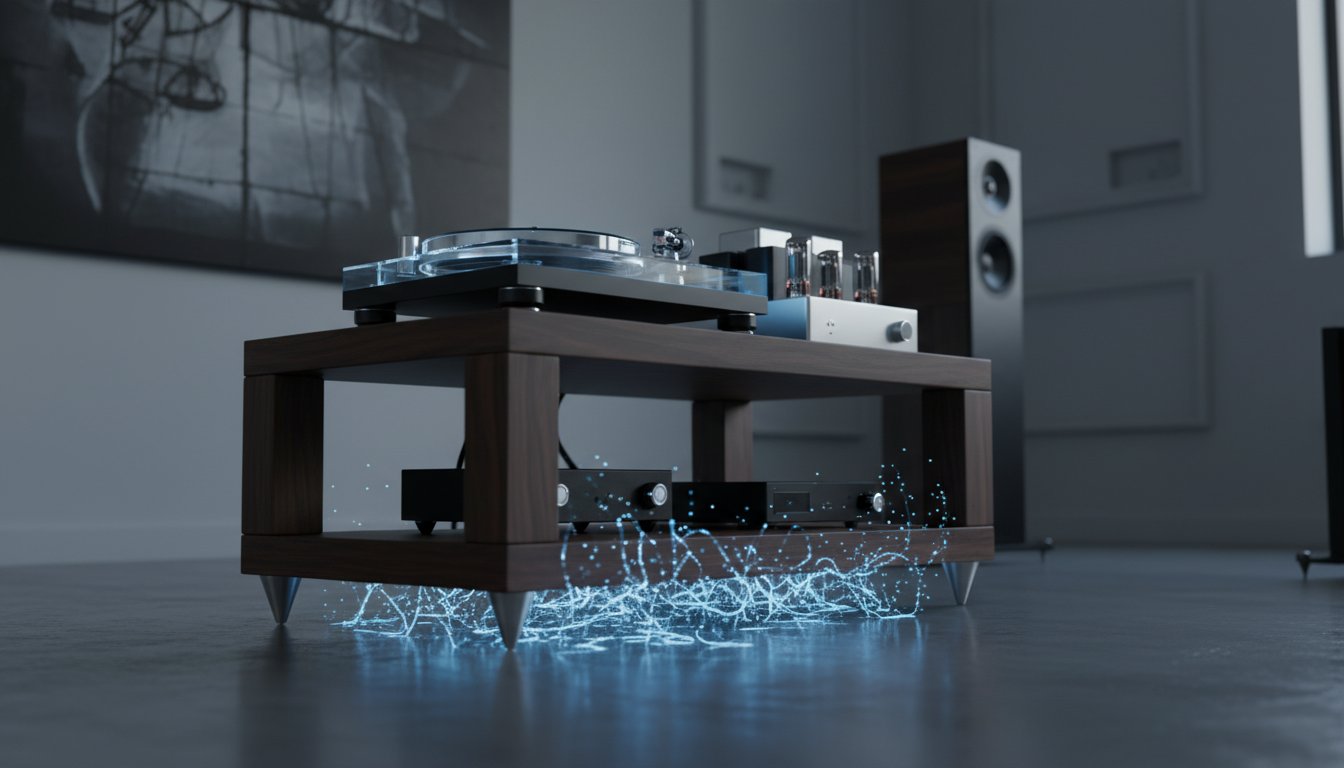
The path to pure sound isn't a single road. It's a choice between two fundamental philosophies: coupling and decoupling. When we focus on isolating audio components from floor vibrations, we're essentially managing kinetic energy. Coupling is the art of connection. It involves using rigid interfaces, like spikes, to "drain" unwanted energy away from your gear and into the floor. Decoupling is the art of separation. This strategy uses compliant materials to break the physical link, ensuring that floor-borne energy never reaches your sensitive electronics.
Choosing the right strategy depends heavily on your environment. Concrete floors are massive and relatively inert, making them ideal for coupling. Suspended hardwood floors act like giant drum skins, often requiring a decoupling approach to prevent feedback loops. Mass also plays a critical role. A heavy, dense support system resists movement through sheer inertia, absorbing energy that would otherwise color your music. The science of acoustics and vibration confirms that managing these mechanical resonances is essential for isolating audio components from floor vibrations effectively.
The Role of Spikes and Mechanical Grounding
Spikes are more than just aesthetic choices. Quality speaker feet concentrate the entire weight of a system onto a tiny surface area. This allows them to pierce through carpet and establish a direct connection with the subfloor. This creates a "diode effect" where energy flows out of the component but struggles to return. We prefer precision-machined brass for these interfaces. It's a material that offers the perfect balance of hardness and internal damping, ensuring a clean exit for mechanical noise.
Decoupling for Sensitive Analog Sources
Turntables are the most vulnerable part of any system. While a solid-state amplifier might tolerate minor tremors, a stylus tracking a groove cannot. For these sensitive sources, we must consider the resonant frequency of the entire support. If your isolation solution is poorly matched, it can become a "tuning fork" for the floor, actually amplifying the vibrations you're trying to stop. Effective decoupling requires a deliberate balance of compliance and control. If you're looking to establish a world-class foundation, our Reference HiFi Rack offers the architectural rigidity needed to make these isolation strategies truly effective.

The Material Science: Why Solid Hardwood Outperforms MDF for Vibration Damping
We often think of wood as a purely aesthetic choice, but for the connoisseur of sound, it's a critical engineering material. When isolating audio components from floor vibrations, the physical makeup of your support system acts as the final filter for your music. Solid hardwood possesses a complex, organic cellular structure that man-made materials simply cannot replicate. While Medium-Density Fiberboard (MDF) is a uniform block of compressed dust and resin, solid timber is a living matrix of varied densities and grain patterns.
This natural variation is our greatest ally. In solid wood hifi racks, the inconsistent grain density works to break up standing waves before they can reach your equipment. Unlike the uniform composition of synthetic boards, which allow resonant frequencies to travel unimpeded, the organic 'imperfections' in oak or walnut act as a series of microscopic baffles. This results in a high 'self-damping' coefficient; the wood absorbs kinetic energy and converts it into trace amounts of heat rather than ringing like a bell.
There's a common myth that sheer mass is the only metric for success. While weight helps with inertia, excessive mass without rigidity can actually trap energy within the rack. The goal is a balance of structural stiffness and natural damping. This pursuit of harmony is reflected in patented vibration isolation technology, which often attempts to mimic the very damping properties that nature perfected in solid timber. We don't just want a heavy rack; we want a responsive one that understands the delicate nature of isolating audio components from floor vibrations.
Solid Wood vs. MDF and Veneer
MDF acts as a storage heater for vibration. Because it's so dense and uniform, it holds onto energy and slowly releases it back into the component chassis, resulting in that 'muddy' sound that plagues unoptimized systems. Veneered furniture is even more problematic, as the glue layers between the thin wood skin and the MDF core create additional boundaries where energy can reflect and distort. We exclusively use solid hardwoods to ensure your music remains untainted by the synthetic resonances of industrial adhesives.
The Longevity of Artisanal Construction
A rack is only as quiet as its weakest joint. Mass-produced 'flat-pack' furniture relies on cam-locks and screws that inevitably loosen, creating microscopic structural rattling. Our approach favors traditional joinery, creating a single, unified structure that stays silent for a lifetime. This commitment to excellence is a core part of our philosophy, which you can explore further on our responsibility page. When engineering meets artisanal pride, the result isn't just a piece of furniture; it's a sanctuary for your sound.
Building a Tiered Isolation Strategy: From Floor to Component
Isolating audio components from floor vibrations isn't a single act; it's a tiered architectural strategy. We believe that true high-fidelity performance is built from the ground up, starting where the floor meets your system and ending where the stylus meets the groove. A haphazard approach often results in a "hit-or-miss" soundstage. By contrast, a methodical, bottom-up framework ensures that every piece of gear operates in a vibration-free sanctuary.
The first step begins with the floor interface. You must evaluate your surface and choose the appropriate base. Spikes are essential for piercing through carpet to the solid subfloor, while precision protectors are necessary for hardwood. Once the interface is established, you must invest in a structurally rigid, solid-material rack. This acts as the primary filter for the entire system. From there, address your most sensitive components, such as turntables and tube stages, with dedicated platforms. Fine-tune the tonal balance with component-level feet or brass spikes. Finally, level the entire system. Even a slight tilt can cause uneven weight distribution, compromising the stability of your isolation layers.
The Foundation: Selecting the Right Rack
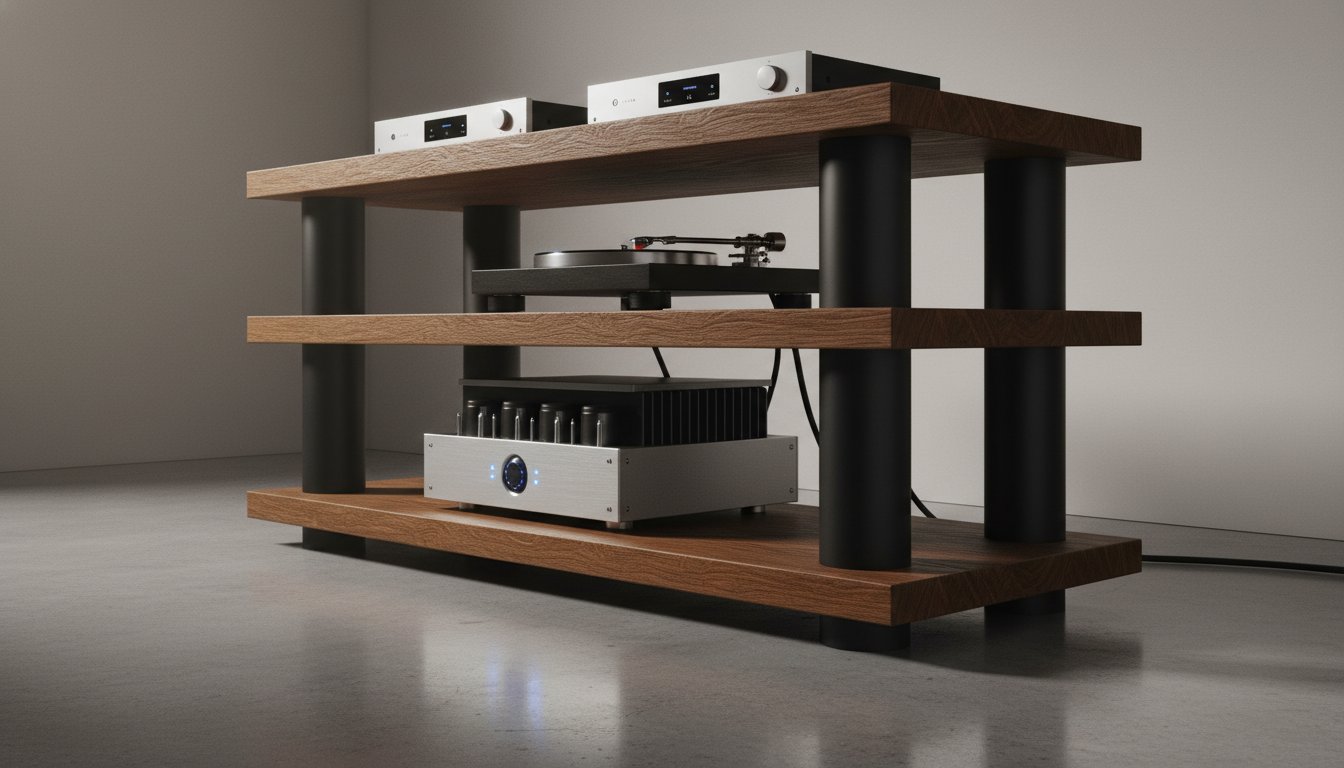
Your choice of rack defines the ceiling of your system's performance. For those seeking the absolute pinnacle of resolution, our Reference HiFi Rack provides ultimate isolation through increased mass and specialized geometry. While our Classic line offers exceptional damping for most systems, the Reference series is engineered for the highest-gain environments. Modular designs are particularly effective because they allow for better energy dissipation between individual shelves. We also pay close attention to shelf thickness. Thicker solid wood shelves provide the necessary damping for heavy power amplifiers, preventing their massive transformers from vibrating the rest of your signal chain.
Turntable Specifics: The Ultimate Challenge
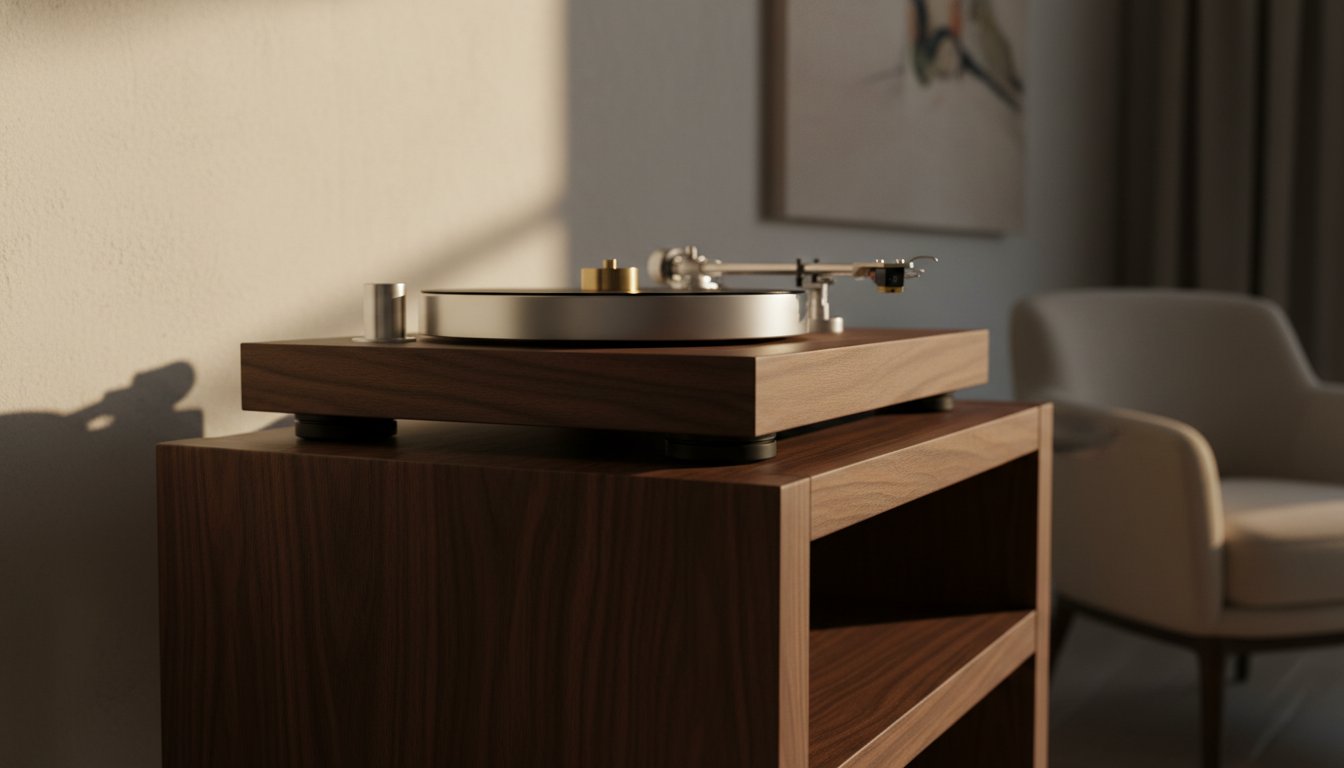
Vinyl enthusiasts face a unique set of hurdles. Because a turntable is a mechanical transducer, a turntable isolation platform is often mandatory rather than optional. In homes with older, suspended timber floors, "bouncy floor" syndrome can make playback nearly impossible. In these cases, you must decide between a high-mass floor stand or a wall-mounted shelf. A floor stand relies on the rack's integrity to manage energy, while a wall shelf bypasses the floor entirely by anchoring to the room's structural perimeter. Whichever path you choose, the goal remains the same: total silence at the source. If you're ready to transform your listening room, explore our full range of handcrafted supports to find the perfect foundation for your journey.
The Handcrafted Foundation: Elevating Your Listening Experience with HiFi Rack
The journey to pure sound concludes not with a digital filter or a cable upgrade, but with the foundation upon which your passion rests. Our work rests upon four pillars: the integrity of raw timber, the precision of manual craft, the science of resonance, and a deep reverence for the listening experience. We view ourselves as boutique specialists, combining rigorous mechanical engineering with the soul of multi-generational Serbian woodworking. When you succeed in isolating audio components from floor vibrations through these artisanal methods, the reward isn't just technical; it's deeply sensory. You finally hear the "blacker" backgrounds and the effortless decay of a piano note. Your system finally breathes.
Every rack we create is a testament to the belief that audio furniture should be a lifetime investment in musicality. Our Serbian-handcrafted designs are built for bespoke systems that demand more than mass-produced solutions can provide. We don't use MDF or veneers because they lack the structural integrity required for true high-fidelity performance. Instead, we rely on the organic damping of solid timber. This commitment to raw, high-quality materials ensures that your rack won't just support your gear. It'll elevate your entire relationship with music, turning a casual pastime into a life-altering passion.
Artisanal Pride Meets High-Fidelity Performance
Our Myro Minimal series is a perfect example of this philosophy. It manages to balance a remarkably small footprint with the high isolation standards required for reference-grade listening. We believe that your furniture should look as beautiful as it sounds. Solid wood is a living material. It possesses a natural warmth that complements the organic nature of analog playback, creating a visual and sonic harmony in your personal sanctuary. This union of performance and aesthetics is our definitive promise to you.
Taking the Next Step Toward Sonic Perfection
Achieving the perfect balance in a high-fidelity system is a personal pursuit. We invite you to view us as a trusted partner rather than a faceless manufacturer. Whether you need a Reference HiFi Rack for a heavy tube amplifier or a Slim HiFi Rack for a minimalist setup, we're here to help you find a custom solution tailored to your specific gear. Choosing the right foundation is about choosing a partner who shares your uncompromising commitment to excellence. When you're ready to unlock the true resolution of your system and master the art of isolating audio components from floor vibrations, visit the HiFi Rack Shop to explore our complete collection.
Reclaim Your System’s True Potential
True high-fidelity sound is a delicate balance of engineering and environment. You've seen how the choice between coupling and decoupling can transform your soundstage, and why the organic damping of solid hardwood is scientifically superior to synthetic MDF. By implementing a tiered strategy for isolating audio components from floor vibrations, you move beyond simple equipment storage and into a world of precision resonance control.
At HiFi Rack, we honor this pursuit through Serbian craftsmanship and multi-generational expertise. We refuse to use MDF or veneers, choosing instead the integrity of raw, solid timber to preserve your signal purity. Whether you require a Reference HiFi Rack or a custom-tailored solution for a bespoke audio system, our work is designed to last a lifetime. We invite you to explore our handcrafted solid wood HiFi racks and start your journey to sonic perfection. Your music has always been there. It's time to finally hear it without the interference of the floor beneath you.
Frequently Asked Questions
Does isolating audio components really make a difference in sound quality?
Yes, the audible difference is profound. By isolating audio components from floor vibrations, you remove the mechanical glare that masks low level detail. This process lowers the noise floor, allowing your system to resolve subtle spatial cues and the natural decay of instruments. It's a vital step for anyone seeking the true resolution of their high fidelity recordings.
What is the best way to isolate a turntable on a bouncy wooden floor?
A high mass isolation platform or a wall mounted shelf is the most effective solution. A wall shelf anchors directly to the room's structural perimeter, effectively bypassing the "drum skin" effect of suspended floorboards. If a wall shelf isn't an option, a heavy, solid wood platform provides the necessary inertia to damp the energy from footfalls and low frequency feedback.
Should I use spikes or rubber feet for my hifi rack on a hardwood floor?
Precision machined spikes paired with floor protectors are the superior choice. Spikes provide a rigid path for mechanical energy to exit the rack, a process known as mechanical grounding. While rubber feet offer some decoupling, they can often trap energy within the rack frame, leading to a loss of transient speed and a softened bass response.
Is solid wood better than metal for audio racks?
Solid wood offers superior natural damping due to its organic cellular structure. Metal racks often suffer from high frequency "ringing" unless they're filled with damping materials like sand or lead shot. The varied grain density in hardwoods like oak or walnut naturally breaks up standing waves, ensuring that the rack doesn't add its own sonic character to your music.
How do floor vibrations affect solid state amplifiers compared to tube amps?
Tube amplifiers are highly sensitive to microphonics, where mechanical vibrations are directly amplified by the glass valves. Solid state electronics are more resilient but certainly not immune. Vibrations affect the capacitors and circuit boards, causing a subtle blurring of high frequency detail. Isolating audio components from floor vibrations ensures that both technologies can perform with maximum transparency.
Can I use a regular bookshelf as a hifi rack if I add isolation pads?
A regular bookshelf lacks the structural rigidity and specific damping properties required for high end audio. Most household furniture is designed for aesthetics and can act as a sounding board, amplifying resonances. While isolation pads help, they can't compensate for a lightweight or resonant frame that colors the sound of your amplifier or source components.
What is the difference between coupling and decoupling in audio?
Coupling uses rigid interfaces like spikes to "drain" energy away from a component and into the floor. Decoupling uses compliant materials to break the physical link and block energy from traveling between the floor and the gear. The choice depends on your floor type; concrete often favors coupling, while suspended wooden floors usually require a decoupling strategy.
Why is MDF commonly used in audio furniture if solid wood is better?
MDF is a commercial choice driven by its low cost and ease of mass production. It costs significantly less than solid hardwood, making it attractive for large scale manufacturing. However, MDF is a uniform material that lacks the organic grain variation needed to dissipate energy. We use solid timber because it offers a more authentic and effective approach to resonance control.