What if the cold, ringing resonance of metal is the only thing standing between you and the pure, authentic sound your speakers were designed to produce? While many enthusiasts believe high-mass steel is the gold standard for stability, the natural grain of solid wood speaker stands offers an organic damping property that metal simply cannot mimic. It's the difference between a clinical reproduction and a performance that feels alive, intimate, and deeply resonant in your personal sanctuary.
You've likely felt the frustration of a muddy mid-range or a bass line that rattles your floorboards instead of your soul. We understand that your listening room should be a harmony of high-end engineering and natural beauty. This guide will show you why solid hardwood is a vital instrument for acoustic isolation rather than just a furniture choice. We'll compare handcrafted timber against industry benchmarks like the Atacama Moseco 6, recently updated in January 2026, and the $649 Solidsteel SS series. You'll discover how to select an investment-grade foundation where sound and style are finally one.
Key Takeaways
- Understand how the organic cellular structure of solid hardwood acts as a precision-engineered isolation tool to eliminate unwanted vibration.
- Master the calculation for your wood speaker stands to ensure tweeters sit at the perfect ear level for optimal high-frequency dispersion.
- Compare the damping factors of Oak and Walnut to determine which species best supports your quest for tighter bass and mid-range clarity.
- Learn why authentic, handmade construction offers a soulful acoustic foundation that mass-market metal and MDF cannot replicate.
Wood Speaker Stands: Aesthetic Luxury or Acoustic Necessity?
Choosing wood speaker stands often starts as an aesthetic decision. You want your listening room to feel like a sanctuary, not a laboratory. However, the true value lies in how these instruments treat the signal. In 2026, we see a definitive shift back to organic materials in high-end audio as listeners move away from the clinical feel of industrial metals. Audiophiles are rediscovering that solid timber provides a level of natural damping that synthetic materials struggle to match. It's a return to the soulful connection between the listener and the music.
Beginners often get lost in the 'wood vs. metal' debate. On forums like Reddit, users frequently claim that wood is purely for looks. This perspective misses the fundamental physics of resonance. While metal stands are often hollow and prone to ringing unless filled with expensive lead shot or sand, solid hardwood is naturally 'dead.' It absorbs energy rather than reflecting it back into the speaker cabinet. This ensures your high-end equipment performs exactly as the designer intended.
To better understand the impact of a solid foundation on your audio quality, watch this detailed exploration of stand construction:
The Role of the Stand in Signal Purity
A speaker stand isn't just a pedestal; it's a precision-engineered isolation tool. The Role of Speaker Stands is to decouple the cabinet from the floor, preventing what engineers call 'cabinet smear.' When a speaker vibrates against a resonant surface, the stereo imaging collapses. A rigid foundation ensures that the only thing moving is the driver itself. By using solid wood speaker stands, you create a stable platform that tightens the bass and clears the mid-range. This allows you to live your passion for music with a holographic soundstage that feels authentic and intimate.
Solid Wood vs. Wood Grain: Know the Difference
It's vital to distinguish between authentic hardwood and the 'wood grain' found in mass-market furniture. Many products use MDF covered in thin vinyl stickers. These lack the density and cellular structure required for true acoustic damping. When we craft stands from Walnut, Oak, or Cherry, we're building heirloom-grade instruments that last a lifetime. These materials offer a unique sonic signature that synthetic alternatives can't replicate. Our commitment to being NATURAL and AUTHENTIC means we never use veneers or particle board. We believe your gear deserves a foundation as honest as the music itself. Explore our handmade collection to see the difference that real timber makes.
The Science of Resonance: Why Solid Hardwood Outperforms MDF
Understanding resonance is the key to unlocking the true potential of your hi-end equipment. While MDF is a frequent choice for mass-produced furniture, it lacks the complex cellular architecture found in authentic timber. Solid wood speaker stands function as a natural filter for your audio system. They don't just hold the speaker; they manage energy. Unlike metal, which can ring like a bell when excited by certain frequencies, solid wood is inherently self-damping. It provides a foundation that feels grounded and technically superior.
Hardwood is composed of millions of microscopic cellulose fibers held together by lignin. This organic structure creates high internal friction. When vibrational energy travels through a slab of Oak or Walnut, these fibers rub together at a microscopic level. This process converts kinetic energy into trace amounts of heat. It's a natural form of energy dissipation that synthetic materials like MDF, which is essentially compressed sawdust and glue, cannot replicate. MDF has a uniform, stagnant structure that doesn't dissipate energy as efficiently as the varying grain patterns of real timber.
The choice between species also impacts your sonic experience. Oak is incredibly dense and rigid. It's an excellent choice for heavy monitors that require a rock-solid foundation. Walnut offers a slightly different damping profile that many listeners find adds a touch of organic warmth to the lower mid-range. We pay close attention to grain orientation during our handmade construction process. Vertical grain paths help channel vibrations away from the speaker cabinet and toward the floor. This ensures your wood speaker stands remain inert even during the most complex musical passages.
Natural Damping and Internal Friction
The way timber handles energy is unique in the world of acoustics. Because of its organic composition, wood possesses high acoustic impedance. Acoustic impedance in solid wood is the measure of how much the material resists the flow of vibrational energy, effectively preventing it from reflecting back into the speaker cabinet. This resistance is why your music sounds cleaner and more focused. By isolating speaker vibrations through these natural channels, you eliminate the "smear" that often obscures fine detail in high-fidelity recordings.
Mass, Rigidity, and Bass Response
A common myth suggests wood is too light for serious audiophile use. This simply isn't true when dealing with thick, solid slabs. A pair of our handcrafted Oak stands can easily outweigh standard hollow metal alternatives. This mass provides the "anchor" your speakers need for a tight, punchy bass response. Rigidity is equally important. If a stand flexes, the speaker moves in opposition to the driver, which softens the impact of the low end. Our wood speaker stands provide a rigid, non-resonant platform where every beat hits with absolute precision.
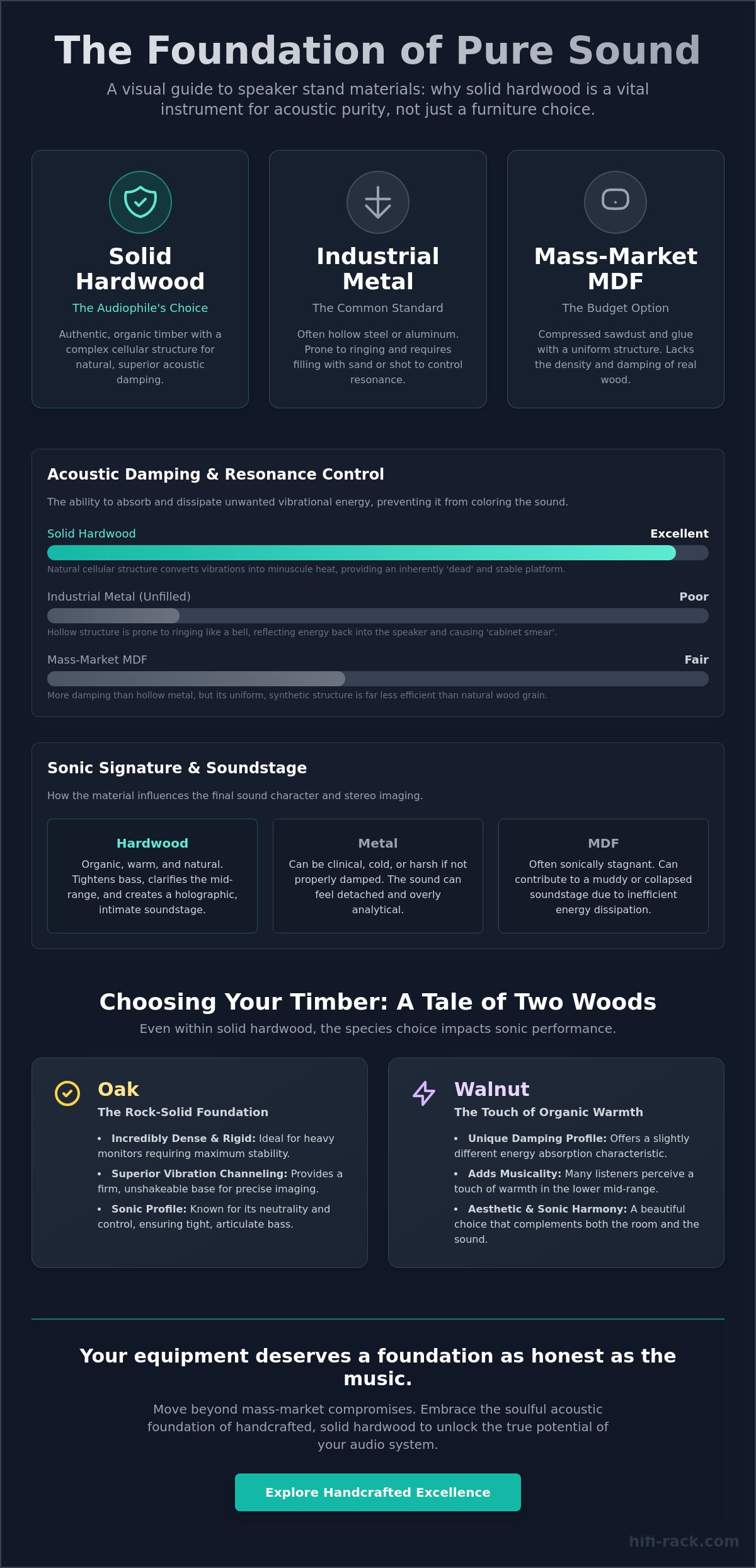
Comparing Wood Speaker Stands vs. Metal and MDF Alternatives
Choosing a foundation for your monitors requires a careful balance of performance, aesthetics, and longevity. While the market is flooded with mass-produced options, the distinction between wood speaker stands and their synthetic counterparts is profound. It's an investment in your listening experience that should last a lifetime. We evaluate these materials through a framework of acoustic integrity and artisanal quality, ensuring your gear sits on a platform that honors the music.
Metal stands often arrive as hollow, lightweight tubes that are prone to sympathetic resonance. To make them viable for high-end audio, enthusiasts must often resort to "mass loading" with kiln-dried sand or lead shot. This is a messy, cumbersome attempt to mimic the natural deadness that solid timber provides out of the box. The Science of Resonance explains that uncontrolled vibrations can color your sound, a problem solid hardwood avoids through its organic density. Our stands don't require external fillers to perform; they rely on the inherent properties of the timber itself.
The environmental and health impact is another critical differentiator. MDF is a composite material held together by synthetic resins, often containing up to 10% urea-formaldehyde. It's a chemical-heavy product that lacks the soul and sustainability of natural materials. We take our responsibility to the planet seriously by using only solid, sustainably sourced hardwoods. Unlike MDF, which can swell or crumble over time when exposed to humidity, solid Oak and Walnut are heirloom materials that grow more beautiful with age. It's the difference between a disposable accessory and a piece of investment-grade furniture.
Performance at a Glance
- Resonance Control: Solid wood offers high internal damping; metal requires filling to prevent ringing; MDF provides moderate damping but lacks structural mass.
- Isolation: Solid hardwood provides a "High" isolation rating by converting micro-vibrations into heat; metal is "Variable" depending on its mass-loading.
- Maintenance: Wood requires only a simple wax or oil treatment every few years; metal can scratch or rust; MDF is prone to permanent edge damage and moisture absorption.
Aesthetic Integration in the Modern Home
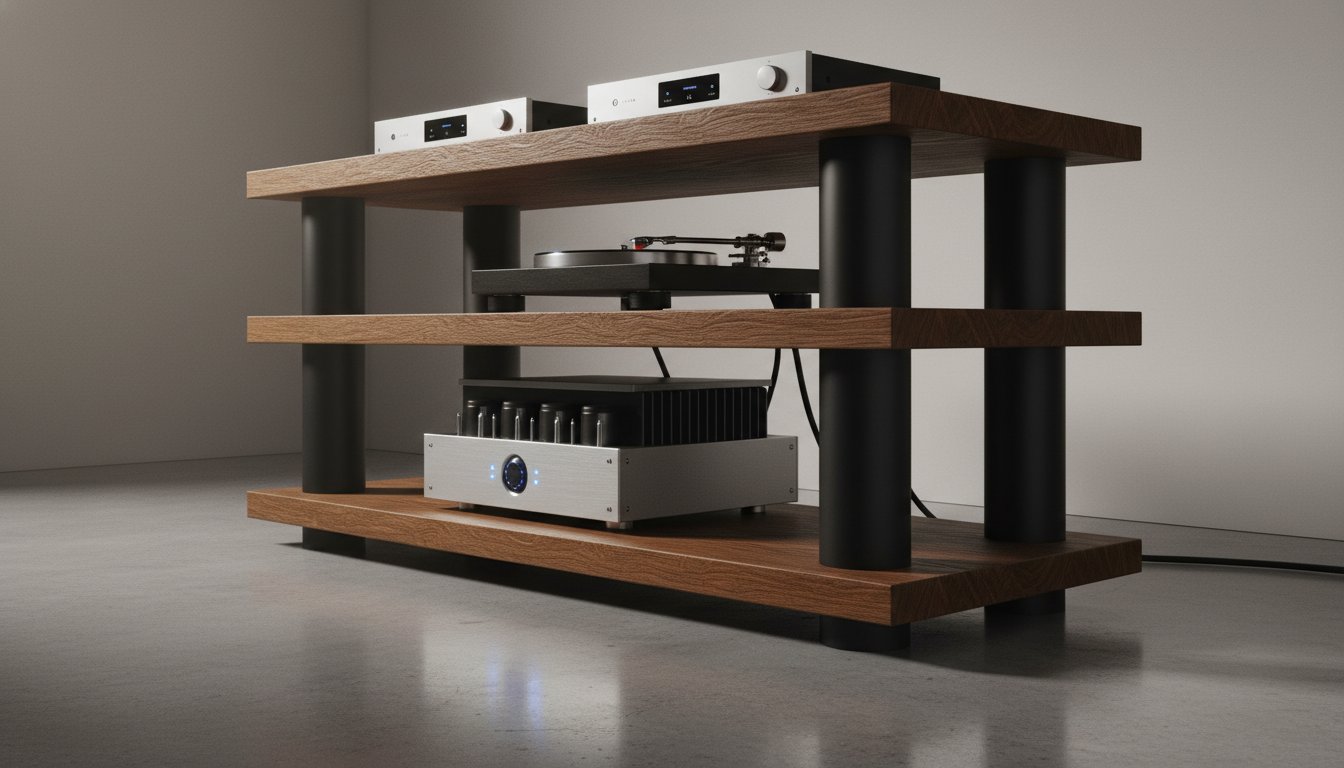
High-end electronics often carry an industrial, tech-heavy aesthetic. Wood speaker stands serve to soften these hard edges, helping your system feel like a part of your home's architecture rather than an intrusion. We believe in a philosophy where sound and style are one. By matching your stands to your decor, you create a personal sanctuary that is as visually stunning as it is acoustically perfect. For those looking to harmonize their entire setup, The Ultimate Guide to Choosing a Solid Wood HiFi Rack offers deeper insights into creating a cohesive, high-performance environment.
Selecting Your Ideal Stand: Height, Mass, and Wood Species
Selecting the perfect pair of wood speaker stands isn't a matter of following a generic industry measurement. While mass-market guides often suggest a standard 24-inch height as a universal fix, true musical perfection requires a tailored approach. You're crafting a personal sanctuary; every inch affects the clarity of high-frequency dispersion and the focus of your soundstage. We believe in a philosophy where sound and style are one, requiring a foundation that matches both your physical space and your acoustic goals.
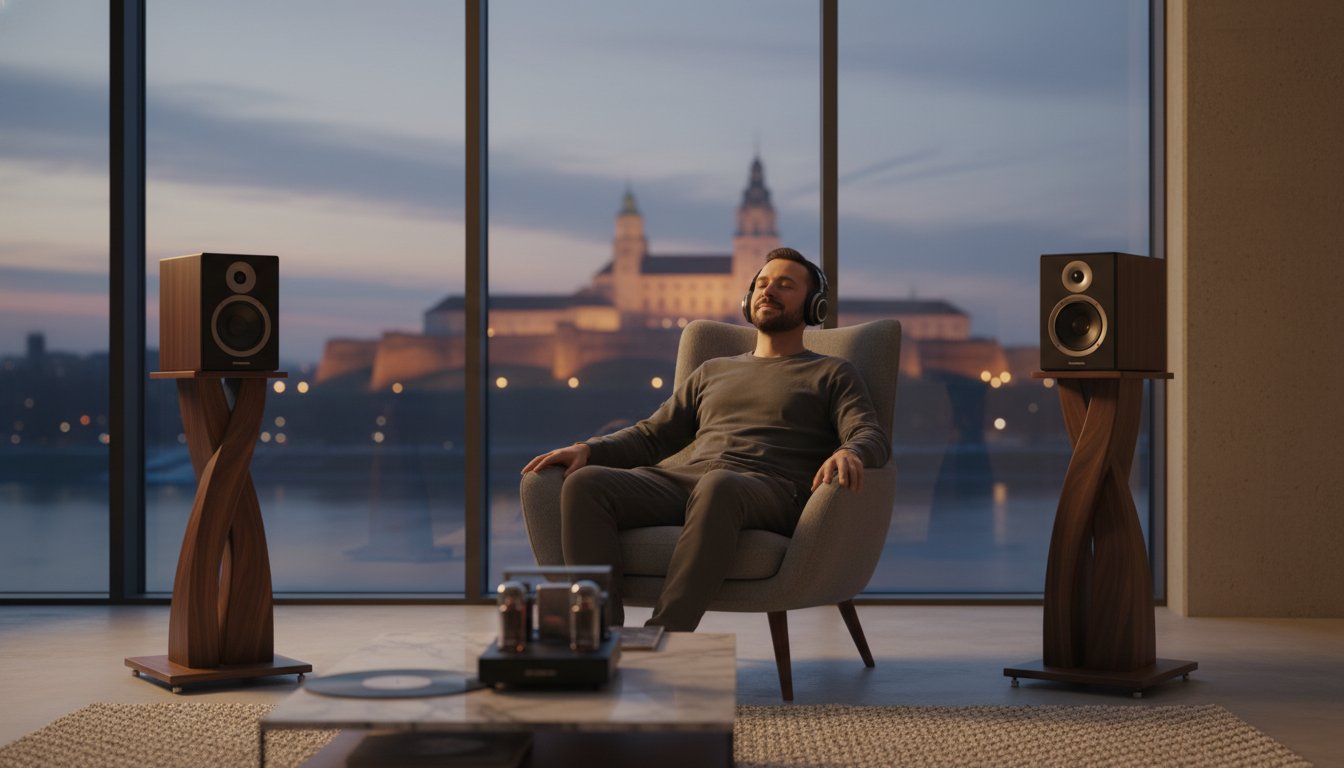
The Golden Rule of high-fidelity audio is simple: your tweeters must align with your ears. High frequencies are directional. If your speakers sit too low or too high, you lose the delicate detail and "air" that defines a premium recording. This is why a custom approach is superior to off-the-shelf solutions that ignore your specific seating position and speaker dimensions.
Calculating the Perfect Height
To find your ideal measurement, follow three simple steps. First, sit in your preferred listening chair and measure the distance from the floor to your ear level. Second, measure the distance from the base of your speaker to the center of its tweeter. Finally, subtract the second measurement from the first. This total represents your ideal stand height. If you use large monitors or tilted designs, you may require a shorter, sturdier base to maintain the correct axis. For a deeper dive into this process, read our guide on How to Choose and Set Up the Best Speaker Stands for Audiophile Sound in 2026.
Choosing the Right Wood for Your Sound
The species of timber you select influences the visual harmony and the acoustic character of your room. At Myro, we prioritize materials that are CUSTOM, HANDMADE, NATURAL, and AUTHENTIC. Walnut is prized for its rich, dark tones and excellent damping properties, offering a sophisticated look. Oak provides maximum structural rigidity and high density, making it the perfect choice for heavy, reference-grade monitors. Ash and Cherry offer a beautiful balance of brightness and stability, often used to complement lighter, modern decor styles. Matching your wood speaker stands to your existing HiFi rack creates a cohesive environment that helps you live your passion for music.
The Finishing Touches: Spikes and Coupling
The final step in achieving acoustic isolation involves the interface between the stand and the floor. Use adjustable brass spikes if your listening room is carpeted. They pierce the weave to anchor the stand to the solid subfloor. For hardwood or tile, utilize precision-machined floor protectors to prevent damage while maintaining decoupling. A perfectly level platform is essential for accurate stereo imaging. Even a slight tilt can shift the perceived soundstage. You can learn more about these critical components in our reference on Speaker Feet and Acoustic Isolation: The Complete Audiophile Reference.
Ready to elevate your listening experience? Browse our custom speaker stands to find the perfect match for your system.
Handcrafted Excellence: The HiFi Rack Approach to Speaker Stands
At Myro HiFi Rack, we don't view our work as furniture manufacturing. We see ourselves as partners in your pursuit of musical perfection. Our wood speaker stands are born from a philosophy that prioritizes the human element over mass-market efficiency. We operate on a "slow-made" principle where quality is never sacrificed for speed. By following our four-pillar mantra; CUSTOM | HANDMADE | NATURAL | AUTHENTIC; we create foundations that help you live your passion for sound.
The journey of every stand begins with raw Serbian hardwood. We strictly avoid MDF, veneers, and chemical-heavy composites because they lack the soul and acoustic integrity your hi-end equipment deserves. Each piece of timber is hand-selected for its grain pattern and density. It's then meticulously shaped into a precision acoustic instrument. This bespoke approach allows us to tailor every dimension to your specific bookshelf monitors, ensuring a perfect fit that feels like a natural extension of the speaker itself. It's a level of dedication that transforms a simple support into a vital component of your signal chain.
Artisanal Pride from Novi Sad
Our workshop in Novi Sad is a place where multi-generational woodworking traditions meet modern audiophile requirements. "Made in Serbia" is more than a geographic marker; it's a signature of uncompromising excellence. We understand that longevity is a form of responsibility. By creating products that last a lifetime, we honor both the craft and the environment. Every cut, sand, and finish is performed by a master craftsman who shares your deep-seated love for music. This connection ensures that the final product isn't just functional, but emotionally resonant.
Complete Your Listening Sanctuary
A high-fidelity system is most effective when its components work in total harmony. You can achieve complete visual and acoustic synergy by matching your stands with a Reference HiFi Rack. This unified approach transforms a collection of electronics into a cohesive listening sanctuary. Where sound and style are one, the equipment disappears, leaving only the music. It's an intimate experience that treats your senses to the ultimate in natural beauty and technical performance. We invite you to slow down and appreciate the finer details of a system built on authentic materials.
Ready to transform your environment? Explore our handcrafted speaker stands in the HiFi Rack Shop and find the authentic foundation your music has been waiting for.
Transform Your Listening Sanctuary with Authentic Foundations
Your journey toward musical perfection shouldn't be compromised by a ringing metal tube or a resonant MDF base. We've explored how the organic cellular structure of solid timber acts as a precision-engineered isolation tool, converting micro-vibrations into heat to reveal the true clarity of your recordings. By ensuring your tweeters align perfectly with your ear level, you unlock a holographic soundstage where every detail feels alive and intimate.
At Myro, we believe your gear deserves a platform as honest as the music itself. Our wood speaker stands are handcrafted in Novi Sad using only sustainable Serbian hardwood. We strictly avoid MDF or veneer in every build; this ensures your investment is an heirloom-grade instrument that lasts a lifetime. Whether you need custom dimensions for a specific monitor or a finish that matches your sanctuary, we're here to help you live your passion.
Discover Handcrafted Solid Wood Speaker Stands
Take the final step in harmonizing your system and experience the profound difference that an authentic foundation makes to your daily listening ritual.
Frequently Asked Questions
Is solid wood better than metal for speaker stands?
Solid wood is superior for listeners seeking natural vibration damping without the need for messy artificial fillers. While metal stands often ring at specific frequencies unless filled with lead shot, the organic cellular structure of timber naturally converts micro-vibrations into trace amounts of heat. This ensures your hi-end equipment delivers a cleaner, more authentic performance. It's a choice that prioritizes a soulful connection to your music over industrial convenience.
What is the best wood for speaker stands?
Oak and Walnut are the premier choices for audiophile applications due to their high density and structural rigidity. Oak provides an incredibly stable, heavy foundation for reference monitors, while Walnut offers a damping profile that many enthusiasts find enhances mid-range clarity. We select these species for their longevity and acoustic integrity, ensuring every pair of wood speaker stands we craft meets our CUSTOM | HANDMADE | NATURAL | AUTHENTIC standards.
How high should my bookshelf speaker stands be?
Your stands should be at a height that places the tweeters exactly at ear level when you're seated in your primary listening position. High frequencies are highly directional, so even a 5-centimeter deviation can cause a loss of fine detail and stereo imaging. Most listeners find that a height between 50 and 70 centimeters is ideal, depending on the specific dimensions of their monitors and the height of their listening chair.
Do wood speaker stands need to be sand-filled?
Solid wood stands don't require sand-filling because they possess inherent mass and natural damping properties that hollow metal tubes lack. The acoustic "deadness" of a 40mm thick solid Oak slab is superior to an unfilled steel column, which can act like a tuning fork. By choosing authentic, solid materials, you avoid the mess of lead shot while achieving a more organic and focused acoustic result for your sanctuary.
Can I use wood stands for large floor-standing speakers?
You can use low-profile wood bases or plinths to isolate large floor-standing speakers from resonant floorboards. While these speakers don't require additional height, they benefit from being decoupled to prevent bass energy from smearing the soundstage. Using a handcrafted solid wood base provides the same isolation benefits as a full-height stand, protecting your signal purity while ensuring your equipment and room decor exist in total harmony.
How do I prevent wood speaker stands from scratching my floor?
Use precision-machined floor protectors or "pucks" to prevent brass spikes from scratching your hardwood or tile surfaces. These protectors couple the stand to the floor for acoustic stability while providing a protective barrier for your home's architecture. For carpeted rooms, spikes should pierce through the weave to the subfloor to ensure a rock-solid foundation. This dual approach ensures your platform remains perfectly level and your floors stay pristine for a lifetime.
Will solid wood stands warp over time?
Solid wood stands won't warp if they're crafted from properly kiln-dried timber and finished with professional-grade oils. We use Serbian hardwoods that have been dried to a specific 8% moisture content to ensure absolute structural stability. This meticulous preparation prevents the timber from moving or cracking as seasons change. It's a commitment to longevity and integrity that defines our boutique approach to the craft of woodworking.
What is the difference between an isolation platform and a speaker stand?
A speaker stand provides both height and isolation, whereas an isolation platform focuses solely on decoupling a component from its resting surface. Stands are essential for bookshelf monitors to achieve the correct ear-level alignment for proper high-frequency dispersion. Platforms are typically used under electronics or large floor-standing speakers to manage resonance. Both are vital instruments in the pursuit of musical perfection, ensuring your gear performs at its peak.