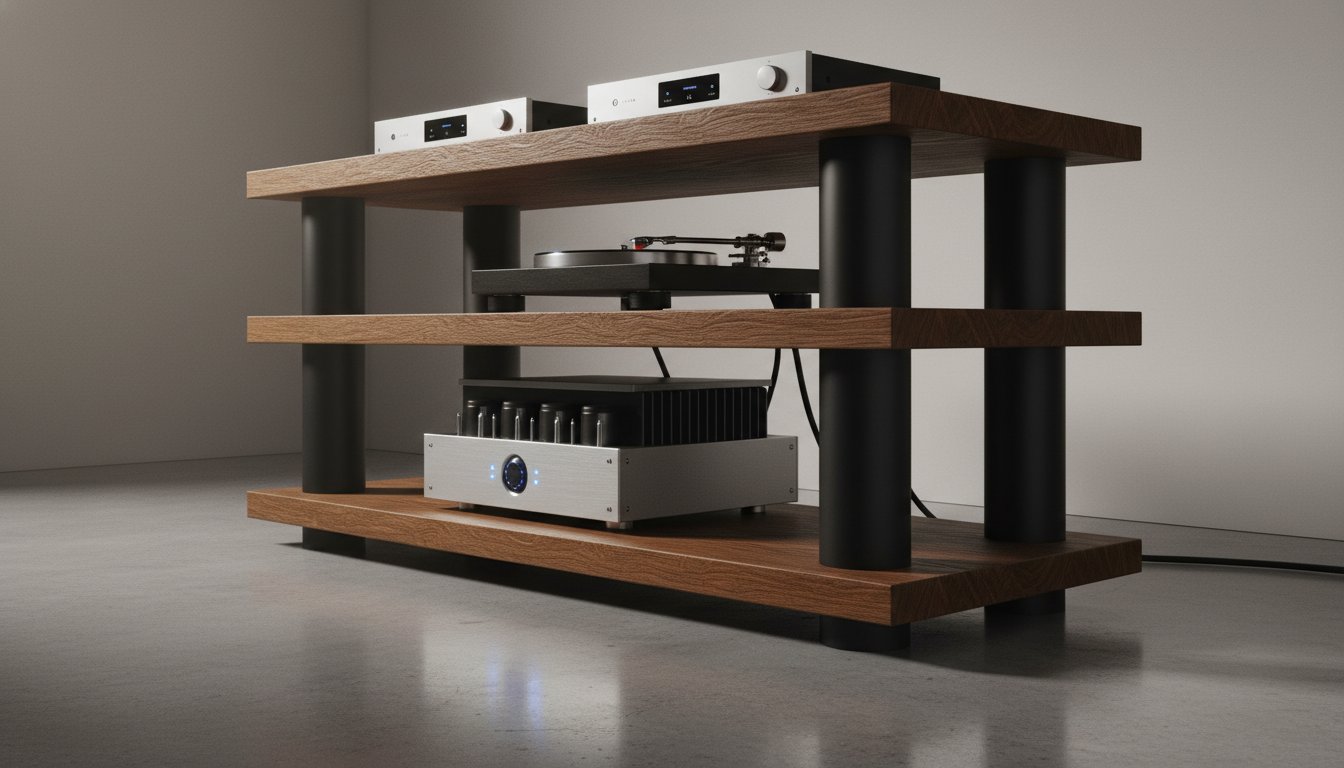

Your HiFi rack is not merely a piece of furniture; it is a precision acoustic instrument. While many enthusiasts focus on DACs and cables, the foundation of your sound often rests on the very surface supporting it. You likely know the frustration of a turntable needle skipping due to floor vibrations or an amplifier losing its breath in a cramped cabinet. As the global Hi-Fi audio market reaches a projected $19.26 billion in 2026, the demand for authentic, high-performance support has never been higher. Understanding what to look for when buying a hifi rack is the difference between a cluttered living room and a dedicated musical sanctuary.
We believe that where sound and style are one, the listening experience becomes truly transformative. This guide promises to show you how to choose a rack that elevates your system's sonic performance while providing the structural support heavy amplifiers require. We'll examine why solid hardwood is the vital component for natural resonance control and how to avoid the pitfalls of industrial looking furniture that clashes with your home. From cable management to thermal airflow, you'll discover how to select a handmade piece that lasts a lifetime and helps you live your passion.
Key Takeaways
- Understand how a dedicated rack manages mechanical vibrations to prevent microphony from masking the fine details of your music.
- Learn why natural solid hardwood is the essential choice for acoustic neutrality, offering performance that mass-produced MDF cannot match.
- Identify what to look for when buying a hifi rack by evaluating the structural rigidity and mass of Reference, Classic, and Slim designs.
- Gain technical insights into proper component spacing to ensure optimal airflow and long-term protection for your sensitive audio electronics.
- Discover the enduring benefits of the "Slow-Made" philosophy, where handcrafted quality creates a permanent sanctuary for your listening passion.
The Science of Silence: Why Your Components Need a Dedicated HiFi Rack
A high-end audio system is a collection of sensitive instruments. To hear them at their best, you must control the environment around them. A dedicated HiFi rack is a sophisticated vibration-management system designed to protect your electronics from the invisible forces that degrade sound. While a standard living room sideboard might look pleasant, it often acts as a resonant chamber, amplifying the very frequencies that muddy your music. Knowing what to look for when buying a hifi rack begins with understanding that every component in your signal chain is susceptible to its surroundings.
The primary enemy of pure audio is microphony. This occurs when mechanical vibrations, whether from your speakers or a passing truck, enter the chassis of your equipment. These vibrations turn into unwanted electrical signals that mix with your music. The result is a higher noise floor and a loss of low-level detail. By providing a stable, isolated platform, a proper rack lowers this noise floor, allowing the subtle textures of a recording to emerge from the silence. It's the difference between hearing a performance and feeling the space where it happened.
To better understand how these structural choices and accessories impact your setup, watch this helpful video:
Mechanical Isolation vs. Acoustic Damping
Effective rack design balances two distinct disciplines: isolation and damping. Isolation blocks external energy, such as floor-borne vibrations from footfalls, from reaching your sensitive tubes or laser assemblies. Damping deals with internal resonance. Every transformer and spinning motor inside your gear generates energy. A rack built from natural materials absorbs this energy rather than reflecting it back into the circuitry. Decoupling creates a physical barrier, ensuring that energy transfer stops before it reaches your music. This dual approach is exactly what to look for when buying a hifi rack for a serious listening room.
The Turntable Factor: Why Analog Demands the Best
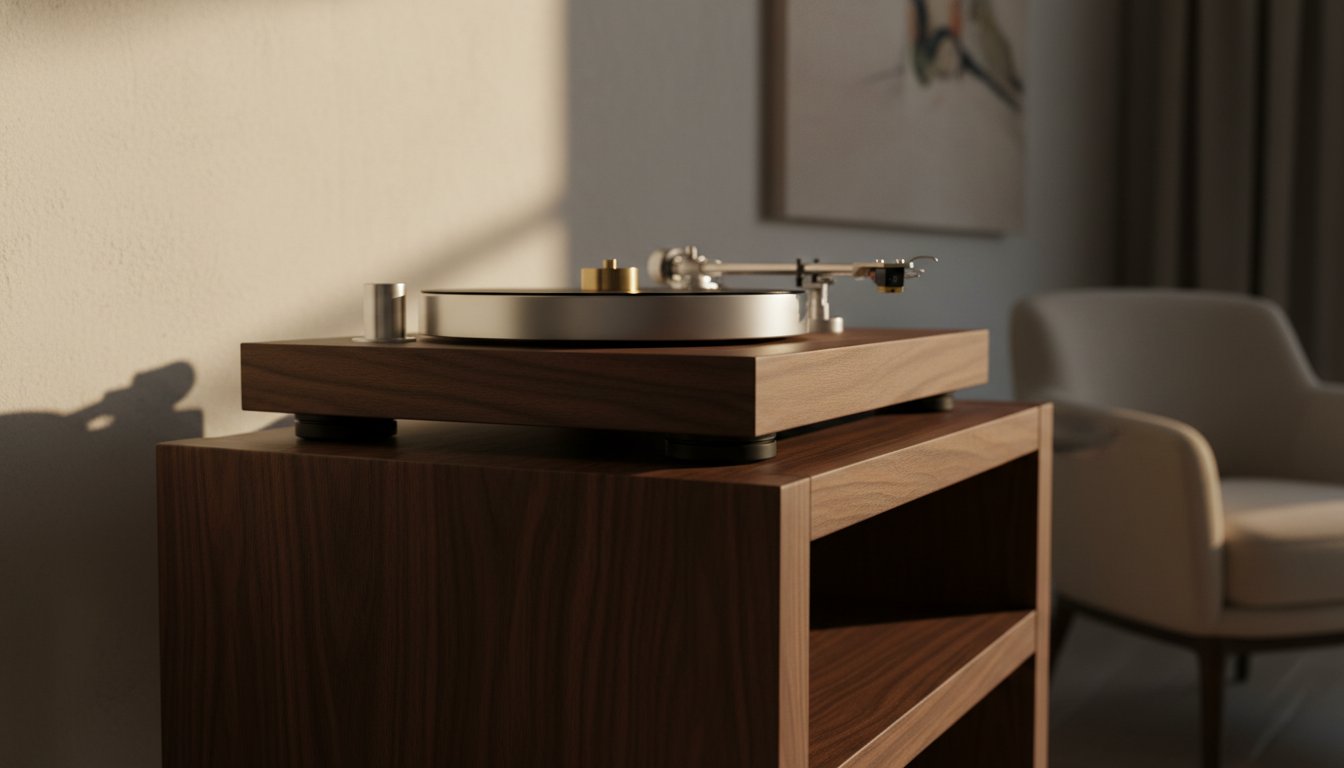
No component is more vulnerable than the turntable. Because a stylus reads grooves measured in microns, even the slightest structural instability can cause tracking errors or audible rumble. If you've ever experienced a needle skip because someone walked across the room, you've seen the impact of poor support firsthand. High-quality support ensures tracking accuracy and preserves the soul of your vinyl collection. For a deeper dive into protecting your analog setup, consult our turntable isolation platform guide. Choosing the right foundation is the first step in honoring your passion for sound.
Material Integrity: Solid Hardwood vs. the World of MDF
When considering what to look for when buying a hifi rack, the choice between solid timber and composite materials is the most impactful decision you'll make. Most mass-market furniture relies on Medium Density Fiberboard (MDF) or particle board. These materials are essentially compressed wood dust and chemical resins. While they offer a flat surface, they lack the organic complexity needed to interact with sound in a meaningful way. We believe that your equipment deserves a foundation that is as authentic as the music it reproduces.
Our manufacturing philosophy is anchored by four pillars: CUSTOM | HANDMADE | NATURAL | AUTHENTIC. By choosing solid wood over synthetic alternatives, you aren't just buying furniture. You're investing in a component that works in harmony with your system. Solid wood provides a unique combination of mass, rigidity, and internal damping that composites simply can't replicate. It's a material that lives and breathes, offering a soulful connection to your listening sanctuary.
Solid Wood: The Natural Resonator
Different wood densities possess distinct acoustic signatures. Oak is celebrated for its immense density and grounded stability. Walnut offers a sophisticated, slightly warmer resonance profile, while Cherry provides a balanced, neutral foundation. Unlike MDF, which is acoustically "dead" in a way that can make music feel flat, solid hardwood manages energy through its intricate grain structure. As one master craftsman put it, "Solid wood doesn’t just support gear; it manages energy naturally."
MDF lacks this internal architecture. Because it is a uniform, man-made slab, it tends to store energy and release it slowly, which can smear the timing of your audio. This natural resonance control is exactly what to look for when buying a hifi rack that aims for reference-level performance. If you are ready to move beyond mass-produced composites, explore our collection of solid wood racks to see the difference for yourself.
The "No Veneer" Rule
Veneer is often a cosmetic mask used to hide inferior structural materials. It's a thin layer of wood glued over a core of glue and sawdust. Over time, these layers can delaminate, especially in environments with varying humidity. More importantly, a veneered shelf lacks the structural integrity to support the heavy transformers found in high-end power amplifiers without sagging. A 50kg amplifier requires the uncompromising strength of a solid plank.
We use solid wood through and through because it offers aesthetic longevity. A solid wood rack can be refinished and passed down through generations. It gains character with age, much like a fine musical instrument. You can learn more about our commitment to sustainable, high-quality timber on our HiFi Rack Responsibility page. Choosing solid wood is a declaration of quality that honors both the craft of woodworking and the art of listening.

Structural Architecture: Reference, Classic, or Slim?
After selecting the right materials, the physical architecture of your support system becomes the next pillar of performance. A rack is more than a series of shelves; it is a structural dampener that must be tailored to the specific needs of your electronics. High-mass systems require a different approach to energy management than a simple integrated amplifier setup. This is what to look for when buying a hifi rack: a design that matches the physical demands of your current gear while accommodating the inevitable evolution of your system.
Modularity is a core requirement for any serious listener. Audiophile journeys are rarely static. You might start with a single source and an amp, but as your passion grows, so does your component list. A modular architecture ensures your investment lasts a lifetime. You can add tiers or reconfigure the layout without losing the acoustic benefits of solid wood. This flexibility allows your furniture to grow alongside your collection, maintaining the harmony of your listening sanctuary.
The Reference Standard for High-End Systems
For those pursuing the absolute peak of sonic fidelity, the Reference HiFi Rack sets the benchmark. This architecture is engineered for high-current, high-mass systems where individual components often exceed 50kg. A heavy power amplifier generates significant internal vibration. The Reference series uses massive construction to sink this energy effectively into the floor. Double-width or triple-width configurations don't just provide more room; they improve spatial organization. This allows for better separation between sensitive signal cables and high-voltage power lines, further lowering the noise floor of your system.
Classic and Slim: Performance in Every Profile
Not every listening room requires a massive footprint. The Classic HiFi Rack is the versatile heart of our collection, providing a balanced profile for standard audiophile setups. It offers the same handmade integrity as our Reference line but in a footprint that fits seamlessly into most homes. It's the ideal choice for those seeking a beautiful furniture piece that doesn't compromise on resonance control. It provides the stability your turntable needs while maintaining a sophisticated, understated presence.
For space-constrained environments or minimalist aesthetics, the Slim/Minimalist Rack proves that performance doesn't require bulk. Even in these leaner designs, we maintain the "Natural and Authentic" principles of solid wood isolation. This is essential when deciding what to look for when buying a hifi rack for a modern apartment or a dedicated secondary listening room. Where sound and style are one, even the most compact architecture can deliver a clearer soundstage and the authentic experience you deserve.
Technical Considerations: Dimensions, Airflow, and Spikes
Precision begins with a tape measure. While the aesthetic of a rack is paramount, its technical utility depends on a perfect fit for your specific gear. You should measure your largest component first. This is usually the power amplifier or a reference-grade turntable. Don't just measure the chassis. Factor in the depth required for heavy interconnects and power cables. A standard amplifier might be 440mm wide, but a massive monoblock can extend much further. Knowing these dimensions is a fundamental step in what to look for when buying a hifi rack that serves your system for years.
Cable management is another technical hurdle that often goes overlooked. Closed cabinets trap heat and make cable swaps a nightmare. Open-back designs are the professional choice. They provide the necessary space for thick, high-end power cords that don't bend easily. This layout also prevents signal interference by allowing you to separate power cables from sensitive interconnects. A well-organized rack doesn't just look better; it functions as a more efficient electronic environment.
Ventilation and Component Longevity
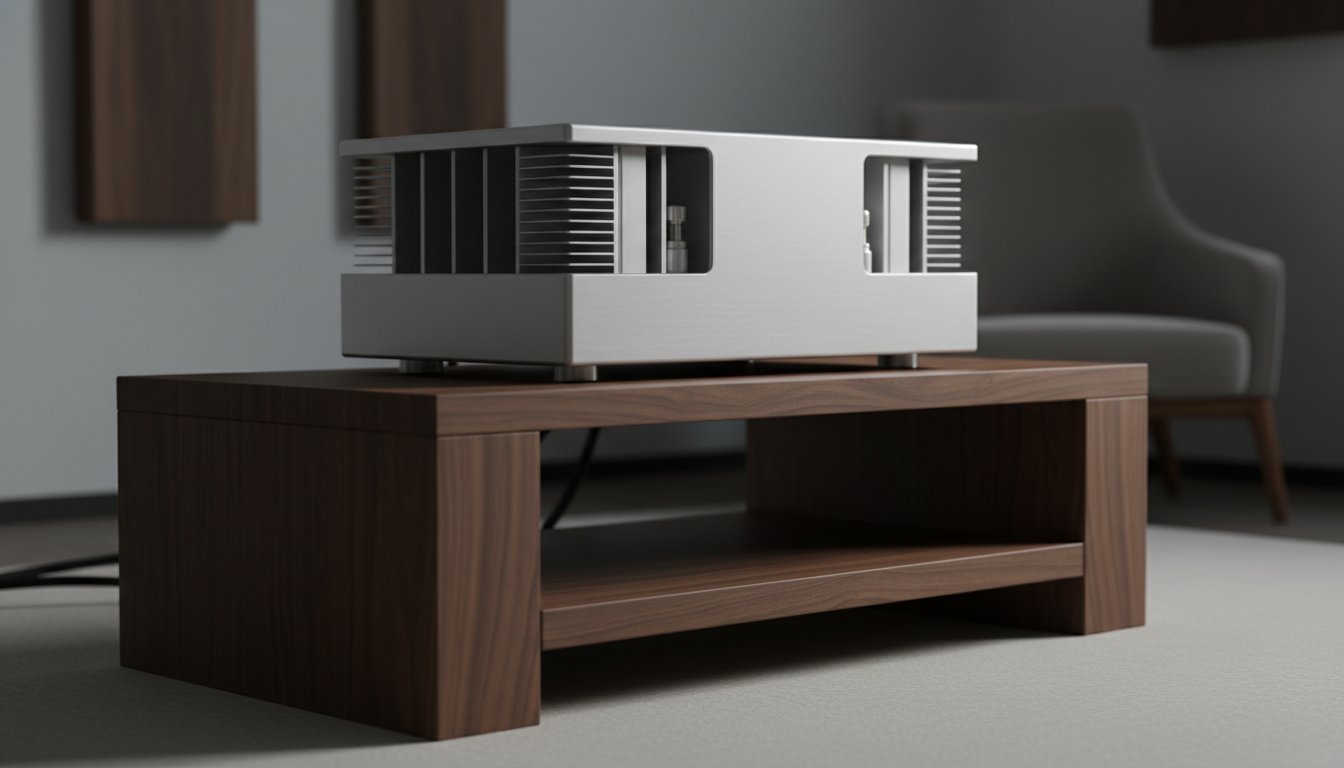
Heat is the silent enemy of high-fidelity electronics. Class A amplifiers, known for their sonic purity, often operate at high temperatures and require significant airflow. Providing 10cm to 15cm of vertical "breathing room" above these units is essential for natural thermal convection. Without proper clearance, heat buildup can degrade the electrolyte in capacitors. Research into electronic longevity suggests that excessive heat can shorten the lifespan of these components by nearly 50% over a five-year period. Proper shelf spacing isn't a luxury; it's a protective measure for your investment.
The Finishing Touch: Spikes and Floor Protectors
The final step in achieving sonic harmony is proper coupling. Precision-machined brass spikes act as a mechanical diode, draining unwanted energy from the rack into the floor. This is critical for turntable performance. A perfectly level surface is required for the tonearm to track accurately. Even a 1-degree tilt can introduce channel imbalance or tracking distortion. Brass is chosen for its specific density and ability to damp vibrations without adding a "ringing" quality to the sound. If you want to master the art of decoupling your entire system, read our Speaker Feet and Acoustic Isolation guide.
Ready to build your custom setup? Browse our modular rack options to find the perfect dimensions for your gear.
Handcrafted in Novi Sad: Choosing Your Forever Rack
Buying a HiFi rack is often the final step in an audiophile's journey, yet it is the one that secures the entire investment. When you consider what to look for when buying a hifi rack, you aren't just looking for a shelf; you're looking for a legacy. In an era where mass-produced, flat-pack furniture dominates the market, we choose a different path. Our "Slow-Made" philosophy rejects the rush of modern manufacturing. We believe that quality takes time, and that the hands of a master craftsman can imbue a piece of furniture with a soul that a machine simply cannot replicate.
This approach ensures that your rack isn't a temporary solution. It is a "forever" piece. By choosing solid wood, you're opting for a material that matures alongside your system. While electronics will inevitably be upgraded or replaced as technology advances, a handmade solid wood rack remains a constant. It is the steady foundation of your personal sanctuary, where sound and style are one. It provides the emotional payoff of knowing your system is supported by something as authentic as the music itself.
Customization: Tailoring to Your Passion
The beauty of a bespoke approach is that it adapts to your unique collection. Many audiophiles cherish vintage gear, such as the massive receivers of the 1970s or specialized tube amplifiers that don't fit into standard retail units. Custom dimensions allow you to provide the exact clearance and support these treasures require. Every HiFi Rack we produce is born from the rich Serbian woodworking tradition in Novi Sad. We offer a variety of natural finishes, from the deep warmth of Walnut to the classic strength of Oak, ensuring your rack matches your home decor perfectly.
The Investment Value of Solid Hardwood
Choosing solid timber is a financially sound decision for any serious listener. Unlike MDF or veneered furniture, which often loses its value and structural integrity over time, solid hardwood maintains a high resale value and incredible durability. It can withstand decades of use without sagging under the weight of heavy components. More importantly, the structural integrity of a high-quality rack prevents accidental damage to your expensive electronics. A stable, level platform reduces the risk of mechanical wear in delicate components like turntable bearings.
When you decide what to look for when buying a hifi rack, prioritize longevity and authentic craft. A well-made rack is a silent partner in your pursuit of musical perfection. It protects your gear, enhances your sound, and elevates your environment. Treat your equipment to the home it deserves. We invite you to explore the HiFi Rack Shop and discover a piece that will help you live your passion for a lifetime.
Elevate Your Listening Sanctuary Today
Your audio system deserves a foundation that matches its performance. Selecting a dedicated support is about more than aesthetics; it's about reclaiming the fine details lost to mechanical noise and thermal stress. By prioritizing solid wood over synthetic composites, you ensure your components operate in a naturally damped environment. This guide has outlined what to look for when buying a hifi rack, from the vital necessity of vertical airflow to the uncompromising structural rigidity of reference-grade architectures.
At HiFi Rack, we honor the CUSTOM | HANDMADE | NATURAL | AUTHENTIC mantra in every piece we create. Each rack is handcrafted in Novi Sad using multi-generational woodworking techniques that ensure your furniture lasts a lifetime. We maintain a strict zero MDF or veneer policy to preserve pure acoustic integrity. Because your gear is unique, every unit is custom-built to your specific component dimensions for a perfect, professional fit.
Explore our handcrafted Reference and Classic HiFi Racks and discover the place where sound and style are one. It's time to treat your music to the home it's always deserved. Happy listening.
Frequently Asked Questions
Do HiFi racks actually improve sound quality?
Yes, a dedicated support lowers the noise floor by isolating sensitive electronics from mechanical vibrations. This clarity allows your system to resolve low-level details that are otherwise masked by resonance. It's a fundamental part of what to look for when buying a hifi rack if you want to experience the full dynamic range of your recordings.
Why is solid wood better than MDF for audio furniture?
Solid wood manages energy through its natural grain structure, whereas MDF is a uniform slab that stores and slowly releases resonance. This storage smears the timing and clarity of your audio. We strictly avoid veneers because they often hide inferior materials that can't support the weight of high-end equipment.
How much weight can a solid wood hifi rack support?
A properly engineered solid wood rack easily supports over 50kg per shelf. This capacity is essential for high-current power amplifiers and heavy reference turntables. The structural integrity of solid hardwood prevents the sagging often seen in composite furniture, ensuring your components remain perfectly level and safe for a lifetime.
What is the best wood for a hifi rack?
Oak and Walnut are the premier choices for acoustic performance. Oak provides immense mass and grounded stability, while Walnut is prized for its sophisticated resonance profile. The choice often depends on your aesthetic preference and the specific tonal balance of your listening room.
How much space should I leave between components for ventilation?
You should leave at least 10cm to 15cm of vertical clearance above heat-generating components. Class A amplifiers and tube gear rely on thermal convection to stay cool. Providing this breathing room prevents heat from degrading internal capacitors, which can extend the life of your electronics by up to 50% over five years.
Can I use a regular bookshelf as a hifi rack?
No, a regular bookshelf isn't designed to manage the specific frequencies that affect audio gear. Most bookshelves are hollow or made from thin composites that amplify vibrations. A dedicated rack is an acoustic instrument, built to provide the isolation and mass required for high-fidelity playback.
Do I need floor protectors for my hifi rack spikes?
Floor protectors are necessary to prevent the precision-machined spikes from damaging your flooring. They allow the spikes to drain unwanted energy into the ground while protecting delicate surfaces like hardwood or marble. This setup ensures that the mechanical connection remains rigid without leaving permanent marks on your sanctuary.
How do I level my hifi rack for a turntable?
You level your rack by adjusting the threaded brass spikes at the base of each leg. Use a high-precision spirit level on the top shelf to ensure the surface is perfectly horizontal. This is critical for turntable performance, as even a minor tilt can cause uneven stylus wear and tracking errors.