What if the most significant bottleneck in your high-fidelity system isn't a silver cable or a high-end DAC, but the very surface where your equipment rests? You've likely spent years refining your signal path, yet it's easy to overlook how a lack of structural integrity introduces unwanted noise. Premium audio cabinets are far more than aesthetic choices; they are foundational acoustic instruments. Technical research into mechanical isolation suggests that external vibrations can increase measurable harmonic distortion in sensitive tube amplifiers by as much as 15 percent. Without proper dampening, your turntable's needle captures every floorboard creak instead of the pure, intended signal.
You know the frustration of seeing expensive gear overheat in a closed shelf or struggling with a chaotic web of cables that degrades signal purity. We'll show you how a transition to specialized, handmade housing provides the thermal management and resonance control your system demands. This guide explores how to achieve a resonance-free listening environment where your gear is both protected and showcased. Discover the path to a setup where your passion for music meets the authentic beauty of natural materials, proving that sound and style are truly one.
Key Takeaways
- Understand how a specialized equipment support transcends mere storage to become a vital instrument in your pursuit of musical perfection.
- Discover the science of resonance control and how professional audio cabinets isolate sensitive electronics from destructive mechanical feedback.
- Learn why natural, handcrafted hardwoods offer superior acoustic damping and authenticity compared to synthetic, mass-market composites.
- Identify the "silent killers" of high-fidelity sound, from trapped thermal loads to improper cable geometry and signal interference.
- Master the essential steps to design a custom sanctuary where high-end performance and artisanal style are finally one.
Defining the Modern Audio Cabinet: More Than Just Storage
An audio cabinet is far more than a resting place for your amplifier. It functions as a specialized equipment support engineered to mitigate mechanical vibration and manage demanding thermal loads. In a high-fidelity ecosystem, every component interacts with its environment; your furniture is no exception. A poorly designed stand allows external energy to muddy the soundstage. By 2026, the sophisticated listening room requires a unified concept where sound and style are one. This evolution moves beyond the simple utility of storage toward a piece of furniture that serves as a vital instrument in the pursuit of musical perfection. It's about protecting the signal-to-noise ratio of your entire system from the ground up.
Specialized Audio Furniture vs. General Home Decor
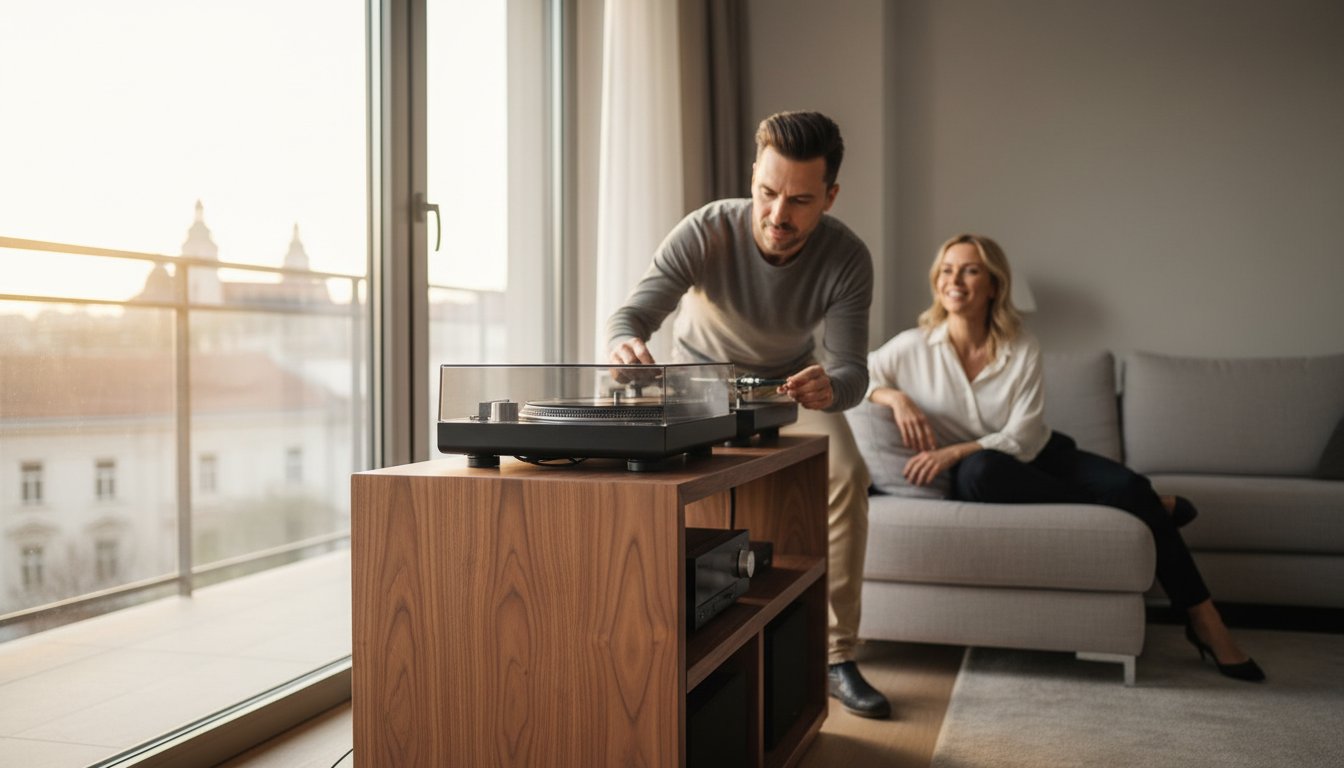
Standard particle-board furniture often fails under the weight of high-end gear. High-end amplifiers frequently exceed 25 kilograms, causing thin, mass-market shelves to bow and lose their level. This physical sagging is only the beginning of the problem. Aesthetic-first designs often use hollow cavities or resonant materials that compromise the performance of sensitive analog components. A turntable, for example, requires a level of isolation that general home decor simply cannot provide. Just as Loudspeaker enclosure design dictates the clarity and resonance of a driver, the structure housing your electronics influences their final output. The audio cabinet is a passive acoustic component in the signal chain.
The Anatomy of a High-Performance Audio Cabinet
High-performance audio cabinets rely on absolute structural rigidity to maintain sonic purity. A rock-solid frame prevents turntable skipping and keeps delicate laser assemblies in CD players tracking with precision. This stability is non-negotiable for serious listeners who treat their equipment with reverence. Thermal management is equally critical; high-bias Class A amplifiers can reach internal temperatures of 60 degrees Celsius, requiring a cabinet designed with airflow in mind to prevent component degradation.
Design choices usually fall between modular and fixed structures. Modular systems offer the flexibility to adapt to changing equipment stacks as your collection grows. Fixed designs provide a singular, dense foundation for ultimate stability. At Myro HiFi Rack, our philosophy centers on natural, authentic materials that honor the craft of woodworking. Solid wood provides inherent damping properties that synthetic materials lack, ensuring your audio cabinets are handmade to last a lifetime. This approach creates a personal sanctuary where high-end engineering and organic beauty exist in total harmony.
The Science of Resonance and Isolation in Audio Cabinets
Vibrations are the silent enemy of high-fidelity sound. Every footfall on a hardwood floor or the low-frequency thrum of a passing vehicle sends mechanical energy through your home's structure. This energy travels directly into the legs of your furniture and eventually reaches the sensitive internal circuits of your amplifier. This process, known as mechanical feedback, creates a layer of noise that obscures fine musical detail. To combat this, high-performance audio cabinets must act as sophisticated energy filters rather than simple storage units.
Effective vibration management relies on two core principles: damping and decoupling. Damping involves the use of materials that convert kinetic energy into heat, effectively "soaking up" the vibration before it reaches the gear. Decoupling, on the other hand, seeks to break the physical path between the floor and the component. High-end Resonance control and vibration isolation strategies often combine both to ensure the equipment stays perfectly still. When a cabinet lacks these features, the resulting harmonic distortion can make a $10,000 system sound like a budget setup.
Mass is your greatest ally in this pursuit. Physics dictates that a heavier object requires more energy to move. A solid wood cabinet weighing 85 kilograms provides a much more stable foundation than a 20-kilogram alternative made of thin veneers or metal tubing. This density prevents the furniture from vibrating in sympathy with the music, ensuring that the only thing moving in your room is the air pushed by your speakers.
Managing Micro-Vibrations in Sensitive Electronics
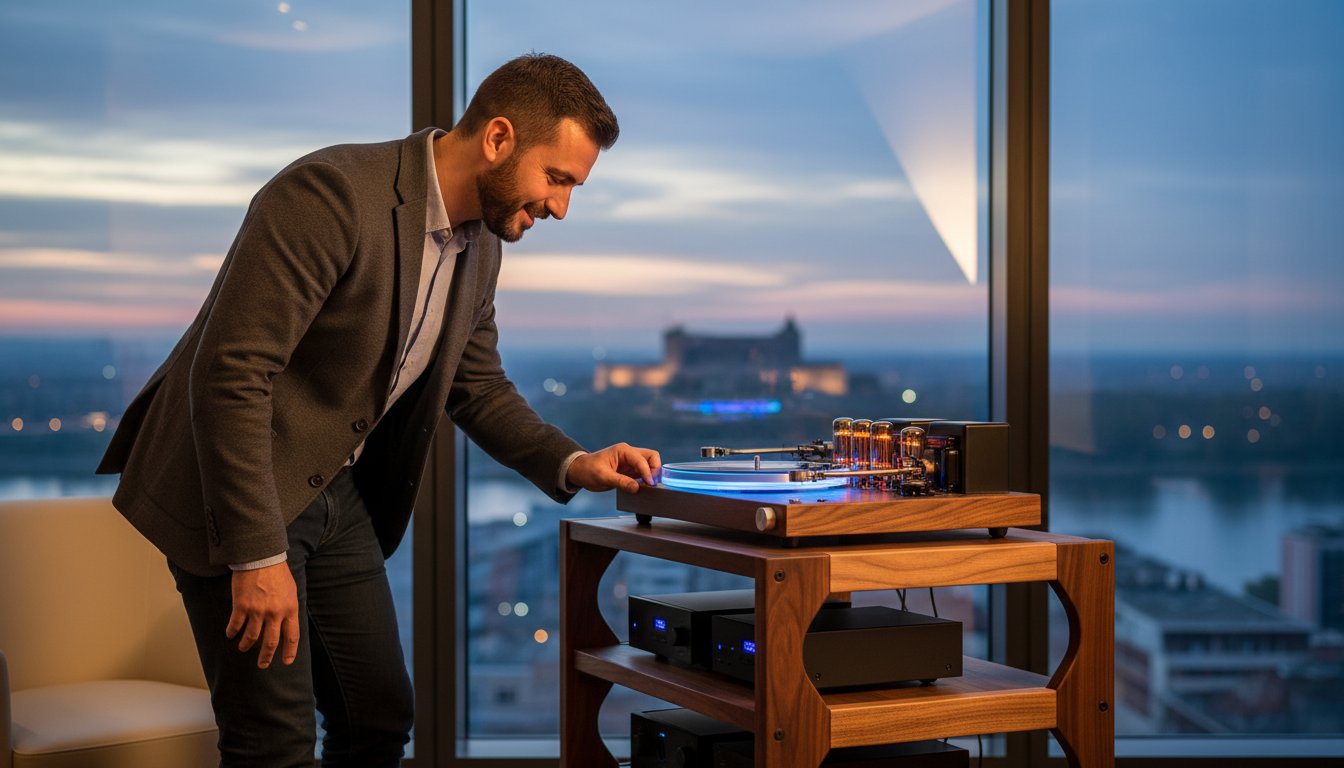
Sensitive components like vacuum tubes are inherently microphonic. They pick up physical vibrations and translate them into audible ringing or "ghost" notes. Even modern high-precision DACs suffer; mechanical stress on internal clocks can increase jitter by 15% or more, blurring the stereo image. While glass doors and shelves are common in furniture design, they often create unwanted ringing at frequencies between 500Hz and 3kHz. We choose solid wood because its organic cellular structure naturally dissipates energy. It's a material that embodies our philosophy: CUSTOM | HANDMADE | NATURAL | AUTHENTIC.
Mass Loading and Structural Rigidity
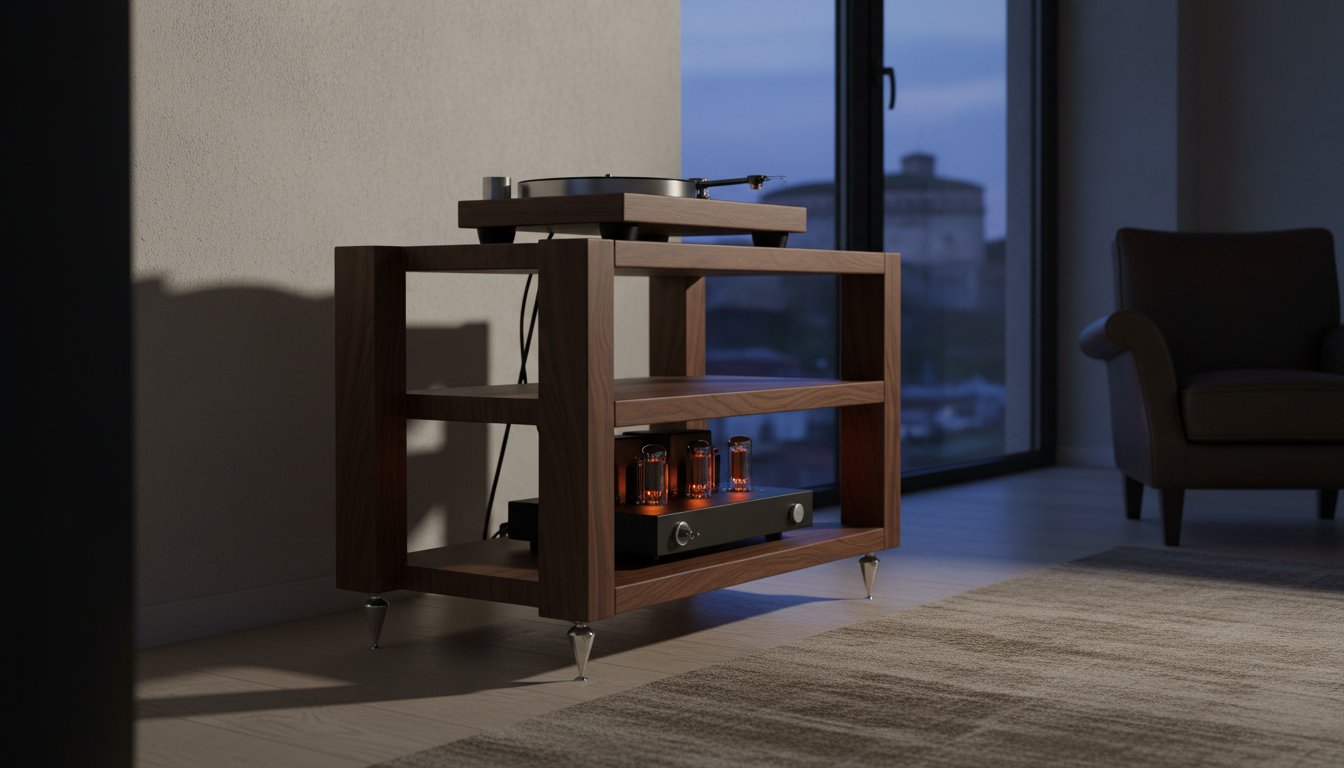
Rigidity is essential for maintaining low-frequency clarity. A flimsy rack will flex under the pressure of deep bass notes, creating a "muddy" sound. Heavy-duty construction ensures that the cabinet remains inert, allowing your speakers to provide the punch and definition they were designed for. To ground the system, we utilize solid brass spikes. These spikes focus the entire weight of the cabinet onto a tiny surface area, which effectively drains internal energy into the floor. For a deeper technical dive into breaking the vibration chain, read our reference on Speaker Feet and Acoustic Isolation.
Where sound & style are One, the furniture becomes a silent partner in the performance. If you want to experience this level of clarity in your own home, you can explore our collection of artisan racks designed specifically for the serious listener.
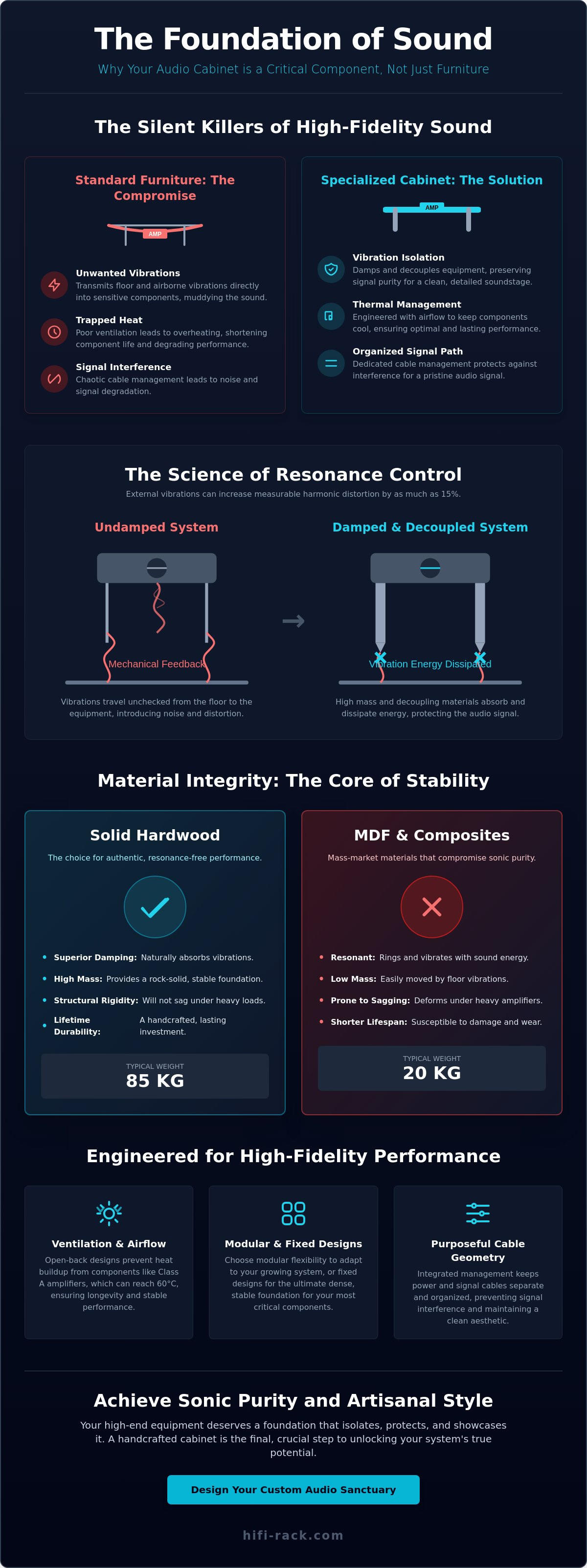
Material Integrity: Why Solid Hardwood Outperforms MDF
The "MDF Myth" has persisted for decades, fueled by a manufacturing industry that prioritizes profit margins over sonic purity. Most mass-produced audio cabinets are constructed from Medium Density Fiberboard because it's cheap, uniform, and easy to machine. It's a choice dictated by the factory floor, not the listening room. While industrial boards offer a flat surface for thin veneers, they lack the organic soul required to breathe life into a high-fidelity system. For the discerning listener, a cabinet isn't just a box; it's a foundation.
The Acoustic Damping Properties of Natural Wood
Natural hardwoods like oak, walnut, and cherry possess a complex cellular structure that acts as a sophisticated energy management system. These organic fibers absorb high-frequency micro-vibrations that would otherwise travel through a steel rack and into your sensitive components. Research into the science of vibration and resonance in audio furniture, including collaborations with the Dortmund University of Applied Sciences and Arts, confirms that material density directly impacts acoustic transparency. Because solid hardwood lacks the uniform internal frequency of synthetic MDF, it naturally prevents the formation of standing waves that otherwise muddy the soundstage. This inherent damping creates a warmer, more authentic sonic signature. It allows your equipment to perform with the clarity the engineers intended.
Avoiding the Pitfalls of Veneer and MDF
Choosing solid wood is a commitment to health and longevity. Standard MDF is often saturated with urea-formaldehyde glues, which can off-gas chemicals into your home sanctuary for years. Beyond the air quality, there's the issue of structural fatigue. Heavy power amplifiers, some weighing over 40 kilograms, put immense stress on shelving. Over time, the weak bonds in particle board begin to yield, leading to the "MDF sag" that ruins the alignment of your audio cabinets.
Solid wood is a lifetime investment. It can be refinished, repaired, and passed down through generations. Our approach at Myro HiFi Rack centers on responsibility and sustainability, ensuring every piece of timber is ethically sourced and built to endure. In a digital age of disposable electronics, there's a profound aesthetic value in something handmade. It's a return to the tactile and the real. When you touch a hand-finished walnut surface, you feel a connection to the craft that no synthetic composite can replicate. We believe in a philosophy where sound and style are one, anchored by our four pillars: CUSTOM | HANDMADE | NATURAL | AUTHENTIC. Your audio cabinets should be as timeless as the music they support.
Functional Design: Ventilation, Cable Management, and Load Capacity
Your audio system is a living, breathing entity. To treat it as mere furniture is to ignore the physical demands of high-end electronics. When selecting audio cabinets, the priority shifts from simple storage to active thermal and electrical management. A poorly designed enclosure acts as a kiln, slowly baking the delicate internal components of your gear and degrading the signal you've worked so hard to refine.
Thermal Management and Equipment Longevity
Heat is the silent killer of audiophile equipment. Electrolytic capacitors, vital for stable power delivery, can see their operational life cut by 50% for every 10-degree Celsius increase in operating temperature. Effective cabinets utilize the "Chimney Effect," where natural convection draws cool air from the floor and exhausts heat through the top. This is critical for Class A amplifiers. These components require a minimum of 15cm of clearance above the chassis to dissipate heat safely. Standard audio cabinets with glass doors often trap this thermal energy, leading to premature component failure and thermal throttling that chokes your dynamic range.
Organizing the Signal Path
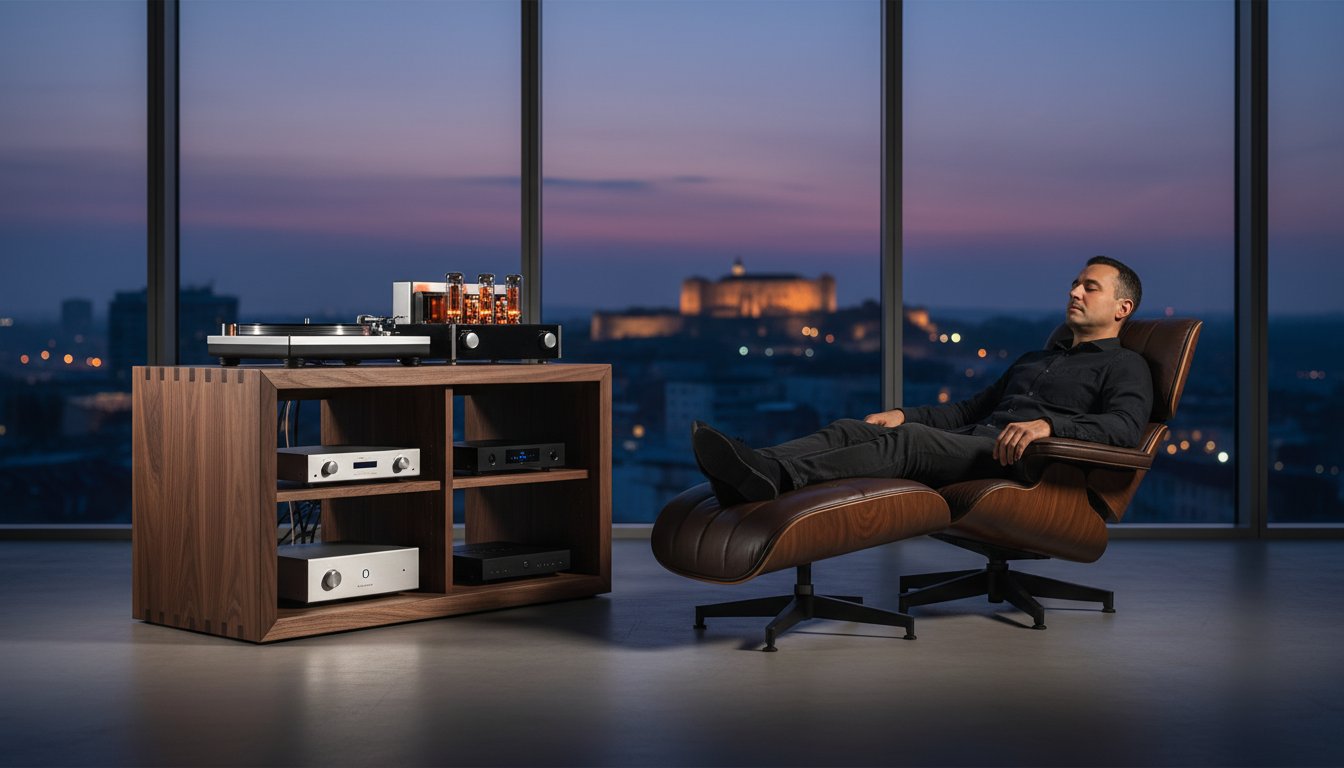
The space behind your equipment is just as important as the shelf it sits on. Cable geometry dictates that high-current power cords and sensitive signal interconnects shouldn't run parallel in close proximity. Proper design allows for clear separation to minimize EMI and RFI interference. We believe in providing easy access to the rear panel, making cable swaps a tactile pleasure rather than a frustrating chore. The Reference HiFi Rack sets the standard for this approach, utilizing an open-architecture layout that prioritizes maximum airflow and cable isolation.
Structural integrity must also account for the sheer mass of premium gear. A high-performance power amplifier can easily weigh 50kg or more. If your shelving lacks the density to support this load, it'll bow, creating mechanical stress and unwanted vibrations. Open-architecture designs offer a distinct advantage here, providing the rigidity needed for heavy components while maintaining the natural and authentic aesthetic of a dedicated listening room. Choosing between open and enclosed designs is ultimately a choice between maximum performance and aesthetic concealment, but for the serious listener, the open path is often the most honest.
Ensure your equipment has the foundation it deserves.
Browse our custom handmade racksChoosing Your Custom Audio Cabinet: Form Meets High-Fidelity
Selecting the right foundation for your system is a ritual that balances technical necessity with personal style. Your choice in audio cabinets dictates the physical limits of your listening experience. To ensure your investment provides both structural integrity and aesthetic harmony, follow this deliberate selection process.
- Step 1: Inventory your current gear. List every component, from your phono stage to your streamer. Always allow 20% extra space for future upgrades. This buffer isn't just for new purchases; it ensures essential airflow and room for high-end cabling that requires a larger bend radius.
- Step 2: Measure your largest component. High-performance power amps often exceed standard depths, and massive turntable plinths require wide footprints. A Class A amplifier might need 15cm of vertical clearance to dissipate heat effectively.
- Step 3: Select a hardwood. Choose a timber that complements your room's acoustic profile. Solid walnut and oak aren't just visual choices; their density provides natural damping properties that composite materials cannot match.
- Step 4: Determine isolation accessories. Precision-machined spikes are vital. These components decouple the rack from floor-borne vibrations, ensuring that the only movement in your room comes from the air pushed by your speakers.
Customization for Specific Component Dimensions
Mass-produced furniture fails the audiophile because it assumes a standard depth that rarely exists in high-end circles. True performance requires a bespoke approach. While adjustable shelving offers some flexibility, fixed bespoke heights provide maximum structural stability by reducing the number of moving parts. For those who value a modular approach without sacrificing the "built-for-me" feel, the Classic HiFi Rack offers a timeless solution that grows alongside your passion.
The "Slow-Made" Philosophy: Handcrafted in Serbia
In our workshop in Novi Sad, we reject the frantic pace of modern manufacturing. We embrace a "slow-made" philosophy rooted in multi-generational woodworking expertise. Every audio cabinets project we undertake is a tribute to the craft, ensuring that your furniture is as enduring as the music you love. We build each piece to be a life-long partner in your pursuit of sonic perfection.
CUSTOM | HANDMADE | NATURAL | AUTHENTIC
These four pillars define the Myro HiFi Rack experience. We don't just build storage; we create instruments of silence that allow your music to breathe. It's a soulful connection between the artisan, the listener, and the sanctuary of the home.
Ready to transform your listening space? Explore our full range of handcrafted audio cabinets and find the piece where sound and style are one.
Harmonize Your Sound and Style
The journey to sonic perfection doesn't end with the purchase of high-end electronics. It's completed by the environment you create for them. You've learned how structural integrity and isolation directly influence clarity, and why solid hardwood is the only choice for those who refuse to compromise. Proper ventilation and precise cable management aren't just conveniences; they're essential for the longevity of your investment.
At Myro HiFi Rack, we believe your equipment deserves a home that's as refined as the music it plays. Our audio cabinets are handcrafted in Serbia by artisans using woodworking techniques refined over three generations. We use strictly zero MDF or veneer. Every piece is built from 100% natural hardwoods and custom-tailored to your specific equipment dimensions to ensure a perfect fit. It's a commitment to the philosophy where sound and style are one.
CUSTOM | HANDMADE | NATURAL | AUTHENTIC
Discover Handcrafted Solid Wood Audio Cabinets
Invest in a piece that honors your passion and transforms your listening room into a true sanctuary. Your music has never been in better hands.
Frequently Asked Questions
Do audio cabinets really improve sound quality?
Yes, high-quality audio cabinets directly improve sound quality by isolating components from parasitic vibrations. When a turntable or amplifier sits on a resonant surface, micro-vibrations distort the signal. Research into mechanical grounding shows that a dense, decoupled structure can reduce the noise floor by up to 10 decibels. This clarity allows you to hear the subtle textures of a recording that would otherwise be lost to mechanical interference.
Why is solid wood better than MDF for audio furniture?
Solid wood offers superior damping properties and structural rigidity compared to Medium Density Fiberboard. While MDF is cheaper, solid hardwoods like oak or walnut possess a non-uniform cellular structure that naturally breaks up standing waves. A 40mm thick solid wood shelf provides a more stable platform for sensitive hi-end equipment. This organic density ensures your music remains authentic and free from the boxy coloration often found in mass-produced composite furniture.
How much weight can a standard audio cabinet hold?
A professionally engineered rack typically supports between 50 and 100 kilograms per shelf. High-end tube amplifiers can weigh over 40 kilograms alone, requiring a frame that won't sag or warp over time. Handcrafted racks often utilize mortise and tenon joinery to ensure 100 percent structural integrity. This robust construction prevents the physical deformation that can misalign delicate internal components in your CD players or streamers.
Is an open-back cabinet better than one with glass doors?
Open-back designs are technically superior for performance because they prevent heat buildup and simplify cable routing. Power amplifiers can reach internal temperatures of 65 degrees Celsius, necessitating constant airflow to prevent thermal throttling. Glass doors often trap this heat and can introduce unwanted reflections or chatter at high volumes. An open architecture ensures your gear stays cool while providing easy access to your 24-carat gold-plated connectors.
What is the best way to manage cables in an audio rack?
The most effective cable management strategy involves physically separating power cords from signal cables by at least 15 centimeters. This distance minimizes electromagnetic interference that causes audible hum. Use dedicated cable channels or Velcro ties to route wires vertically along the rear supports. Keeping your signal path clean isn't just about aesthetics; it's about preserving the 110-decibel signal-to-noise ratio your equipment was designed to deliver.
Can I use a regular TV stand for my HiFi equipment?
You can use a standard TV stand, but it won't provide the vibration isolation required for true high-fidelity sound. Most consumer furniture uses thin veneers and hollow cores that resonate at frequencies between 50 and 200 Hertz. This resonance colors the bass and smears the stereo image. Investing in dedicated audio cabinets ensures that your equipment is supported by materials chosen specifically for their acoustic neutrality and long-term durability.
How do I stop my turntable from vibrating on a wooden floor?
To stop floor-borne vibrations, place your turntable on a dedicated isolation platform or a wall-mounted shelf. Footfall vibrations on a wooden floor can reach 5 Hertz, which is enough to cause groove skipping or muddy low-end response. Adding a 20-pound granite slab or a specialized decoupling base can reduce these disturbances. This creates a stable environment where the needle can track the record groove with 100 percent precision.
What are the benefits of using brass spikes on audio cabinets?
Brass spikes act as mechanical diodes that drain vibrational energy away from your equipment and into the floor. Brass is a preferred material because its specific gravity and hardness allow for efficient energy transfer without adding its own sonic signature. By reducing the contact area to a point smaller than 1 square millimeter, you decouple the rack from the room. This results in a tighter bass response and a more focused soundstage.