Your high-end audio system is only as refined as its weakest connection. Often, that weakness is the hidden chaos of your wiring. A tangled "cable forest" is more than just an eyesore; it's a physical barrier between you and the pure, authentic sound your system was built to deliver. You've invested hours selecting perfect components, yet visual clutter and signal hum can ruin the sanctuary you've worked so hard to create. It's frustrating to struggle with a port when you simply want to lose yourself in the music.
This guide explores how thoughtful hifi rack cable access design, a cornerstone of the HiFi Rack philosophy, transforms your setup from a cluttered workspace into a high-performance masterpiece. At HiFi Rack, we believe that where sound and style are one, every detail matters. You'll learn how to use specialized tools like the $12.99 Sweetwater hook and loop ties or the award-winning January 2026 HIFISTAY Sound Wings+ to improve your signal-to-noise ratio. We'll show you how to maintain easy access for future upgrades while highlighting the natural, handcrafted beauty of your solid wood furniture.
Key Takeaways
- Understand why strategic routing is essential for eliminating electromagnetic interference and preserving the purity of your signal.
- Discover how intentional hifi rack cable access design simplifies component swaps by ensuring adequate hand-clearance and logical entry points.
- Learn to map your rack elevation by placing high-current amplifiers on lower tiers to minimize cable length and physical strain.
- Explore advanced isolation techniques, including the use of cable risers to decouple wiring from floor-borne vibrations and static.
- Realize the structural benefits of authentic solid wood furniture in supporting heavy, high-end cabling without the resonance issues found in MDF.
The Audiophile’s Dilemma: Why Cable Access Design Matters
For the dedicated listener, the equipment is only half the story. The other half is the environment that supports it. Effective hifi rack cable access design is the strategic planning of entry points and routing paths within your audio furniture. It's the difference between a chaotic "cable forest" and a serene listening sanctuary. While basic furniture focuses on merely hiding wires, high-end audio requires a deeper understanding of cable management principles to protect the signal from degradation.
Poorly planned routing often leads to electromagnetic interference (EMI) and radio frequency interference (RFI). These invisible forces raise the noise floor and obscure the micro-details in your favorite recordings. Unlike mass-produced MDF or veneer alternatives, our solid hardwood racks provide a naturally inert foundation. Solid wood doesn't just look better; it absorbs energy rather than reflecting it back into your sensitive cabling. As of January 2026, vibration control has become a defining feature for serious enthusiasts who recognize that every physical contact point affects the final sound.
To better understand how to organize your components for maximum performance, watch this helpful video:
Signal Integrity and the Noise Floor
Cables are more than just conduits; they're sensitive antennas. When power cables are bundled too tightly with low-level interconnects, they "pollute" the signal. This often results in a persistent hum or a loss of dynamic range. We recommend the 90-degree crossing rule. By ensuring power and signal lines only cross at right angles, you minimize inductive coupling. Our Reference HiFi Rack is designed to facilitate this separation, keeping your signal pure and your background black.
Bespoke wood furniture also plays a role in dampening micro-vibrations. These tiny tremors can travel through cables and into your components, affecting delicate clocking and circuitry. A handmade rack treats the cable as an extension of the instrument itself. Using hifi rack cable access design to keep cables suspended or properly routed prevents them from picking up floor-borne interference that can muddy the soundstage.
Heat Dissipation and Component Longevity
A dense nest of cables does more than ruin the view; it traps heat. High-power amplifiers generate significant thermal energy that must escape to ensure longevity. An open-architecture design allows for natural convection, pulling cool air from the bottom and exhausting heat through the back. When you plan your rack elevation, identify the "hot zones" around your power stages. Proper cable access ensures that wiring doesn't block these vital airflow paths. This commitment to harmony between form and function is where sound and style are one. By avoiding the "cable forest" effect, you protect your investment and allow your equipment to breathe, ensuring it performs at its peak for a lifetime.
Planning Your Rack Elevation for Optimal Access
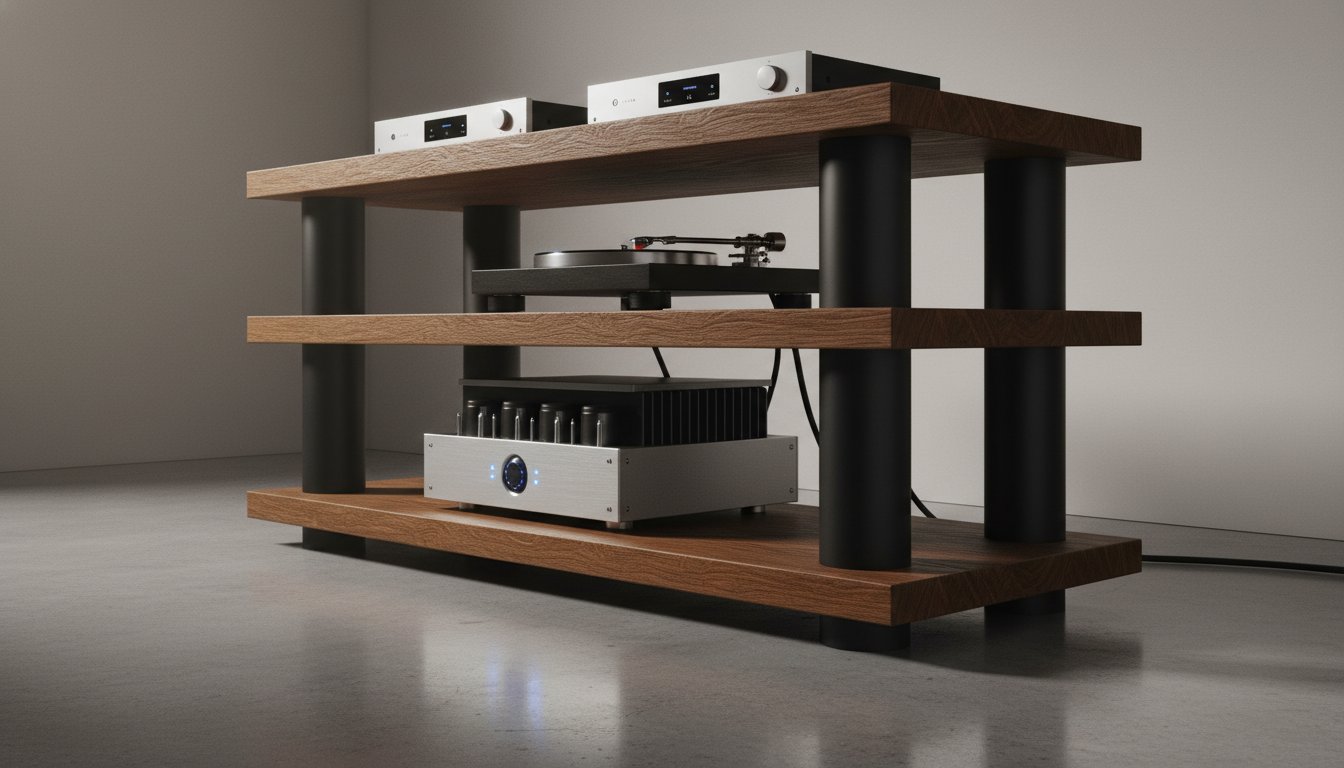
A common mistake in the audiophile journey is selecting furniture based solely on shelf count. True performance begins with a blueprint. Effective hifi rack cable access design requires you to map your components before the first spike touches the floor. By visualizing the rear panel of your system, you can anticipate where connections will cluster. This prevents the "cable strain" that occurs when heavy, high-end power cords pull against sensitive inputs. We recommend placing your heaviest, most power-hungry amplifiers on the lowest tiers. This keeps the center of gravity stable and allows for the shortest possible runs for thick power cables that are often difficult to bend.
One detail often overlooked is "Hand-Clearance." You need more than just enough vertical space to fit a component. We suggest a minimum of 75mm of open space above the deepest piece of gear. This gap isn't just for cooling; it allows you to reach behind the unit to swap interconnects or adjust a ground wire without dismantling the entire stack. Modular systems, such as those discussed in The Ultimate Guide to Choosing a Solid Wood HiFi Rack, offer a distinct advantage here. They allow you to adjust shelf heights as your collection of gear evolves, ensuring your access remains uncompromised.
The Logic of Component Placement
Source components like turntables and streamers belong at the top of your elevation. This placement serves a dual purpose. First, it provides easy physical access for changing records or checking connections. Second, it minimizes the length of sensitive phono cables. As noted in Audioholics' Cabling Guide, keeping low-level signal paths short is critical for preserving signal strength and preventing noise floor creep. By keeping these delicate lines away from the high-current power supplies of your amplifiers at the bottom, you maintain a cleaner, more authentic soundstage.
Visual Symmetry and Cable Paths
Achieving a minimalist look doesn't mean hiding your passion. It means organizing it. You can design a "central spine" where cables are bundled neatly behind the main pillars, or opt for side-routing to keep the center view clear. The solid wood structure of a Myro Classic provides natural masking points that MDF simply cannot match. The grain and sturdy pillars act as a visual anchor, drawing the eye to the handcrafted beauty of the wood rather than the wiring behind it. If you prefer a more understated aesthetic, our Slim HiFi Rack maintains a low profile while still offering the structural integrity needed to manage complex looms. If you aren't sure which elevation fits your room, explore our bespoke configurations to find the perfect balance of form and function.

A Step-by-Step Guide to a Clean Audio Setup
True craftsmanship doesn't stop at the joinery of the wood; it extends to how you curate the space behind your gear. To achieve a pristine audio sanctuary, start with a total teardown. Clear your solid wood rack completely. This blank canvas lets you evaluate the true potential of your hifi rack cable access design without the distraction of legacy clutter. It's a moment to appreciate the grain of the timber before it's once again populated by the instruments of your passion.
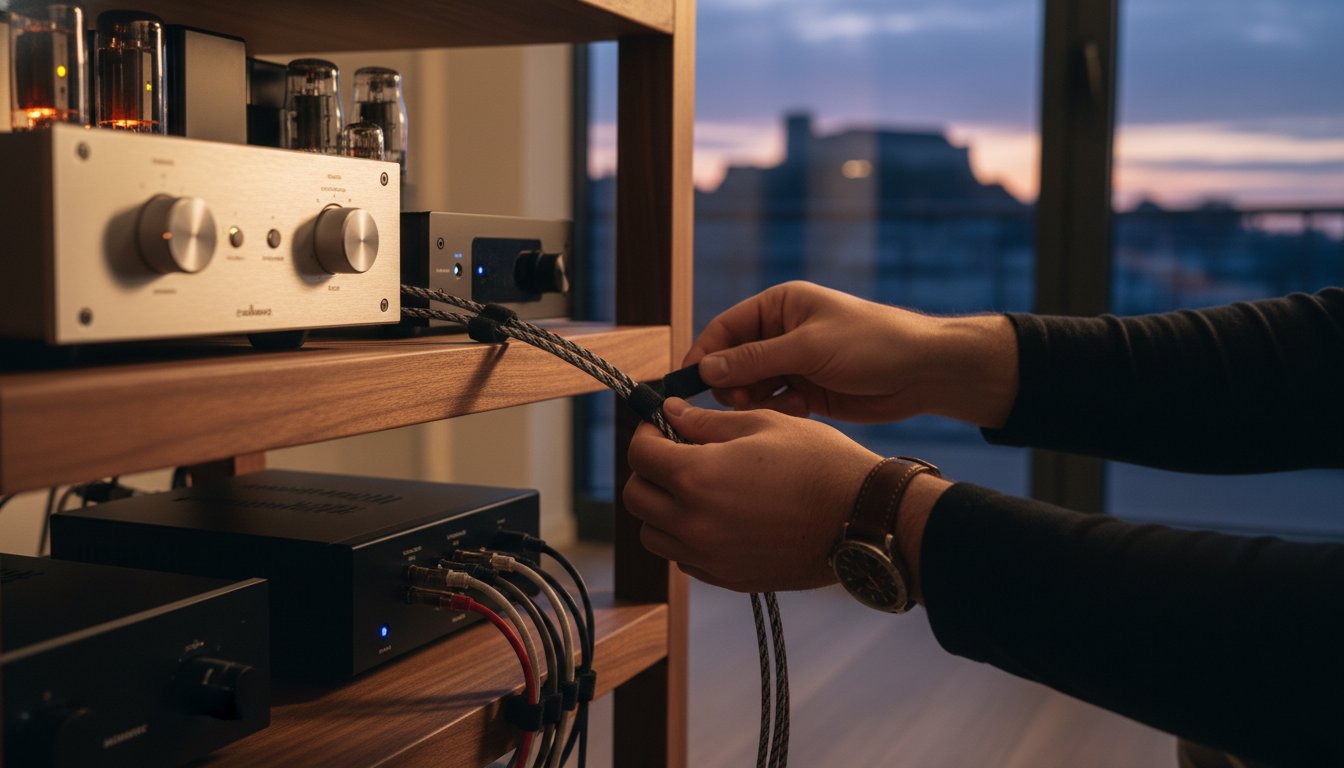
Route your power first. High-current cords are the heavyweights of your system and often the most stubborn to position. By laying them along the floor or the lowest tier, you create a stable foundation that won't interfere with delicate signal lines later. Second, maintain strict signal separation by keeping interconnects on a distinct path. Third, prioritize tension management. A cable should never "hang" from a component’s jack; it should rest naturally. Fourth, use non-marring ties for the final dressing to protect the handmade finish of your furniture while keeping the loom tight and intentional.
Managing Cable Strain and Weight
High-end cables often carry surprising mass. A single 1.5-meter boutique power cord can exert enough leverage to strain expensive RCA or XLR connectors. This "cable sag" isn't just a visual issue; it can physically damage internal circuitry or lead to loose connections over time. Use the sturdy cross-members of your rack as natural strain-relief points to take the weight off the input. Solid wood pillars offer a far superior anchor for weight distribution than the vibrating metal rails found in cheap alternatives, ensuring your connections stay secure for years.
Labeling for the Long Term
Keep your "Natural" aesthetic intact with discrete labeling techniques. Small heat-shrink tags or subtle alphanumeric codes near the connectors are far more elegant than messy tape. If you're managing a complex multi-channel system, a subtle color-coding system can be a lifesaver during future troubleshooting. We suggest the "One-In, One-Out" rule for your Reference HiFi Rack. When you upgrade a component, remove the old wiring immediately. This simple habit ensures your hifi rack cable access design remains as clear and intentional as your listening experience.
Advanced Audiophile Techniques: Risers and Damping
Lifting your cables off the ground is more than a visual choice. It is a calculated move to reduce floor-borne vibrations and static interference. When a high-fidelity cable rests directly on a carpeted floor, it interacts with the dielectric properties of the flooring material. This interaction can alter the capacitance of the cable and subtly degrade the signal. By incorporating risers into your hifi rack cable access design, you create a physical barrier that preserves the integrity of your audio path. It helps you live your passion without the interference of the mundane world.
We believe that every element should reflect the quality of the system. Using matching solid wood risers ensures that your aesthetic remains CUSTOM | HANDMADE | NATURAL | AUTHENTIC. These risers serve as an extension of the rack itself, providing consistent damping properties. This is particularly important for preventing microphonic feedback, where physical vibrations from the rack or floor are converted into electrical noise within the cable. For those using sensitive analog sources, a small amount of cable slack is vital. This loop prevents mechanical energy from traveling up the wire and causing the "Turntable Skip" during high-energy passages. This is where sound and style are one.
Cable Risers and Floor Isolation
Lifting cables off the carpet reduces dielectric involvement by ensuring the air acts as the primary insulator around the cable jacket. This technique is a natural progression from the concepts explored in Speaker Feet and Acoustic Isolation. The Skin Effect is a phenomenon where high-frequency signals travel primarily along the outer surface of a conductor, making the cable’s proximity to external surfaces even more critical for signal purity. By isolating the cable, you ensure that your hifi rack cable access design supports the highest possible fidelity.
Dressing the Open-Back Rack
Managing an open-architecture rack requires a delicate touch. Without a rear panel to hide behind, every routing choice is visible. You can creatively mask power conditioners behind the sturdy solid wood legs of our furniture. Instead of plastic zip-ties that can mar the wood finish, we recommend using authentic materials like leather strips or cotton ties. These natural fibers complement the artisanal beauty of the timber. For systems with fewer components, the Myro Minimal provides an ultra-clean foundation that celebrates simplicity. If you are ready to elevate your listening experience, browse our collection of handmade racks to find your perfect match.
Where Sound and Style Are One: The HiFi Rack Solution
At Myro HiFi Rack, we believe your furniture should be as high-performance as the electronics it supports. Our CUSTOM | HANDMADE | NATURAL | AUTHENTIC approach ensures that every hifi rack cable access design is built with the listener's specific needs in mind. We don't just build shelves; we create instruments of order that honor the artisanal beauty of your home. By focusing on the intersection of acoustic isolation and visual harmony, we transform a functional necessity into a sensory experience. It is about more than organization; it's about reverence for the art of listening.
We strictly avoid MDF and veneers. These mass-produced materials often lack the structural integrity required to support the weight of heavy, high-end cabling without bowing or adding unwanted resonance to the signal path. Instead, our master craftsmen in Novi Sad utilize centuries-old woodworking traditions to hand-select solid timbers. This dedication to authentic materials provides a stable, inert foundation for your gear. If your system requires unique dimensions for oversized power conditioners or complex looms, we offer bespoke modifications to adjust widths and depths. This ensures your hifi rack cable access design remains perfectly tailored to your specific collection of components.
The Reference Series Advantage
The Reference HiFi Rack acts as the ultimate blank canvas for your cable routing. Its open-architecture design prioritizes both spacing and airflow, making the management of thick, high-current cords effortless. You won't struggle with cramped ports or trapped heat behind your amplifiers. Our commitment to using only natural, sustainable materials is detailed in our Responsibility statement, reflecting a philosophy that values longevity over mass production. Every joint and surface is finished by hand, ensuring that the touch of the wood is as refined as the sound of your speakers.
Your Passion, Our Craft
There is a profound emotional payoff in a clean, silent, and beautiful listening room. When the visual noise of a cable forest is replaced by the warm grain of handmade furniture, your focus returns to the music. It's about creating a sanctuary where you can truly lose yourself. We invite you to explore our Full Shop to discover how our bespoke furniture solutions can elevate your environment. Let us help me live my passion by building a custom-designed setup that brings your audio system to its full potential.
Elevate Your Listening Sanctuary
Your audio system deserves a foundation as refined as the music it plays. By mastering hifi rack cable access design, you've moved beyond simple organization into the realm of acoustic optimization. You now understand how to eliminate signal interference while preserving the artisanal beauty of your listening space. Since 2015, our family-owned workshop has been dedicated to this pursuit of excellence. We reject resonant MDF and veneer in favor of authentic solid hardwood to ensure your equipment remains isolated, cool, and secure.
Every piece we create is a testament to the harmony between form and function. Whether you need bespoke dimensions for a specific amplifier or a modular setup for a growing digital library, our handcrafted solutions are tailored to your unique journey. It's time to treat your components to the structural stability they require and the sophisticated style you deserve. Where sound and style are one, your sanctuary awaits.
Explore our handcrafted, solid wood HiFi racks designed for the ultimate audio experience.
Frequently Asked Questions
Does cable management actually improve the sound of my HiFi system?
Proper cable management lowers the noise floor by preventing cross-talk between power and signal lines. When cables are organized, you reduce electromagnetic interference that can mask subtle musical details. This creates a blacker background and improved dynamic range, allowing the authentic character of your equipment to shine through without the veil of electronic haze.
How do I prevent humming or buzzing noises in my audio rack?
Humming often stems from ground loops or inductive coupling caused by poorly routed wires. To solve this, ensure power cables cross signal lines at 90-degree angles rather than running parallel. Using a high-quality solid wood rack provides a non-conductive foundation that helps isolate components from the mechanical vibrations that can sometimes exacerbate electrical noise.
Should I bundle my power and signal cables together to look cleaner?
You should never bundle high-voltage power cords with sensitive low-level interconnects. While a single loom looks tidy, it forces the signal to fight against the magnetic fields generated by the power supply. Keep your power cables on one side of the rack and your signal cables on the other to maintain the purity of the audio path.
What are cable risers, and do I really need them for my setup?
Cable risers are supports that lift cables off the floor to reduce static and dielectric interference. By lifting the cables, you minimize the interaction between the cable's jacket and the floor's static charge. This subtle refinement is a key part of an advanced hifi rack cable access design, ensuring that every connection remains unpolluted by external environmental factors.
How much space should I leave behind my HiFi rack for cable access?
Aim for a minimum of 200mm of clearance between the back of your rack and the wall. This space allows for the natural bend radius of thick audiophile cables without putting stress on the connectors. Adequate clearance also facilitates better airflow, which is vital for cooling high-power amplifiers that generate significant thermal energy during long listening sessions.
Are plastic zip-ties safe to use on high-end audiophile cables?
Plastic zip-ties are often too aggressive for delicate cable geometries and can permanently indent the wood of a bespoke rack. Over-tightening can crush the internal dielectric, subtly changing the cable's electrical properties. We prefer using natural materials like cotton ties or leather strips, which offer a secure grip without compromising the structural integrity of the cable or the furniture.
How do I manage cables on an open-architecture solid wood rack without hiding the wood?
An effective hifi rack cable access design utilizes the natural lines of the furniture to guide the cables. By routing wires directly behind the solid wood pillars, you maintain the clean, minimalist aesthetic of the front view. This technique allows the handcrafted beauty of the timber to remain the focal point while keeping the necessary connections accessible and orderly.
Can cable weight damage the inputs on my amplifier or DAC?
Heavy boutique cables can exert enough leverage to strain or break internal solder joints over time. Without proper support, the constant downward pull leads to intermittent connections or costly repairs. Use the rack's cross-members as strain-relief points to ensure the cable weight is carried by the furniture rather than the sensitive electronics.