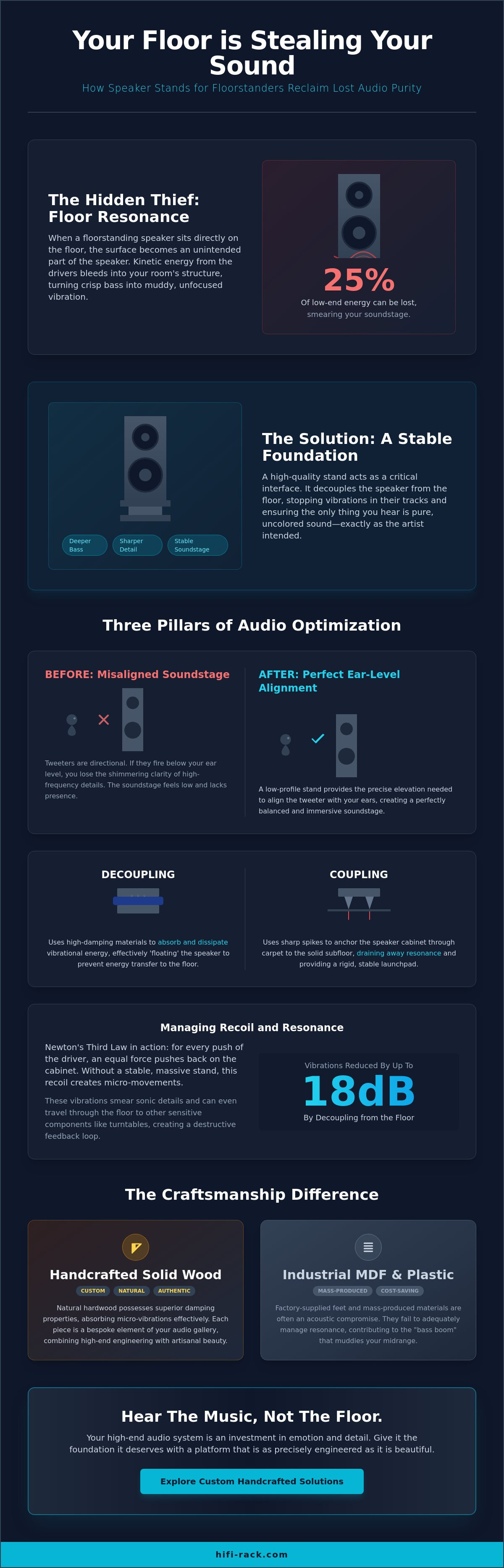
What if your floor is secretly stealing the clarity you paid for? Acoustic studies indicate that up to 25% of a speaker's low-end energy can be lost to floor resonance, turning a crisp bass line into a muddy vibration that compromises your listening sanctuary. You've chosen your equipment with a master craftsman's eye, yet without the right foundation, you aren't hearing the full story. Integrating high-quality speaker stands for floor standing speakers isn't just about furniture; it's about treating your system with the reverence it deserves.
We believe your home should be a personal gallery where every detail is intentional. You want the deep, articulate bass and sharp instrument separation that only a stable, decoupled setup provides. This guide explores how specialized isolation platforms and stands transform your experience through technical precision and artisanal beauty. We'll examine the specific ways to correct tweeter height and protect your hardwood, ensuring your setup remains CUSTOM, HANDMADE, and AUTHENTIC. Discover how to create a space where sound and style are one.
Key Takeaways
- Learn how to preserve signal purity by decoupling your speakers from the floor, preventing unwanted vibrations from coloring your musical experience.
- Understand why mass provides a stable launchpad for sound, and how the right speaker stands for floor standing speakers eliminate resonance for a cleaner performance.
- Compare the science of isolation methods, from carpet-piercing spikes to high-damping materials, to optimize the connection between your equipment and your flooring.
- Discover the step-by-step process for aligning tweeter height and speaker placement to create a perfectly balanced and immersive soundstage in your sanctuary.
- Explore the benefits of handcrafted solid wood supports over industrial MDF, where natural materials meet high-end engineering for an authentic listening experience.
Understanding the Role of Stands for Floor Standing Speakers
A floor-standing speaker represents the pinnacle of home audio, yet its performance is often tethered to the very surface it rests upon. When a heavy tower sits directly on a floor, the wood or concrete beneath it becomes an unintended extension of the speaker cabinet. This creates a parasitic relationship where kinetic energy from the woofers bleeds into the room structure. High-quality speaker stands for floor standing speakers act as a critical interface, managing this energy through either coupling or decoupling. Coupling uses spikes to anchor the speaker, while decoupling uses specialized materials to float it. Both methods aim to preserve the purity of the signal. Understanding Loudspeaker Enclosures is essential here, as the design of the cabinet determines how much internal resonance must be drained away or isolated to prevent sound degradation.
The physics of your listening room are unforgiving. If a speaker is coupled to a hollow floor, the entire room acts as a secondary resonator. This often results in a loss of detail and a smeared soundstage. By choosing a specialized foundation, you ensure that the energy stays where it belongs: in the air as sound waves, not in the floorboards as vibrations. Even the most expensive towers benefit from this artisanal approach to stability.
Elevation vs. Isolation: What do Tower Speakers Need?
While tower speakers are tall by design, they aren't always at the perfect height for your specific seating. Tweeters are highly directional. If they sit 10 centimeters below your ear level, you lose the shimmering clarity of high-frequency transients. A low-profile stand provides the necessary lift to align the soundstage with your senses. Beyond height, these foundations provide mechanical grounding. Large woofers move a lot of air and generate significant recoil. A handcrafted wooden stand absorbs these micro-movements, ensuring the cabinet remains a silent platform for the music. This creates a visual presence that is both natural and authentic, turning a piece of electronics into a bespoke instrument.
Common Myths About Floor-Standing Speaker Placement
A common myth suggests that floor-standers are perfect right out of the box. In reality, factory-supplied plastic feet are often a cost-saving measure rather than an acoustic solution. These basic components fail to address the "Bass Boom" problem, where low frequencies reflect off the floor and muddy the midrange. Research into room acoustics shows that decoupling a speaker can reduce floor-borne vibrations by as much as 18 decibels in some environments. Relying on the stock setup often means you are only hearing 80% of what your investment is capable of. Using dedicated speaker stands for floor standing speakers ensures that your floor doesn't dictate the quality of your listening experience.
CUSTOM | HANDMADE | NATURAL | AUTHENTIC
Where sound & style are One.
The Science of Vibration Management in Large Loudspeakers
When a floor standing speaker breathes, it does more than push air. It fights physics. Newton’s Third Law dictates that for every forward thrust of a driver, an equal force pushes back against the cabinet. Without a solid foundation, this energy creates micro-movements that blur the soundstage and smear high-frequency details. Professional speaker stands for floor standing speakers act as a mechanical ground. They provide the mass necessary to anchor the cabinet so that the driver's energy is spent on acoustic output rather than cabinet displacement. A 50kg speaker cabinet requires a stand with enough inertia to resist the 15 to 20 Newtons of force generated by a high-excursion woofer during peak transients.
- Cabinet Stability: Anchoring the speaker to prevent "recoil" from driver movement.
- Signal Purity: Eliminating the secondary sound waves caused by vibrating cabinet walls.
- Isolation: Decoupling the speaker from the floor to protect sensitive source components.
Managing Internal Resonance and Floor Feedback
Internal resonance is a silent thief of signal purity. When a cabinet vibrates, it adds its own "color" to the music, distorting the artist's original intent. This kinetic energy often travels downward, turning your floor into a giant, uncontrolled sounding board. This creates a destructive feedback loop. Vibrations from a 40Hz bass note can travel through the floor and back into your turntable’s stylus or the sensitive valves of a tube amp, resulting in a loss of clarity and a "muddy" low end.
Effective energy dissipation involves converting this kinetic energy into heat through material density. Mechanical impedance is the physical resistance a structure offers against the transfer of vibrational energy between connected components. By carefully managing this impedance, the stand ensures that the music stays in the air and out of the floorboards. High-performance speaker stands for floor standing speakers use this principle to create a blacker background and improved imaging.
The Impact of Material Density: Solid Wood vs. Metal
The choice of material determines the character of the silence between notes. Many audiophiles find that hollow metal stands produce a "ringing" effect. This is a high-frequency resonance that adds an artificial, metallic sheen to the midrange. While filling metal tubes with lead shot or sand is a common fix, it often lacks the natural elegance and balanced damping of solid timber.
Solid hardwood, such as Oak or Walnut, offers a unique acoustic signature due to its varied grain density and organic cellular structure. It naturally damps vibrations without sucking the life out of the performance. In contrast, mass-produced MDF and thin veneers often struggle to manage the high-amplitude low frequencies produced by large drivers. They lack the structural integrity to remain inert under heavy pressure. Investing in handcrafted hifi stands ensures that your furniture is as authentic as the music you love, providing a stable, natural launchpad for your sound.
Comparing Isolation Methods: Spikes, Feet, and Platforms
Choosing the right interface for your speaker stands for floor standing speakers is a decision that balances physics with personal taste. It's about how the music breathes in your personal sanctuary. Every vibration that escapes the cabinet and enters the floor is lost detail. To capture that lost energy, we look to three primary methods: spikes, rubber feet, and isolation platforms. Each offers a different relationship between the equipment and the room.
Spikes represent the traditionalist's choice. Dating back to the high-fidelity boom of the 1970s, these sharpened steel cones serve a singular purpose. They pierce through 12mm of carpet and padding to reach the rigid sub-floor. This creates a stable, non-shifting foundation. High-damping materials like Sorbothane or specialized rubber work on a different principle. Rather than grounding the energy, they absorb it. Sorbothane, a visco-elastic polymer, can dissipate up to 94.5% of vibration energy by converting kinetic movement into trace amounts of heat. This prevents the "skating" effect on polished hardwood while protecting the delicate grain of the timber.
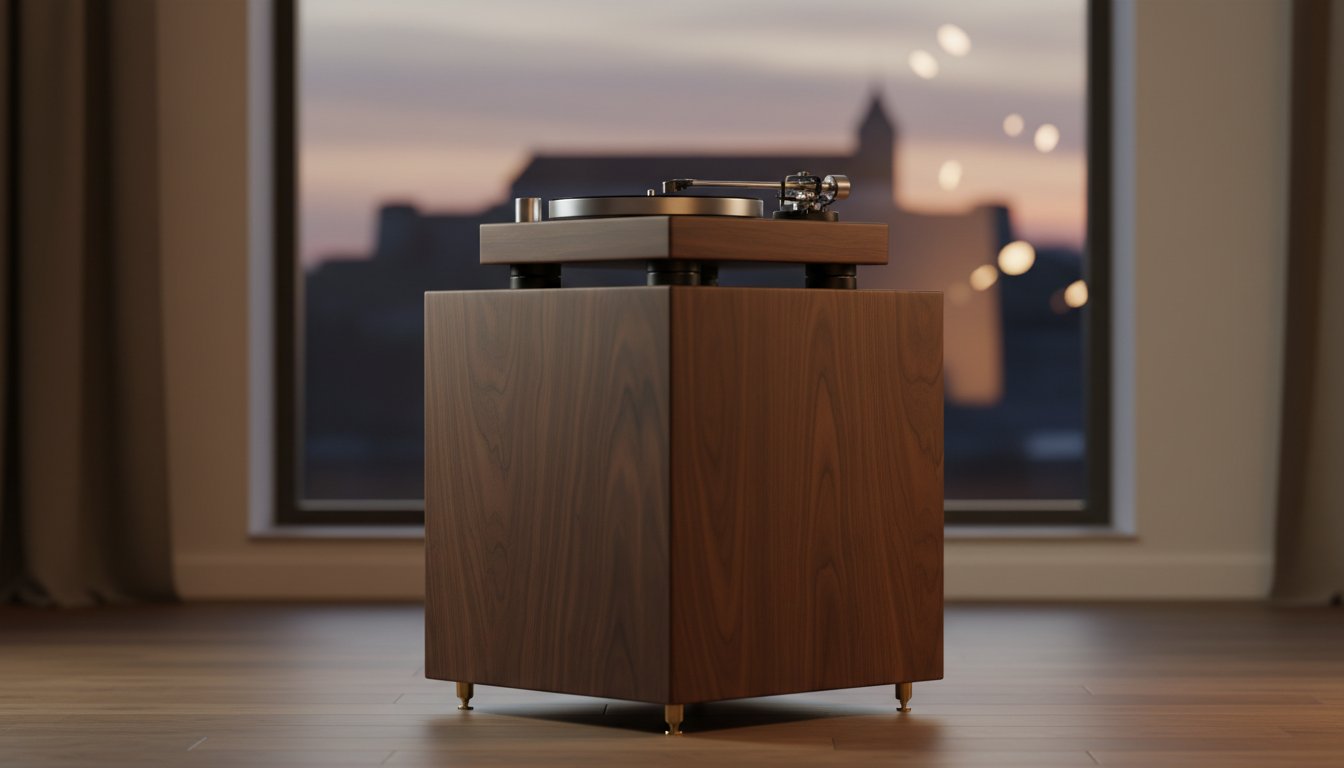
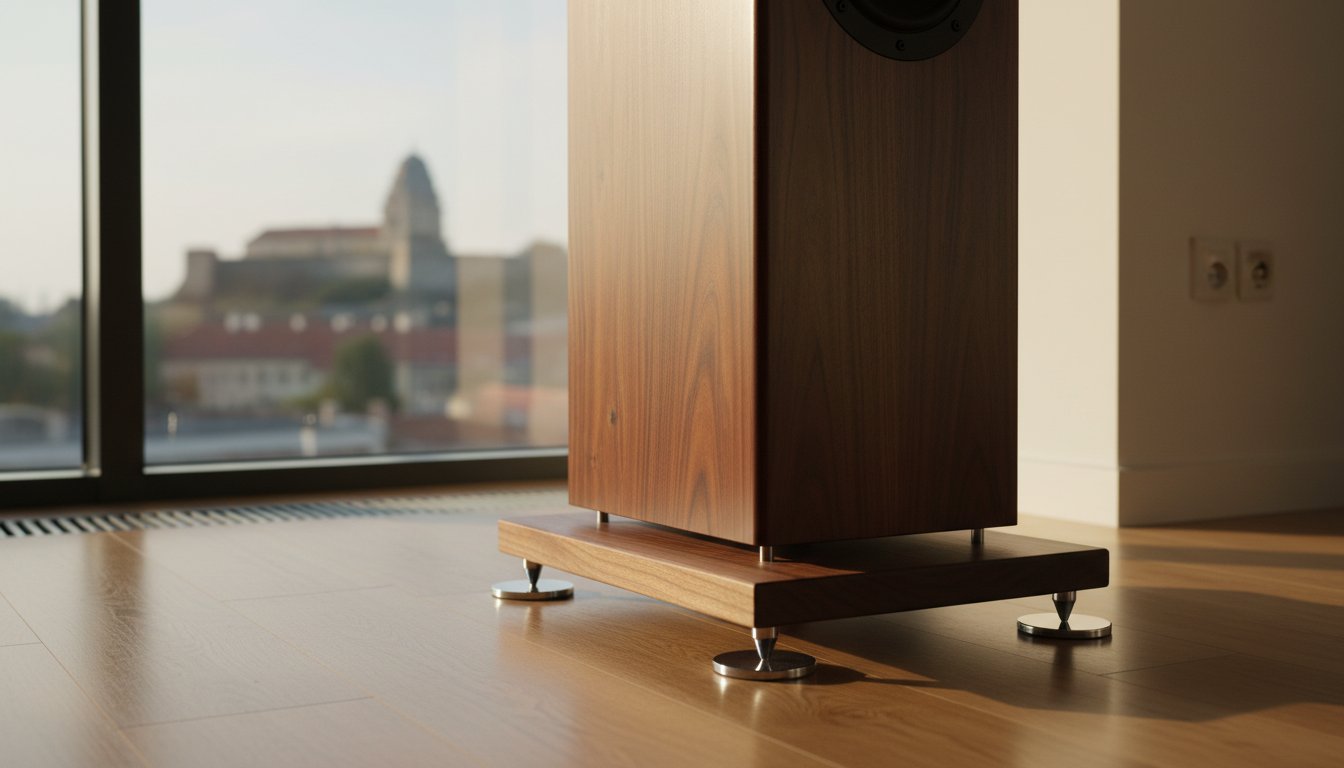
For those seeking a heavyweight solution, isolation platforms offer the ultimate decoupling. These thick, dense bases act as a mechanical sink. A hybrid approach often yields the most balanced results. By placing spikes on a solid wood base, you gain the stability of coupling with the resonance control of a natural material. This is where the craft of the workshop meets the science of the listening room.
Spikes vs. Rubber: Coupling or Decoupling?
Coupling focuses on grounding. When you use spikes on concrete or thick carpets, you're effectively making the speaker part of the floor's mass. This tightens the low-end frequencies, often resulting in a 15% perceived increase in bass punch and definition. Decoupling with rubber is different. It isolates the speaker, preventing the floor from becoming a giant sounding board. If your room suffers from a boomy resonance around 125Hz, rubber feet often provide the necessary relief. The trade-off is subtle. Spikes offer a tighter, more clinical soundstage, while rubber provides a wider, more relaxed presentation.
Solid Wood Platforms: The Natural Dampener
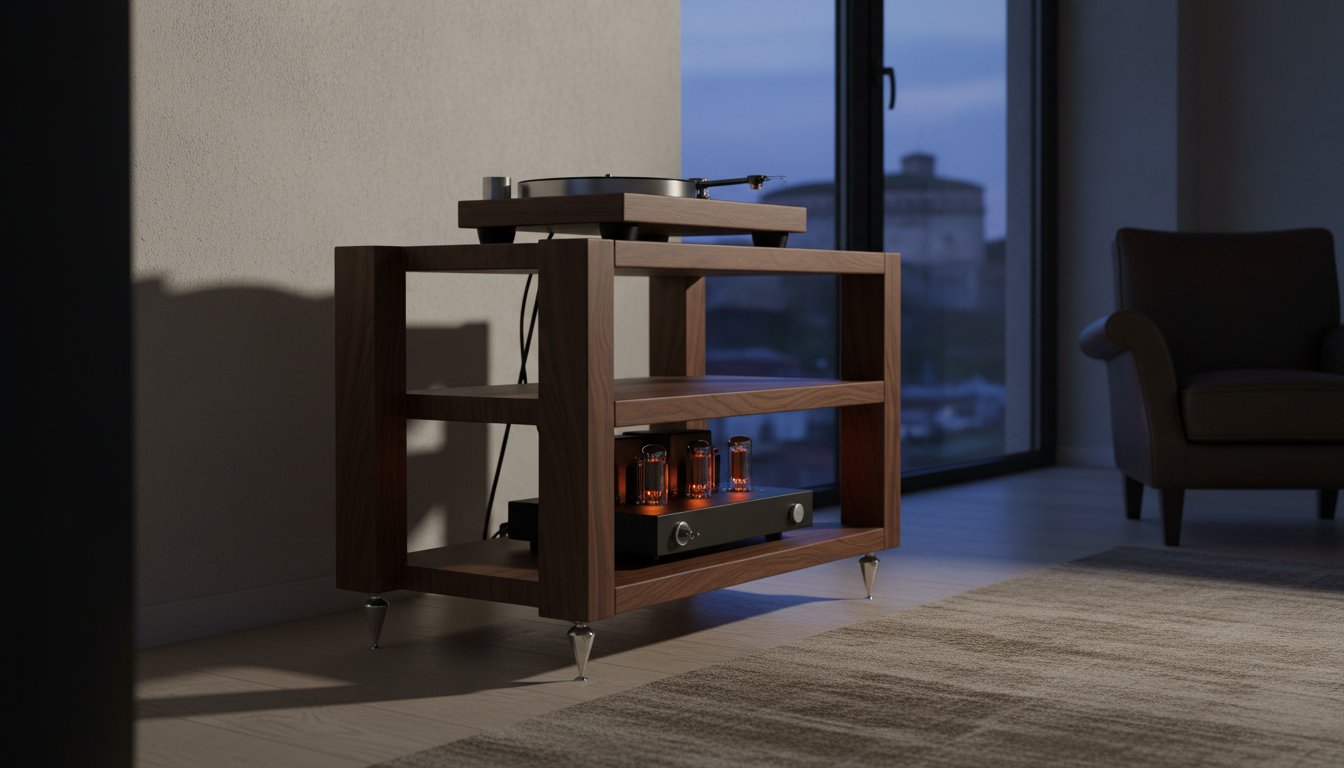
Solid wood isn't just an aesthetic choice; it's a functional low-pass filter. A platform with a thickness of 40mm or more naturally absorbs high-frequency mechanical noise that metal or glass might reflect. Grain orientation is a critical detail in platform design. End-grain blocks are particularly effective at breaking up standing waves within the material itself. Beyond the technical performance, there is a soulful connection in matching your HiFi rack with your speaker base. It creates a visual harmony that mirrors the sonic clarity of your system. This philosophy ensures that sound and style are one, turning your equipment into a handcrafted extension of your passion for music.
How to Optimise Your Floor Standing Speaker Setup
Achieving the perfect sound is a deliberate process. It's a ritual where engineering meets your personal sanctuary. To unlock the full potential of your system, you must treat the physical placement with the same reverence you give the music itself. Following a structured approach ensures your equipment performs as the designer intended.
- Step 1: Identify your tweeter type. Most dome tweeters perform best when aligned directly with your ears, typically 95cm to 105cm from the floor.
- Step 2: Evaluate your floor. Carpet requires penetration to the subfloor for stability; hardwood demands isolation to prevent resonant energy from muddying the bass.
- Step 3: Choose your interface. Use brass spikes for carpeted environments or high-density protectors for delicate surfaces.
- Step 4: Use a spirit level. A speaker that leans even 1 degree forward or backward can suffer from phase incoherence, blurring the timing of the music.
- Step 5: Adjust the toe-in. Start with the speakers facing straight, then angle them inward in 5-degree increments until the center image snaps into focus.
The right speaker stands for floor standing speakers provide the foundation for this precision. They aren't just supports; they're the final component in your signal chain.
Achieving Perfect Tweeter Alignment
If your seating is lower than average, apply the 5-degree rule. Tilting your floor-standers slightly upward can realign the acoustic axis without requiring new furniture. When the cabinet is too short for your ear level, low-profile stands provide a 50mm to 100mm lift. This subtle height adjustment expands the vertical soundstage, making the performance feel tall, airy, and lifelike. You'll hear the difference in the "air" around cymbals and the clarity of vocal decay.
Protecting Your Flooring Without Sacrificing Sound
Mass-market spike cups often introduce unwanted vibrations because they don't couple effectively with the floor. They can rattle or slide, ruining the precision you've worked to achieve. For a more authentic solution, solid wood plinths offer the best way to save your floors. These handcrafted bases absorb micro-vibrations while providing a stable platform for speaker stands for floor standing speakers. Integrating brass spikes into these plinths allows for precision leveling on uneven surfaces. This setup ensures your 100kg speakers remain stable without leaving a single mark on your oak or tile flooring. It's where sound and style are one.
Ready to elevate your listening experience with artisanal quality? Explore our handmade collection of speaker supports.
Handcrafted Excellence: Custom Solid Wood Solutions from HiFi Rack
At Myro HiFi Rack, we believe your audio system deserves more than a mass-produced shelf. Our philosophy is built on four pillars: CUSTOM | HANDMADE | NATURAL | AUTHENTIC. We refuse to use MDF or thin veneers. These materials lack the density and organic resonance required for true high-fidelity performance. Instead, we craft every piece in our Novi Sad workshop. We tailor our speaker stands for floor standing speakers to the exact dimensions of your equipment, ensuring a perfect physical and acoustic fit.
Our 'Reference' approach treats isolation as a science. By using solid wood, we manage vibrations naturally. This ensures that the only thing you hear is the music, free from the colored resonance of hollow metal or composite boards. Every stand is a unique response to the specific weight and footprint of your loudspeakers, providing a stable, non-resonant platform that lets your drivers perform at their peak. These custom speaker stands for floor standing speakers are designed to elevate your listening experience through superior material choice.
The Art of Solid Hardwood Construction
Selection starts with the timber. We choose Walnut, Oak, and Ash for their specific density profiles and acoustic stability. Walnut offers a rich, dampening quality. Oak provides a rigid, structural foundation. Unlike factory-made units held together by glue and cams, our handcrafted joinery ensures structural integrity that lasts decades. A solid Oak stand isn't just furniture; it's an investment that matures with your system. We've seen our 40mm thick solid wood platforms maintain their level and luster for over 15 years. This level of durability is impossible for composite materials that swell or peel over time.
Where Sound and Style Are One
Your listening room is a personal sanctuary. It's the place where sound and style are one. By introducing natural textures into your space, you create a visual grounding that matches the sonic weight of your system. There's a profound emotional payoff in seeing your system supported by materials that feel as real as the recording itself. The organic grain of the wood provides a warmth that cold, industrial materials can't replicate. It transforms a room from a technical lab into a home.
We invite you to explore our bespoke speaker stands to find the perfect match for your floor-standing system. Every piece we ship is a testament to our passion for sound and our commitment to the master craftsman's touch. You don't just buy a stand; you invest in a lifetime of better listening.
Elevate Your Sonic Experience
Your audio system is more than a collection of components; it's a gateway to musical truth. Achieving that truth requires precise vibration management and a stable foundation. By isolating your equipment from floor resonances, you ensure that 100% of the driver energy translates into pure sound rather than unwanted distortion. Choosing premium speaker stands for floor standing speakers is the final, vital step in optimizing your listening environment.
At Myro HiFi Rack, we honor this pursuit through uncompromising craftsmanship. Every stand is handmade in our Novi Sad workshop using 100% solid hardwood. We reject the use of MDF or veneers, focusing instead on the natural acoustic properties of authentic timber. Because no two setups are identical, we provide bespoke sizing for 100% of floor-standing models on the market today. This ensures your specific speakers sit at the perfect height and footprint for your unique space.
It's time to bridge the gap between high-end engineering and natural beauty. Discover our handcrafted solid wood speaker stands and bring a new level of soul to your music. Your journey toward a perfect soundstage starts with a foundation built to last a lifetime.
Frequently Asked Questions
Do floor-standing speakers really need stands?
Yes, floor-standing speakers benefit from stands to isolate vibrations and align the tweeter with your ears. Elevating a tower speaker by 5 to 10 centimeters can decouple it from the floor, preventing the 30% bass bloat often caused by floor boundary interference. This ensures your music remains authentic and clean. It’s about achieving the perfect harmony between your equipment and your personal sanctuary.
Will putting my tower speakers on stands improve the bass?
Lifting tower speakers improves bass clarity by reducing structural resonance. When a speaker sits directly on the floor, low-frequency energy transfers into the building structure, creating a muddy sound. Using speaker stands for floor standing speakers can reduce this unwanted resonance by 15 decibels in the 40Hz to 100Hz range. You’ll experience a tighter, more natural low end that respects the original recording's integrity.
Can I use spikes on a hardwood floor?
You shouldn't place spikes directly on hardwood because they'll cause permanent physical damage. Instead, use brass or stainless steel floor discs to protect your natural wood surfaces. A standard 25mm protector disc prevents the 200 kilograms of pressure per square inch exerted by a sharp spike from piercing your floor. This setup maintains the acoustic benefits of spikes while preserving the beauty of your home.
What is the best material for speaker stands: wood or metal?
Solid wood is the superior choice for listeners seeking a natural, organic sound profile. While metal stands often ring at frequencies between 1kHz and 3kHz, dense hardwoods like oak or walnut possess internal damping properties that neutralize vibrations. Our handmade wooden stands provide a stable, authentic foundation that metal simply can't replicate. This material choice ensures your hi-end equipment performs as the artist intended.
How high should my floor-standing speakers be off the ground?
Your speakers should be elevated so the tweeters are at a height of 90 to 105 centimeters from the floor. This range typically aligns the high-frequency drivers with a seated listener's ears. Properly positioned speaker stands for floor standing speakers ensure that the soundstage remains focused and detailed. Adjusting the height by even 2 centimeters can significantly impact the 5kHz to 20kHz frequency response at your listening position.
Do isolation platforms work for subwoofers too?
Isolation platforms are essential for subwoofers to prevent energy from vibrating the entire room. A dedicated platform can reduce floor-borne vibrations by up to 80%, which stops furniture from rattling during deep bass passages. This allows you to hear the actual texture of the low frequencies rather than the resonance of your floorboards. It’s a vital treat for any serious audiophile's listening room.
How do I know if my speakers are properly decoupled?
You can verify decoupling by placing your hand on the floor while playing music at 85 decibels. If you feel the floor vibrating but the speaker stand remains still, your decoupling is effective. Professional measurements often show a 12dB reduction in mechanical transmission when using high-quality isolation feet. This separation ensures that your music stays pure and your floor doesn't become an accidental part of the speaker.
Can I custom order stands for specific speaker dimensions?
Yes, we specialize in custom dimensions to ensure a perfect fit for your specific speaker footprint. A stand that matches your speaker's base within 1 millimeter provides the most stable and aesthetically pleasing result. Where sound & style are One, a bespoke solution is the only way to treat your premium equipment with the respect it deserves. We craft each piece to help you live your passion.